







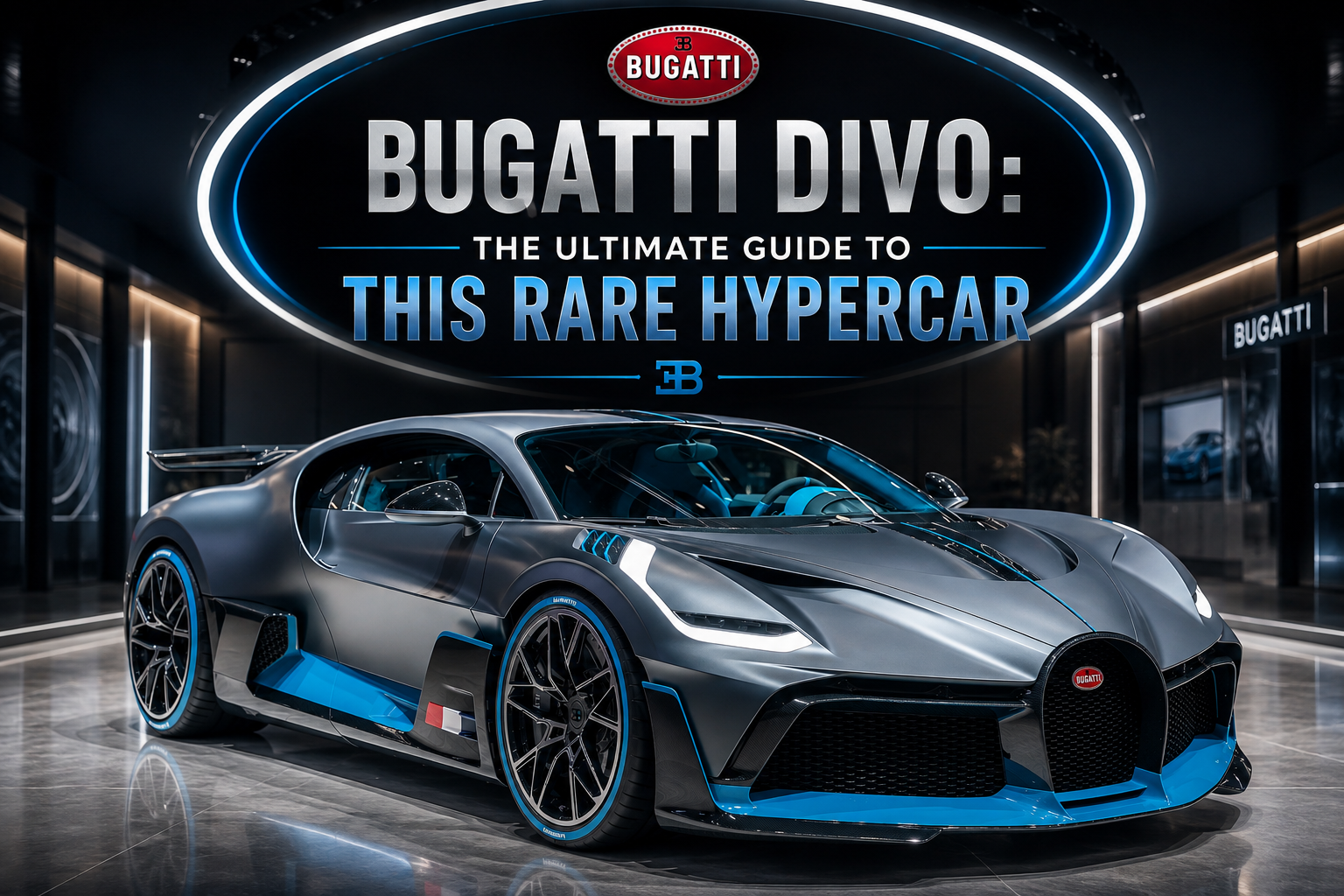
The Bugatti Divo is one of the most distinctive hypercars of the modern era. While Bugatti is famous for enormous power and extraordinary top speeds, the Divo was created with a slightly different purpose. Instead of concentrating almost entirely on straight-line speed, Bugatti engineers focused heavily on cornering, agility, aerodynamics, and driver involvement.
Introduced in 2018, the Divo was based on the Chiron but received extensive changes to its bodywork, chassis, suspension, and aerodynamic package. It also became one of Bugatti’s most exclusive creations, with production limited to just 40 examples. Every car was sold to selected customers before production even began. Bugatti originally announced a net price of €5 million per vehicle, making the Divo its most expensive model at the time.
The result was not simply a Chiron with a different body. The Divo represented a different interpretation of what a Bugatti hypercar could be: still incredibly fast and luxurious, but noticeably more focused on winding roads.
BIO
| Label | Information |
|---|---|
| Name | Bugatti Divo |
| Type | Limited-production hypercar |
| Manufacturer | Bugatti Automobiles |
| Origin | Molsheim, France |
| Debut | 2018 |
| Engine | 8.0-liter W16 |
| Turbochargers | Four |
| Power | 1,500 PS |
| Torque | 1,600 Nm |
| Top Speed | 380 km/h |
| 0–100 km/h | 2.4 seconds |
| Production | 40 units |
| Original Price | €5 million net |
What Is the Bugatti Divo?
The Bugatti Divo is a limited-production hyper sports car developed around the mechanical foundation of the Chiron. Its purpose was to deliver a more agile and dynamic driving experience while retaining the comfort, refinement, and performance expected from Bugatti.
The name comes from Albert Divo, a French racing driver who competed for Bugatti and won the famous Targa Florio mountain race in Sicily twice for the marque in the late 1920s. His connection with demanding, winding roads made the name particularly appropriate for a car designed around cornering performance.
Bugatti described the Divo as a modern interpretation of its historic coachbuilding tradition. In the company’s earlier years, Bugatti vehicles could receive distinctive bodies designed around existing mechanical platforms. The Divo brought that philosophy into the modern hypercar era by combining an existing technical foundation with substantially different styling and engineering priorities.
The Story Behind the Divo
The idea for the Divo emerged in 2018 after Bugatti considered how it could offer existing customers something beyond the Chiron. The goal was to create a car with a more sporting character without abandoning the comfort and sophistication associated with the brand.
Engineers therefore concentrated on areas that could improve the car’s behavior through corners. Aerodynamics were extensively revised, the chassis and suspension were modified, and weight was reduced.
The development program was demanding. According to Bugatti, chassis development included more than 5,000 kilometers of testing across different environments and speeds. Engineers worked on spring rates, dampers, steering, wheel camber, and other chassis parameters to create the desired handling balance.
Before the public unveiling, Bugatti showed the Divo to selected Chiron customers. The response was exceptionally strong. All 40 planned cars were sold before the model was publicly revealed at The Quail – A Motorsports Gathering in California in August 2018.
Design and Styling
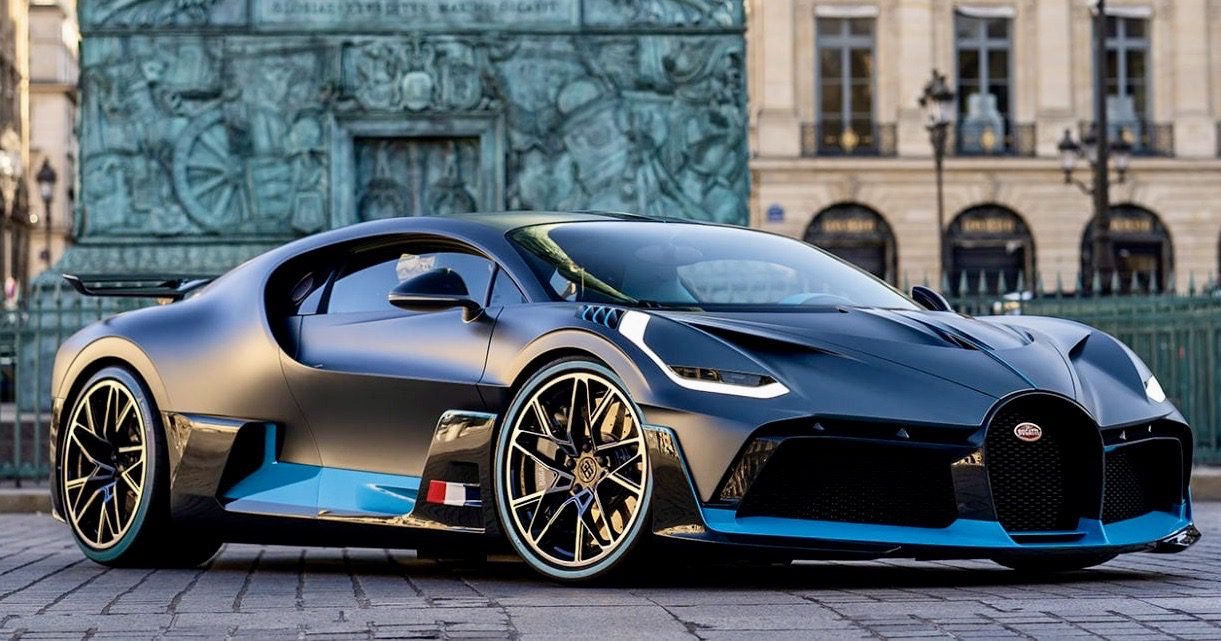
The Divo looks unmistakably like a Bugatti, but it has a character of its own. Compared with the Chiron, its bodywork is more aggressively shaped, with greater emphasis on managing airflow and creating aerodynamic stability.
The front end incorporates larger and more carefully shaped aerodynamic elements, while the body contains numerous channels designed to guide air around and through the vehicle. The design is not simply decorative. Almost every major exterior change has a connection with the Divo’s performance goals.
At the rear, the design becomes particularly dramatic. The car uses a large rear wing and a distinctive lighting arrangement that gives it a wider visual presence. These features contribute to the Divo’s aerodynamic performance while making it immediately recognizable.
One interesting feature is the NACA duct air intake positioned on the roof. Bugatti explains that the intake, combined with the central fin, helps supply air to the W16 engine while improving airflow management around the car.
The overall design therefore follows a simple principle: form and function are closely connected.
Interior and Luxury
Despite its performance-focused character, the Divo did not abandon Bugatti’s emphasis on luxury.
The cabin combines high-quality materials, careful finishing, and a driver-oriented atmosphere. Like other modern Bugattis, the Divo was intended to offer a level of refinement that would make it suitable for road use rather than functioning as a stripped-down racing machine.
Customization was another important part of the Divo experience. Bugatti’s customers could personalize their cars through different materials, finishes, colors, and details.
That individuality matters because only 40 Divos were built. Each example therefore represents not only a rare hypercar but also a highly personalized piece of Bugatti craftsmanship.
Engine and Performance
At the heart of the Divo is Bugatti’s legendary 8.0-liter quad-turbocharged W16 engine.
The engine produces 1,500 PS and 1,600 Nm of torque, figures that put the Divo firmly among the most powerful road-going cars of its era. Bugatti states that the car can accelerate from 0 to 100 km/h in 2.4 seconds.
The Divo’s maximum speed is electronically limited to 380 km/h, or approximately 236 mph. That figure is lower than the maximum speeds associated with some other Bugatti models, but this was intentional.
The engineers were not simply trying to make the Divo faster in a straight line. By accepting a lower maximum speed, Bugatti could devote more attention to aerodynamic load, chassis behavior, and cornering performance.
That distinction is central to understanding the Divo.
Aerodynamics and Handling
The biggest technical difference between the Divo and a conventional Chiron is arguably the attention given to aerodynamics and handling.
Bugatti reports that the Divo produces 90 kilograms more downforce than the standard Chiron while being 35 kilograms lighter. Its lateral acceleration capability was increased to 1.6 g.
More downforce can help a car maintain stability and grip through corners. Combined with the Divo’s revised suspension and reduced weight, this gives the car a more responsive character.
The chassis received several changes, including harder springs, revised wheel camber, a more front-oriented balance, and adjustments to the steering system. These modifications were developed through extensive testing rather than simply being added for appearance.
The result is a hypercar that feels conceptually different from one designed primarily around maximum straight-line speed.
Why the Divo Is Different From the Chiron
The Divo and Chiron share important mechanical foundations, but they were designed with different priorities.
The Chiron represents a remarkable balance of speed, comfort, luxury, and long-distance capability. The Divo shifts that balance toward agility and cornering performance.
The Divo is lighter, has more aerodynamic downforce, and uses a more aggressively tuned chassis. Bugatti reported that the Divo was able to complete its Nardò handling circuit test eight seconds faster than the Chiron.
This difference helps explain why the Divo exists despite sharing so much technology with the Chiron. It was designed to give customers a distinct driving experience rather than simply offering another version of the same car.
Bugatti Divo Specifications
| Specification | Bugatti Divo |
|---|---|
| Engine | 8.0-liter W16 |
| Turbochargers | Four |
| Power | 1,500 PS |
| Torque | 1,600 Nm |
| Transmission | 7-speed dual-clutch |
| Drivetrain | All-wheel drive |
| 0–100 km/h | 2.4 seconds |
| Top speed | 380 km/h |
| Weight reduction vs. Chiron | 35 kg |
| Additional downforce vs. Chiron | 90 kg |
| Lateral acceleration | Up to 1.6 g |
| Production | 40 units |
Bugatti’s official information confirms the Divo’s 1,500 PS output, 380 km/h limited top speed, 35-kilogram weight reduction, 90-kilogram increase in downforce, and 40-unit production run.
How Rare Is the Bugatti Divo?
The Divo is exceptionally rare because Bugatti limited production to just 40 vehicles worldwide.
That number is important when considering the car’s place in the collector world. Even many expensive performance cars are produced in significantly larger numbers. With only 40 Divos, every individual example represents a very small part of the model’s entire production history.
The exclusivity began before the first production car was completed. Bugatti announced that all 40 examples had already been sold to selected customers following private presentations.
Production and customer deliveries eventually took place at Bugatti’s Atelier in Molsheim, France. The first customer deliveries began in 2020, and Bugatti later confirmed the completion of the final Divo, bringing the total production to the planned 40 cars.
Bugatti Divo Price
When the Divo was announced, Bugatti set a net unit price of €5 million. This made it Bugatti’s most expensive model at the time.
The original price, however, does not tell the complete story of the car’s financial significance today. Extremely limited production, individual specifications, condition, ownership history, and provenance can all influence the value of a rare collector automobile.
A Divo configured with particularly desirable colors or materials can also be different from another example. Because the production run was so small, details that might seem minor on an ordinary vehicle can become important when collectors compare individual cars.
It is also important to distinguish the original factory price from the price of a privately resold example. They are not necessarily the same, and secondary-market values can change according to market conditions.
What Makes the Divo Special?
The Divo’s appeal comes from several elements working together.
First, there is the W16 engine, which gives the car extraordinary performance. Then there is the engineering philosophy. Bugatti did not simply increase power; it worked extensively on aerodynamics, suspension, weight, and chassis balance.
The styling also gives the Divo a separate identity. Its aggressive aerodynamic bodywork makes it immediately distinguishable from the Chiron.
Finally, there is the rarity. Only 40 examples were built, and the entire production run was sold extremely quickly.
Perhaps most importantly, the Divo has a clear purpose. It was created for drivers who wanted a Bugatti that placed greater emphasis on winding roads and cornering behavior.
Ownership and Collectability
Owning a car like the Divo is very different from owning an ordinary performance vehicle.
The technical complexity alone means that servicing requires specialist knowledge. A vehicle with such a high level of engineering also benefits from careful maintenance and documentation.
For collectors, provenance can be particularly important. Original documentation, service history, ownership records, factory specification, and overall condition can all contribute to a vehicle’s desirability.
The limited production number makes preservation especially significant. There will never be thousands of Divos on the road, so every surviving example represents a meaningful part of the model’s history.
Bugatti itself described the Divo as a milestone in its history and as the beginning of a new era of modern coachbuilding.
The Divo’s Place in Bugatti History
The Bugatti Divo occupies an interesting position in the company’s modern history.
The Veyron demonstrated what modern Bugatti engineering could achieve. The Chiron continued that philosophy with even greater performance and sophistication. The Divo then took the underlying technology and explored a more specialized direction.
Instead of asking how fast a Bugatti could travel in a straight line, the Divo asked how much more capable that same basic concept could become on a demanding road full of corners.
That approach made it more than a limited-edition styling exercise. The changes to the chassis, aerodynamics, and weight were intended to create a genuinely different driving experience.
The car also marked Bugatti’s return to modern coachbuilding, connecting contemporary technology with an important part of the company’s early history.
Frequently Asked Questions
How much does the Bugatti Divo cost?
The original net price announced by Bugatti was €5 million per car. Current resale values can differ considerably depending on market conditions, specification, condition, and provenance.
How many Bugatti Divo cars were made?
Bugatti produced 40 Divo vehicles. The entire production run was sold to selected customers.
How fast is the Bugatti Divo?
The Divo has an officially limited top speed of 380 km/h, while its 0–100 km/h acceleration time is 2.4 seconds.
What engine does the Bugatti Divo use?
The Divo uses an 8.0-liter quad-turbocharged W16 engine producing 1,500 PS and 1,600 Nm of torque.
Is the Divo faster than the Chiron?
The answer depends on what “faster” means. The Divo has a lower limited top speed than some Chiron configurations, but Bugatti engineered it for stronger cornering performance. It was recorded as eight seconds quicker than the Chiron on Bugatti’s Nardò handling circuit.
Why is the Bugatti Divo so rare?
Only 40 examples were planned and produced. Bugatti also sold the cars to selected customers before the model’s public debut, making the Divo exceptionally exclusive from the beginning.
Final Verdict
The Bugatti Divo is a fascinating example of what happens when a manufacturer takes an already extraordinary hypercar and gives it a very specific mission.
Its 1,500-PS W16 engine provides immense performance, but raw power is only part of the story. The Divo’s real identity comes from its aerodynamics, reduced weight, revised chassis, increased downforce, and focus on cornering.
With only 40 examples produced, the Divo is also one of the rarest modern Bugattis. Its connection to Albert Divo and Bugatti’s historic coachbuilding tradition gives the car a story that goes beyond its specifications.
Ultimately, the Divo is not simply a faster-looking Chiron. It represents a different idea of performance—one where speed, craftsmanship, rarity, and handling come together in a highly specialized package. That combination is what makes the Divo such an important chapter in Bugatti’s modern history.