






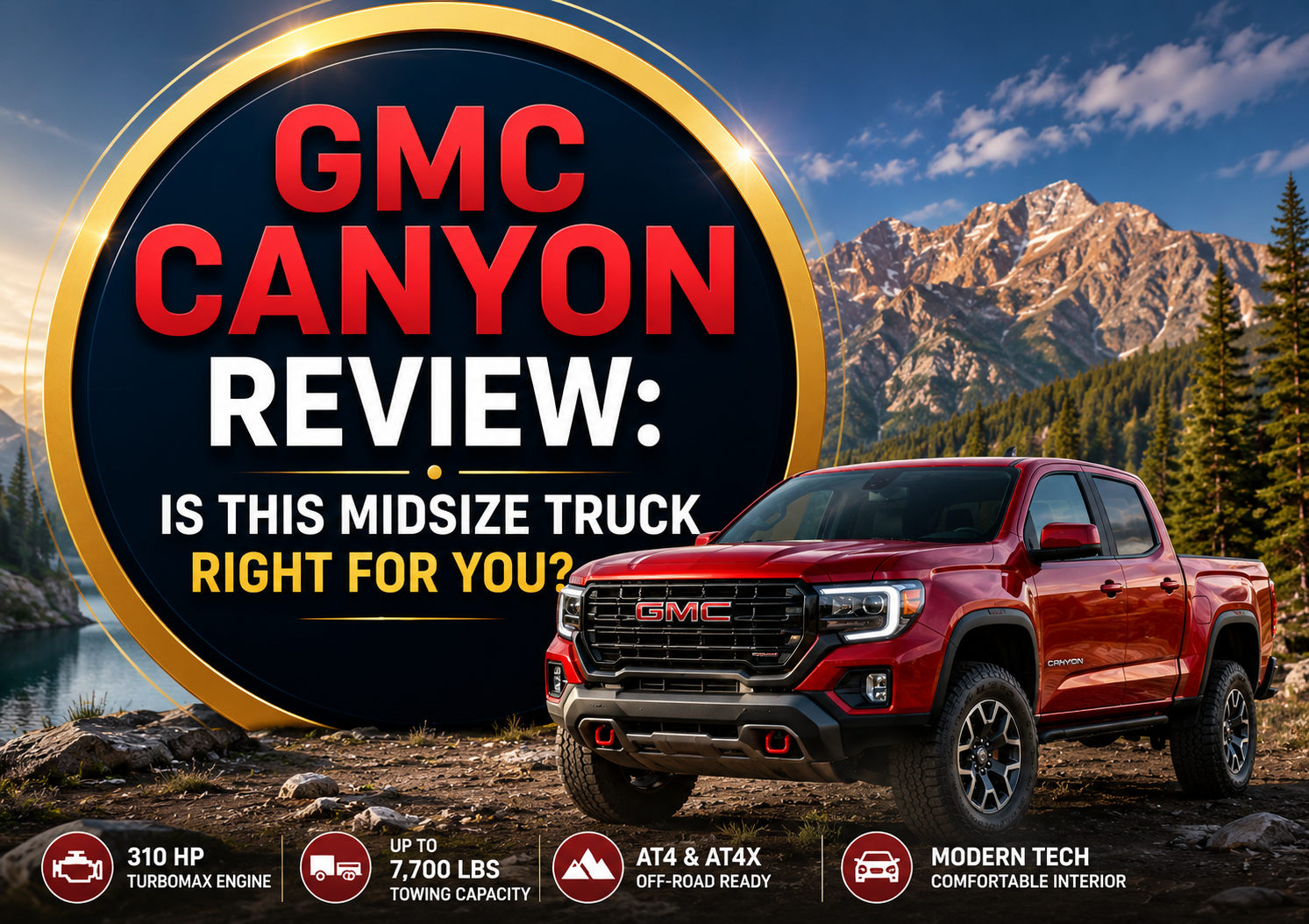
The GMC Canyon has become one of the more capable choices in the midsize pickup truck class. It offers the smaller footprint that many drivers prefer over a full-size truck, while still providing strong towing ability, useful cargo space, modern technology, and serious off-road hardware in selected trims.
For 2026, the Canyon continues with a 2.7-liter TurboMax four-cylinder engine producing 310 horsepower and 430 lb-ft of torque, paired with an eight-speed automatic transmission. Depending on configuration, the truck can tow as much as 7,700 pounds, giving it enough strength for trailers, recreational equipment, and many everyday hauling jobs.
But capability is only part of the story. The real question is whether the GMC Canyon makes sense for your lifestyle, budget, and driving needs. Here is a closer look at what this midsize truck does well, where it has limitations, and which type of buyer should consider
BIO
| Label | Information |
|---|---|
| Vehicle | GMC Canyon |
| Type | Midsize pickup truck |
| Model Year | 2026 |
| Engine | 2.7L TurboMax |
| Horsepower | 310 hp |
| Torque | 430 lb-ft |
| Transmission | 8-speed automatic |
| Max Towing | Up to 7,700 lbs |
| Seating | Up to 5 passengers |
| Drive Options | 2WD or 4WD |
| Main Trims | Elevation, AT4, Denali, AT4X |
| Best For | Daily driving, towing, and off-road use |
GMC Canyon at a Glance
The current GMC Canyon is a five-passenger midsize pickup available in several trim levels, including Elevation, AT4, Denali, and AT4X. The lineup is designed to cover a fairly wide range of buyers, from people who want a practical everyday truck to drivers who want a more luxurious or off-road-focused vehicle.
The common thread across the lineup is the TurboMax engine. It produces 310 horsepower and 430 lb-ft of torque, while an eight-speed automatic transmission manages power delivery. Rear-wheel drive is available, while four-wheel drive is offered on configurations where additional traction and off-road capability are priorities.
GMC also gives the Canyon respectable towing credentials. Properly equipped models can tow up to 7,700 pounds, while maximum payload capacity varies by configuration. GMC lists payload capability as high as 1,670 pounds on its towing and payload information page, while individual configurations can have different ratings.
That combination makes the Canyon more than a lifestyle pickup. It is capable of handling genuine truck duties without moving into the larger dimensions of a full-size pickup.
Design and Size
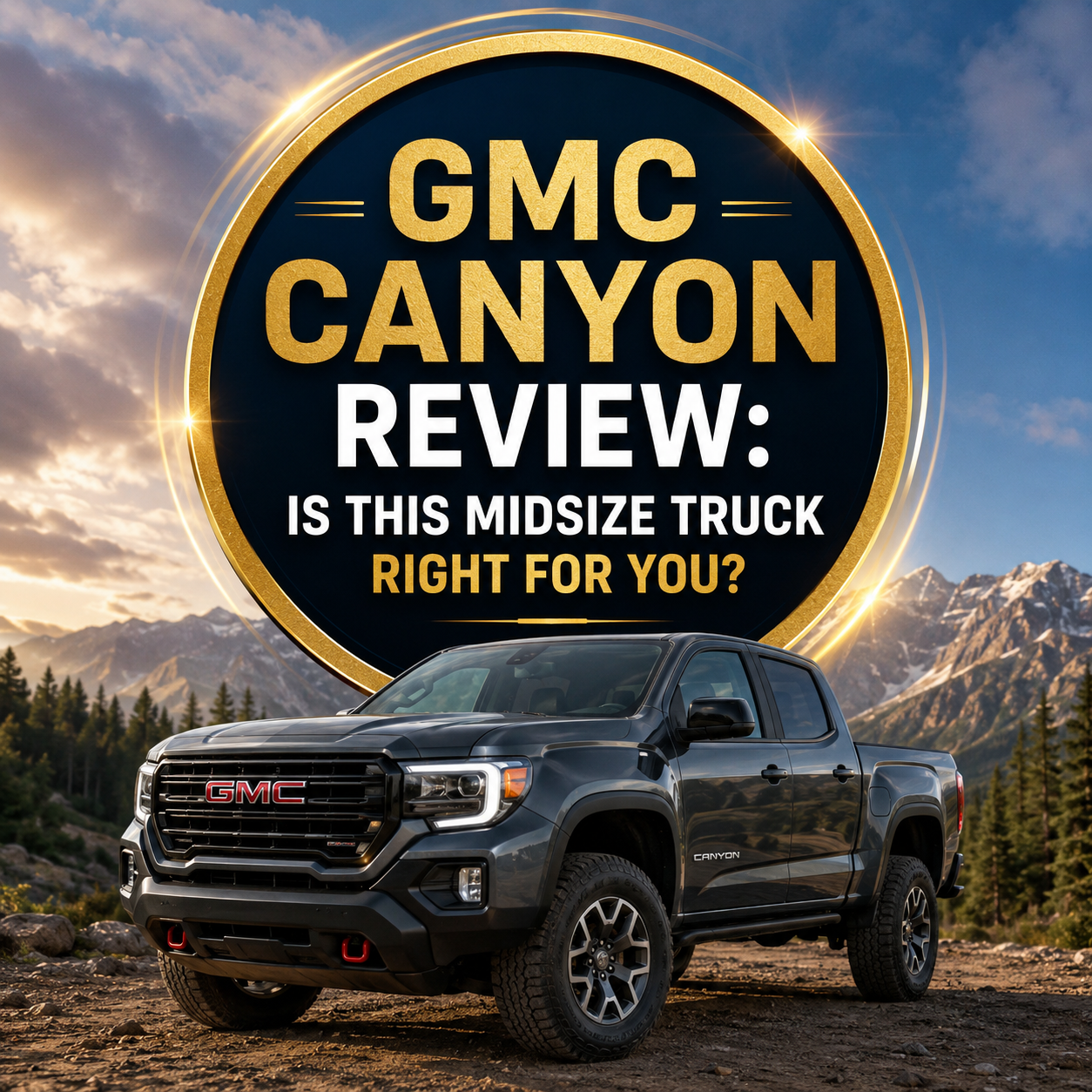
The GMC Canyon has a bold exterior that gives it a more substantial appearance than its midsize classification might suggest. The large grille, upright front end, sculpted bodywork, and available off-road equipment give the truck a confident appearance.
Its midsize dimensions are also an advantage for everyday driving. A full-size pickup can be difficult to maneuver in crowded streets and parking areas, while the Canyon provides a somewhat easier package to live with.
The truck’s bed is useful for carrying tools, outdoor equipment, home-improvement supplies, and other cargo that would be difficult to fit inside an SUV. For someone who needs an open cargo area but does not want the bulk of a larger pickup, that balance can be appealing.
The exterior also changes noticeably depending on trim. The AT4 emphasizes off-road capability, while the Denali focuses more on upscale styling and comfort. The AT4X takes the Canyon further into serious off-road territory.
Performance
The Canyon’s TurboMax engine is one of its strongest features.
With 310 horsepower and 430 lb-ft of torque, the engine provides substantial low- and mid-range pulling power for a midsize truck. The torque figure is particularly useful when accelerating with a load or pulling a trailer.
Independent testing also suggests that the engine provides strong acceleration for the class. Consumer Reports recorded a 0-to-60-mph time of 6.9 seconds in its testing, although real-world performance can vary depending on trim, tires, drivetrain, passengers, and conditions.
The engine is not completely focused on refinement, though. When pushed hard, independent testing has noted a somewhat coarse engine sound. That is not unusual for a turbocharged four-cylinder working hard in a pickup, but buyers who expect a particularly quiet or smooth powertrain should keep it in mind.
For everyday driving, however, the Canyon’s power output is more than adequate. It has enough strength for highway merging, passing, and hauling without requiring a larger engine option.
Towing and Hauling
For many truck buyers, towing capability is one of the most important considerations, and this is an area where the GMC Canyon performs strongly.
When properly equipped, the Canyon can tow up to 7,700 pounds. GMC specifically highlights its ability to handle equipment such as campers and ATVs, while the truck’s Tow/Haul mode is designed to adjust transmission behavior when carrying a heavy load or pulling a trailer.
Of course, the maximum rating should not be treated as the capacity of every Canyon. Towing capability depends on the specific configuration and equipment, so buyers should check the rating for the exact truck they intend to purchase.
For occasional recreational towing, small trailers, and general hauling, the Canyon offers considerable capability for its size. Drivers who regularly tow very heavy loads, however, may be better served by stepping up to a full-size pickup with a higher maximum rating.
Interior and Comfort
Inside, the GMC Canyon aims for a balance between practicality and a more polished passenger environment.
The cabin provides seating for up to five people, making it useful as a family vehicle as well as a work truck. Front-seat passengers get the most comfortable space, while rear-seat room is more limited than what you would find in a full-size pickup.
That is an important consideration for families. If adults regularly occupy the back seats for long trips, it is worth spending time inside the truck before buying.
The higher trims bring a more upscale feel. The Denali, in particular, is positioned as the premium version of the Canyon, giving buyers an option for a truck that feels less utilitarian.
At the same time, the Canyon remains recognizably a pickup. The cabin is designed around durability and usability rather than trying to imitate a luxury sedan.
Technology
Modern technology is another area where the Canyon feels considerably more contemporary than older midsize pickups.
The 2026 model uses an 11.3-inch GMC Premium Infotainment System, accompanied by an 11-inch Driver Information Center on the configurations described by GMC. These displays give the driver access to vehicle information, entertainment functions, and connected features.
The technology is particularly useful when the Canyon is being used as a daily vehicle. Drivers can have the convenience expected from a modern truck without sacrificing the physical controls and practical layout needed when wearing work gloves or driving in less-than-ideal conditions.
Available technology also varies by trim, so buyers should compare equipment carefully rather than assuming every Canyon has the same features.
Safety
Safety equipment is an important part of any modern vehicle, and the Canyon benefits from a range of available driver-assistance technologies.
The Insurance Institute for Highway Safety currently lists a 2026 Canyon evaluation, and its broader test information reflects the current generation that was redesigned for the 2023 model year.
The National Highway Traffic Safety Administration also maintains a vehicle-specific safety information page for the 2026 GMC Canyon.
As with other vehicles, buyers should distinguish between standard and available safety features. Equipment can vary according to trim and optional packages. Anyone placing a high priority on particular driver-assistance systems should verify that those features are included on the exact truck being considered.
Off-Road Ability
The Canyon becomes considerably more interesting when you look at its off-road versions.
The AT4 is aimed at drivers who want enhanced capability away from paved roads without making the truck exclusively an off-road machine. It provides a useful middle ground between everyday transportation and weekend adventure.
The AT4X goes further. It is the model for buyers who expect to spend more time on challenging trails and want a truck designed around that purpose.
Four-wheel drive, off-road-focused hardware, specialized driving modes, increased ground clearance, and other equipment help the higher-performance versions tackle terrain that would be uncomfortable for an ordinary pickup.
Still, off-road equipment comes with compromises. More aggressive hardware and tires can affect ride comfort, road noise, fuel economy, and purchase price. If most of your driving happens on highways and city streets, paying extra for the most specialized configuration may not make financial sense.
Trim Choices
The Elevation is the logical starting point for many buyers. It provides the basic Canyon experience without moving immediately into the higher-priced versions.
The AT4 is better suited to people who want additional off-road capability and four-wheel-drive-focused equipment.
The Denali takes a different approach. Rather than concentrating primarily on trail performance, it gives the Canyon a more premium character for buyers who want comfort and upscale styling.
The AT4X sits at the performance end of the range. It is designed for people who genuinely plan to use the truck’s off-road capability.
Choosing between these versions should therefore begin with how you actually use your truck. There is little reason to pay for specialized off-road equipment if your Canyon will spend nearly every day commuting on pavement.
Fuel Economy
Fuel economy is one area where expectations should remain realistic.
The 2026 Canyon is a powerful midsize pickup rather than a fuel-saving commuter vehicle. EPA estimates vary by configuration. For example, Edmunds lists the rear-wheel-drive Elevation at 19 mpg city, 23 mpg highway, and 20 mpg combined, while the AT4 and Denali are listed at 17 mpg city, 22 mpg highway, and 19 mpg combined.
Actual fuel consumption can vary significantly depending on driving style, traffic, weather, payload, towing, tire choice, and drivetrain.
The Canyon therefore makes more sense for someone who values truck capability and versatility than for a driver whose primary goal is minimizing fuel use.
Pros and Cons
The GMC Canyon has several clear strengths.
Pros
- Strong 310-horsepower TurboMax engine
- 430 lb-ft of torque
- Maximum towing capacity of up to 7,700 pounds
- Useful midsize dimensions
- Modern infotainment and driver displays
- Multiple trim choices
- Strong off-road options
- More upscale character available in Denali form
There are also some limitations.
Cons
- Rear-seat space is not as generous as a full-size pickup
- Fuel economy is average for a powerful midsize truck
- Higher trims can become expensive
- Maximum towing requires the right configuration
- Engine noise can become noticeable under hard acceleration
None of these drawbacks automatically make the Canyon a poor choice. They simply show why the truck is best suited to a particular type of buyer.
Canyon vs. Tacoma
The GMC Canyon competes directly with trucks such as the Toyota Tacoma.
The Canyon has a notable advantage in published engine output and maximum towing capability. The 2026 Canyon produces 310 horsepower and 430 lb-ft of torque, while the comparable 2026 Tacoma’s turbocharged engine produces up to 278 horsepower and 317 lb-ft of torque in the comparison cited by Car and Driver. Maximum towing is listed at 7,700 pounds for the Canyon versus 6,500 pounds for the Tacoma in that comparison.
The Tacoma, however, has its own strengths, including a broad range of configurations and strong off-road credentials.
The better choice depends on priorities. Someone who values the Canyon’s power and towing rating may prefer GMC, while another buyer may find the Tacoma’s configuration choices and overall package more appealing.
Canyon vs. Colorado
The Chevrolet Colorado is another particularly close competitor because it shares major mechanical architecture with the Canyon.
The two trucks use closely related powertrain technology, but GMC positions the Canyon somewhat more toward the premium side of the midsize-truck market.
Pricing is one obvious difference. Car and Driver lists a 2026 Colorado starting at $34,495 and the 2026 Canyon at $40,995, although actual prices vary by trim, options, destination charges, incentives, and dealer pricing.
For buyers who want a more upscale presentation, the Canyon can justify its higher positioning. For someone focused mainly on value and basic truck capability, the Colorado may deserve a closer look.
Price and Value
The 2026 GMC Canyon starts at around $40,995 for the base configuration according to current published pricing from Car and Driver and Kelley Blue Book. The top AT4X reaches considerably higher territory, with Kelley Blue Book listing a starting MSRP of $59,395 for that trim.
That spread shows how different the Canyon can become depending on configuration.
The base truck is easier to justify if your main requirements are strong performance, useful towing, and everyday practicality. Once expensive options and premium trims are added, the Canyon begins to overlap with larger and more luxurious vehicles.
For that reason, choosing the right trim is just as important as choosing the Canyon itself.
Who Should Buy the GMC Canyon?
The GMC Canyon makes the most sense for drivers who want a pickup that can serve several roles.
It can work as a daily commuter, weekend adventure vehicle, family truck, and occasional towing machine. Its midsize dimensions make it easier to live with than a large pickup, while its available towing and off-road equipment give it capabilities that many ordinary SUVs cannot match.
It is particularly attractive to someone who does not need the maximum towing or cargo capacity of a full-size pickup but still wants genuine truck capability.
The Canyon also makes sense for buyers who care about appearance and interior presentation. The Denali, in particular, provides a more premium alternative to a basic work-oriented pickup.
Who Should Look Elsewhere?
The Canyon is not perfect for everyone.
If you frequently carry several adults in the back seat, a larger truck may provide better passenger space. If you regularly tow extremely heavy trailers, a full-size pickup may be the more appropriate tool.
Likewise, someone who rarely uses a truck bed may find that a midsize SUV provides better passenger comfort and cargo flexibility.
Fuel-conscious buyers should also consider their priorities carefully. The Canyon’s power and capability come with fuel consumption that is typical of a capable gasoline pickup rather than an economy vehicle.
Final Verdict
So, is the GMC Canyon right for you?
For many buyers, the answer can be yes. The truck combines strong power, useful towing capability, modern technology, practical dimensions, and genuine off-road potential in a package that is easier to manage than a full-size pickup.
Its 310-horsepower TurboMax engine gives it plenty of authority, while the available towing capacity of up to 7,700 pounds makes it a serious midsize truck rather than simply a lifestyle vehicle.
The biggest question is not whether the Canyon is capable. It clearly is. The better question is which Canyon fits your needs.
The Elevation is a sensible choice for everyday use, the AT4 suits drivers who want more adventure capability, the Denali appeals to buyers seeking a premium experience, and the AT4X is aimed at serious off-road use.
Overall, the GMC Canyon is a well-rounded midsize pickup for buyers who want a strong balance between everyday usability and truck capability. It is not the cheapest option in the segment, and it cannot replace a full-size truck for every job, but for the right driver, its combination of size, performance, towing ability, and available equipment makes it a compelling choice.
Frequently Asked Questions
Is the GMC Canyon a good midsize truck?
Yes. The GMC Canyon offers a strong balance of power, towing ability, technology, and everyday practicality. Its TurboMax engine produces 310 horsepower and 430 lb-ft of torque.
How much can the GMC Canyon tow?
A properly equipped 2026 GMC Canyon can tow up to 7,700 pounds. The AT4X has a lower maximum rating of 6,000 pounds because of its specialized off-road equipment.
What engine does the GMC Canyon use?
The current Canyon uses a 2.7-liter TurboMax gasoline engine paired with an eight-speed automatic transmission. It produces 310 horsepower and 430 lb-ft of torque.
Which GMC Canyon trim is best?
It depends on how you plan to use the truck. The Elevation is a practical choice for everyday driving, while the AT4 is better suited to off-road use. The Denali focuses on premium comfort, and the AT4X is designed for more demanding trails.
Is the GMC Canyon a full-size truck?
No. The GMC Canyon is a midsize pickup truck. Its smaller footprint can make it easier to handle in everyday driving while still offering useful towing and cargo capability.