







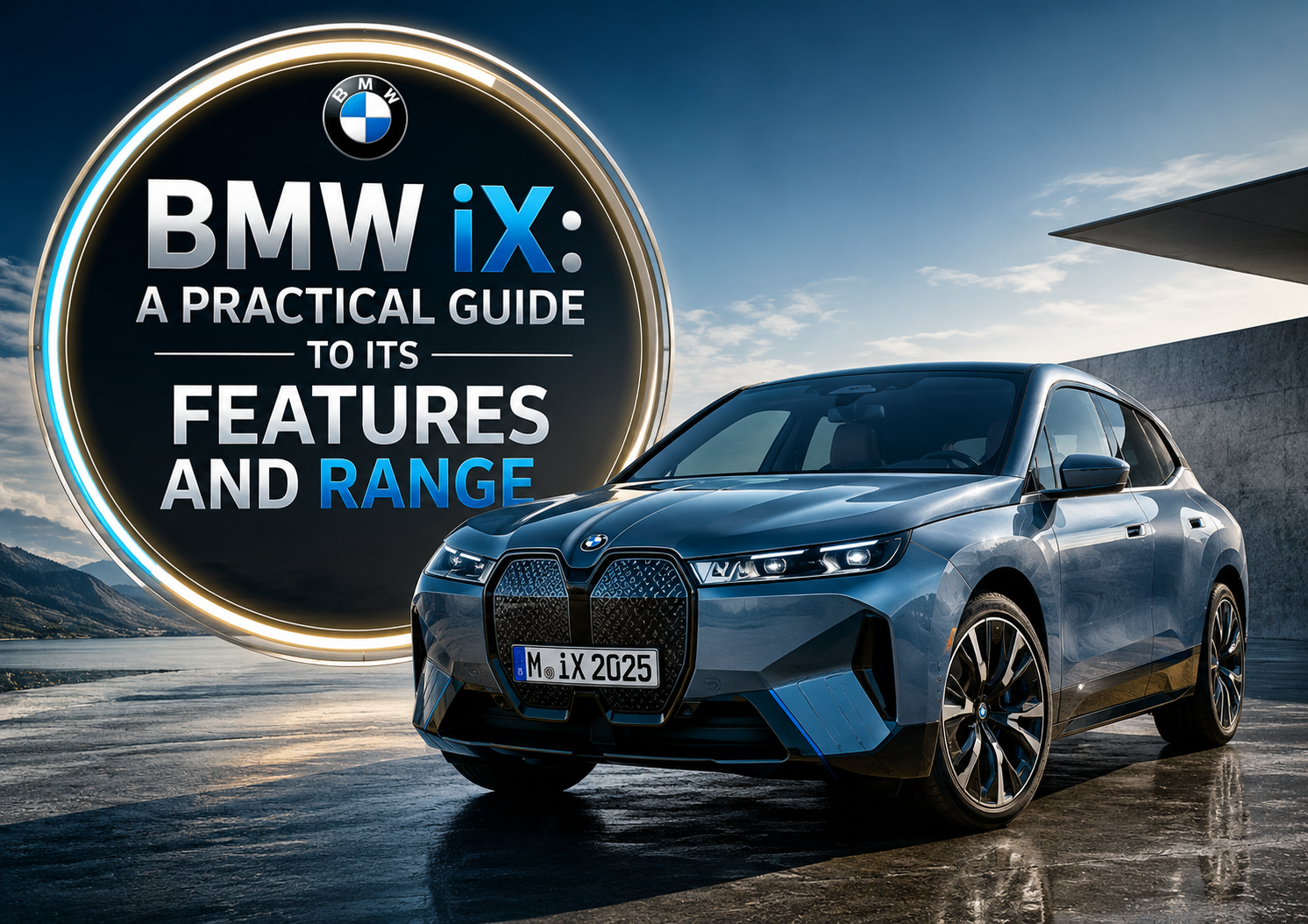
The BMW iX is one of BMW’s most distinctive all-electric SUVs. Rather than simply converting an existing gasoline-powered SUV into an electric vehicle, BMW developed the iX around electric drive technology, modern digital features, and a spacious premium cabin.
For drivers considering an electric SUV, however, good looks and strong performance are only part of the story. Range, charging, comfort, technology, and everyday practicality matter just as much.
The current 2026 BMW iX lineup gives buyers several choices, including the iX xDrive45, iX xDrive60, and performance-focused iX M70 xDrive. BMW lists estimated ranges of up to 312 miles for the xDrive45, 340 miles for the xDrive60, and 302 miles for the M70 under its stated testing conditions. Actual range can be different depending on wheels and tires, driving style, traffic, temperature, accessories, and other factors.
This guide looks at what makes the BMW iX interesting, how its range works in everyday driving, what charging is like, and what potential owners should know before choosing one.
What Is the BMW iX?
The BMW iX is a fully electric luxury SUV built around BMW’s electric-drive technology. Unlike a hybrid, it does not use a gasoline engine as part of its normal powertrain. BMW states that the 2026 iX is offered exclusively with fully electric drive.
The iX uses electric motors and BMW xDrive all-wheel drive. This combination gives the SUV the quick response associated with electric vehicles while retaining the confident traction expected from an all-wheel-drive BMW. BMW’s broader iX information describes the vehicle as combining two electric motors with electric xDrive all-wheel drive.
One of the most interesting things about the iX is that its design does not try to look like a conventional BMW SUV. The exterior uses a smooth, aerodynamic shape, flush door handles, frameless doors, and BMW’s tall kidney grille treatment.
Inside, the approach is equally modern. The cabin focuses heavily on digital controls, premium materials, spacious seating, and a large curved display.
BMW iX Exterior Design
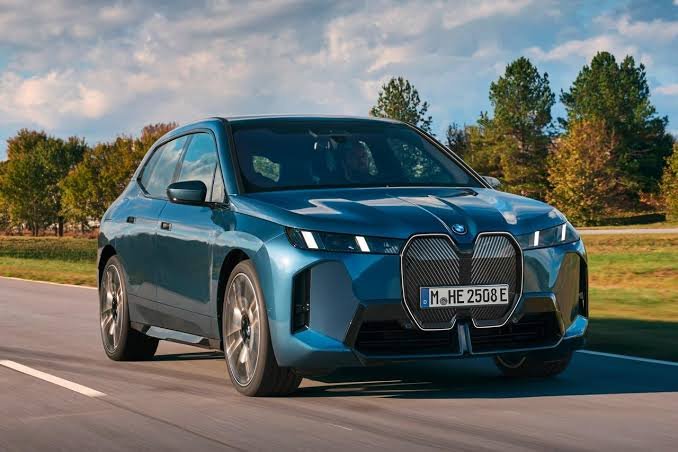
The BMW iX has a design that immediately separates it from more traditional SUVs.
At the front, the large vertical kidney grille is one of its most recognizable features. Because an electric vehicle does not need the same conventional engine-airflow arrangement as a gasoline vehicle, BMW could give the grille a different role and appearance.
The headlights are slim, while the body has clean surfaces rather than numerous aggressive creases. Flush-mounted door handles help create a smoother side profile, and the frameless doors add to the vehicle’s premium character.
The overall shape is not just about appearance. Aerodynamic efficiency is important for an electric SUV because reducing resistance can help lower energy consumption and support driving range.
BMW lists the iX at roughly 4,953 mm long and 1,967 mm wide in its technical information, giving it a substantial road presence while leaving enough interior room for everyday passengers and luggage.
BMW iX Interior and Comfort
The cabin is one of the strongest parts of the BMW iX.
Instead of filling the dashboard with physical switches, BMW uses a cleaner layout centered around digital displays and the iDrive control system. The result is a modern interior that feels considerably different from older BMW SUVs.
The curved display provides a central place for navigation, vehicle information, entertainment, and other functions. Depending on specification, the iX can also be equipped with premium comfort and technology features designed to make longer journeys easier.
The spacious design is particularly important because the iX is positioned as a luxury SUV rather than a small urban EV. Its interior is intended to work for commuting, family trips, business travel, and longer road journeys.
Material choices also contribute to the character of the cabin. BMW has emphasized modern, premium materials and a minimalist design rather than simply covering the interior with traditional leather and glossy trim.
BMW iX Technology
Technology is a major part of the iX experience.
BMW’s iDrive system provides access to vehicle settings, navigation, entertainment, and connected services. The digital interface is designed to allow drivers to interact with the vehicle through the display, controls, and voice functions.
The iX also benefits from connected-car features through BMW’s digital ecosystem. Depending on market and equipment, owners can use connected functions to monitor aspects of the vehicle and manage charging.
For an EV, this type of technology is particularly useful because charging and range information are closely connected to navigation. A good electric vehicle should not simply tell the driver how much charge remains; it should help make that information useful when planning a journey.
BMW also highlights driver-assistance and entertainment technologies as part of the iX equipment package.
BMW iX Performance
Electric power changes the way an SUV responds to the accelerator.
The BMW iX does not need to build engine revs before delivering torque. Electric motors can provide strong response almost immediately, which makes the vehicle feel quick when pulling away from a stop or accelerating onto a highway.
The 2026 lineup provides different performance levels.
The iX xDrive45 produces 402 horsepower according to BMW’s U.S. information and is positioned as the entry point to the current lineup.
The iX xDrive60 increases output to 536 horsepower and combines strong performance with the longest estimated range among the three current variants.
At the top is the iX M70 xDrive, which BMW rates at up to 650 horsepower. It adds a stronger performance focus while retaining the practicality of an electric SUV.
This gives buyers a useful choice. Someone prioritizing efficiency and everyday usability may look toward the xDrive45 or xDrive60, while a driver who wants stronger performance may prefer the M70.
BMW iX Range Explained
Range is probably the most important question for many people considering an electric vehicle.
For the 2026 BMW iX in the United States, BMW currently lists the following estimated ranges:
| BMW iX variant | Estimated maximum range | Power |
|---|---|---|
| iX xDrive45 | Up to 312 miles | 402 hp |
| iX xDrive60 | Up to 340 miles | 536 hp |
| iX M70 xDrive | Up to 302 miles | Up to 650 hp |
These are estimated figures, not guarantees of how far every driver will travel on a full battery. BMW specifically notes that actual range can change because of tire and wheel selection, driving style, traffic, outside temperature, accessories, and other conditions.
That distinction is important.
A vehicle may achieve its published maximum range under favorable conditions, while a different journey involving high speeds, cold weather, heavy heating use, or difficult terrain can produce a lower result.
For that reason, it is better to think about EV range as a flexible figure rather than a fixed distance.
What Affects BMW iX Range?
Several everyday factors influence how much energy an electric vehicle uses.
Speed is one of the biggest factors. Driving at highway speeds generally requires more energy than slower urban driving because aerodynamic resistance increases as speed rises.
Temperature also matters. Cold weather can reduce efficiency, while heating the cabin requires additional energy. Very hot weather can increase energy use through air conditioning as well.
Wheels and tires can make a difference. BMW specifically identifies wheel and tire selection as one factor affecting estimated range.
Driving style matters too. Frequent hard acceleration and high-speed driving can use more energy than smooth, predictable driving.
Traffic conditions, vehicle load, accessories, and charging habits can also influence the distance available from a full battery.
This is why two owners can drive the same BMW iX and see different range numbers.
BMW iX Range in Everyday Driving
The iX’s range makes it suitable for much more than short city trips.
For daily commuting, most owners can plan around charging at home or at another convenient charging location. If the vehicle is plugged in regularly, there is less need to make special charging stops during normal weekday use.
Longer journeys require more planning, but the iX’s charging capability helps reduce the amount of time spent waiting.
The xDrive60 is particularly interesting for drivers who frequently travel long distances because BMW lists it with the highest estimated range in the 2026 iX lineup. BMW’s current U.S. range information gives the xDrive60 an estimated range of up to 340 miles, with a listed range band of 318–364 miles depending on configuration.
The M70 gives up some range in exchange for considerably more power, which is a reasonable trade-off for buyers who value performance.
BMW iX Charging
Charging is just as important as range when evaluating an electric SUV.
The 2026 BMW iX supports DC fast charging at up to 195 kW, according to BMW. Under suitable conditions, BMW says the high-voltage battery can charge from 10% to 80% in as little as 35 minutes.
Actual charging time can vary.
Battery temperature, current state of charge, charging-station capability, and other conditions can affect how quickly energy enters the battery. Maximum charging power is not maintained throughout an entire charging session, so the fastest possible figure should not be interpreted as the speed for every minute of charging.
For long trips, the important point is that the iX can use DC fast charging to add a significant amount of energy during a planned stop.
Home Charging
Home charging can make EV ownership much easier.
BMW states that the 2026 iX’s charging unit supports AC charging at up to 11 kW. BMW estimates approximately 9 hours and 45 minutes for a 0–100% charge on the xDrive45 and approximately 11 hours and 15 minutes for the xDrive60 and M70 when using 11 kW charging.
For many owners, the advantage is not necessarily charging from empty to full every night.
Instead, a driver can plug the vehicle in after returning home and start the next day with a useful amount of energy already stored. This makes the charging routine feel quite different from visiting a fuel station.
BMW also notes that the charging system can optionally support AC charging up to 22 kW, depending on the applicable equipment and charging setup.
BMW iX for Long-Distance Travel
The iX can be a capable road-trip vehicle, but planning is still important.
Before a long journey, it makes sense to consider the distance, expected weather, highway speeds, and available charging locations. Drivers should also leave some flexibility rather than planning a trip around the absolute maximum published range.
The best strategy is to treat fast charging as part of the journey rather than as an emergency measure.
A charging stop can be combined with a meal, coffee break, shopping trip, or rest stop. With modern EVs, the goal is not necessarily to wait until the battery is completely empty and then recharge it fully. A shorter charging session can provide enough energy to continue the trip.
BMW’s connected technology is designed to make charging and trip planning easier, and the company also provides charging-related features through its digital services.
BMW iX Safety and Driver Assistance
Safety is another important consideration in a premium SUV.
The iX can be equipped with a range of driver-assistance technologies designed to support the driver in situations such as highway driving, parking, and traffic.
These systems can make driving less tiring, especially on longer journeys, but they should be treated as assistance rather than a replacement for the driver.
The person behind the wheel remains responsible for paying attention to the road and using the systems appropriately.
BMW iX Everyday Practicality
The biggest advantage of the iX is that it does not feel like a compromise simply because it is electric.
Its SUV shape provides useful passenger space, while the quiet electric powertrain suits city driving particularly well.
For commuting, the iX offers a calm and refined experience. At higher speeds, the electric drivetrain provides strong acceleration when needed, while the cabin is designed around comfort.
For families, interior space and luggage capacity are important. For business users, the premium cabin and technology may be equally attractive.
The iX therefore sits in an interesting position: it can be both a comfortable daily vehicle and a serious long-distance machine when charging is planned properly.
BMW iX Efficiency
Getting the most from an electric SUV is not only about having a large battery.
Efficient driving can help extend the usable range between charging stops.
Smooth acceleration, sensible highway speeds, proper tire maintenance, and appropriate climate-control use can all help reduce unnecessary energy consumption.
BMW’s own range information emphasizes that outside temperature, driving style, traffic, wheel and tire selection, and other conditions influence actual range.
This is useful to remember when comparing the iX with another EV. A published range number is helpful, but real-world efficiency is what ultimately determines how often a driver needs to charge.
BMW iX Pros and Cons
Pros
- Fully electric powertrain with no gasoline engine
- Strong performance across the current lineup
- Long estimated range, especially in the xDrive60
- Premium and spacious interior
- Advanced digital technology
- All-wheel drive
- DC fast-charging capability
- Comfortable design for everyday driving
- Distinctive exterior styling
Cons
- Premium pricing can put it beyond some EV buyers’ budgets
- Actual range can be lower than the maximum advertised figure
- Large size may not suit every city or parking situation
- Long-distance trips still require charging planning
- The large number of digital functions can take time to learn
Is the BMW iX a Good Electric SUV?
The BMW iX makes the most sense for someone who wants a premium SUV but is ready to move completely to electric driving.
Its biggest strengths are not limited to acceleration. The combination of range, comfort, technology, all-wheel drive, and fast charging gives it a broad range of uses.
The xDrive45 is a sensible option for buyers who want the iX experience without focusing entirely on maximum performance. The xDrive60 is particularly appealing to drivers who place a high value on range and power. The M70 is aimed at people who want the strongest performance from the lineup.
The right choice ultimately depends on how the vehicle will be used.
Someone with regular access to home charging may find EV ownership especially convenient. A person who frequently drives long distances should pay closer attention to charging availability along their usual routes.
BMW iX Specifications at a Glance
| Feature | 2026 BMW iX |
|---|---|
| Vehicle type | All-electric luxury SUV |
| Powertrain | Fully electric |
| Drive system | BMW xDrive all-wheel drive |
| xDrive45 power | 402 hp |
| xDrive60 power | 536 hp |
| M70 power | Up to 650 hp |
| xDrive45 estimated range | Up to 312 miles |
| xDrive60 estimated range | Up to 340 miles |
| M70 estimated range | Up to 302 miles |
| Maximum DC charging | Up to 195 kW |
| DC charging | 10–80% in up to 35 minutes |
| AC charging | Up to 11 kW standard charging capability |
| Main focus | Luxury, technology, range and performance |
The figures above are based on BMW’s current U.S. information for the 2026 model year. Range and charging performance can vary by configuration and conditions.
Final Thoughts on the BMW iX
The BMW iX shows how far an electric SUV can move beyond simply replacing a gasoline engine.
It combines a distinctive exterior with a spacious premium interior, strong electric performance, modern technology, all-wheel drive, and useful long-distance range. The current xDrive60 stands out for its balance of power and estimated range, while the M70 gives performance-focused drivers a much stronger electric SUV.
Range is still something every EV owner needs to understand, but the iX makes the process easier through its charging capability and connected technology.
The most important thing is to look beyond the headline range figure. Real-world distance depends on temperature, speed, tires, traffic, driving style, and many other factors. BMW itself makes this clear in its current range information.
For buyers who have convenient access to charging and want a premium SUV without a gasoline engine, the BMW iX is a compelling option. It is comfortable enough for everyday use, powerful enough to feel genuinely quick, and equipped with the range and charging technology needed to make electric driving practical for more than just short trips.
Frequently Asked Questions About the BMW iX
1. How much range does the BMW iX have?
The 2026 BMW iX offers estimated ranges of up to 312 miles for the xDrive45 and 340 miles for the xDrive60. Actual range depends on conditions such as temperature, driving style, tires, and traffic.
2. How quickly can the BMW iX charge?
The BMW iX can support DC fast charging at up to 195 kW. BMW says a 10–80% charge can take as little as 35 minutes under suitable conditions.
3. Is the BMW iX fully electric?
Yes. The 2026 BMW iX is offered exclusively with a fully electric powertrain, making it a zero-tailpipe-emission SUV.
4. Is the BMW iX suitable for long trips?
Yes. Its useful driving range, fast-charging capability, comfortable cabin, and available charging infrastructure make it suitable for longer journeys. However, charging stops should still be planned.
5. What affects BMW iX range?
Range can change with speed, weather, traffic, driving style, wheel and tire selection, accessories, and other conditions. Cold temperatures can also reduce EV range.