





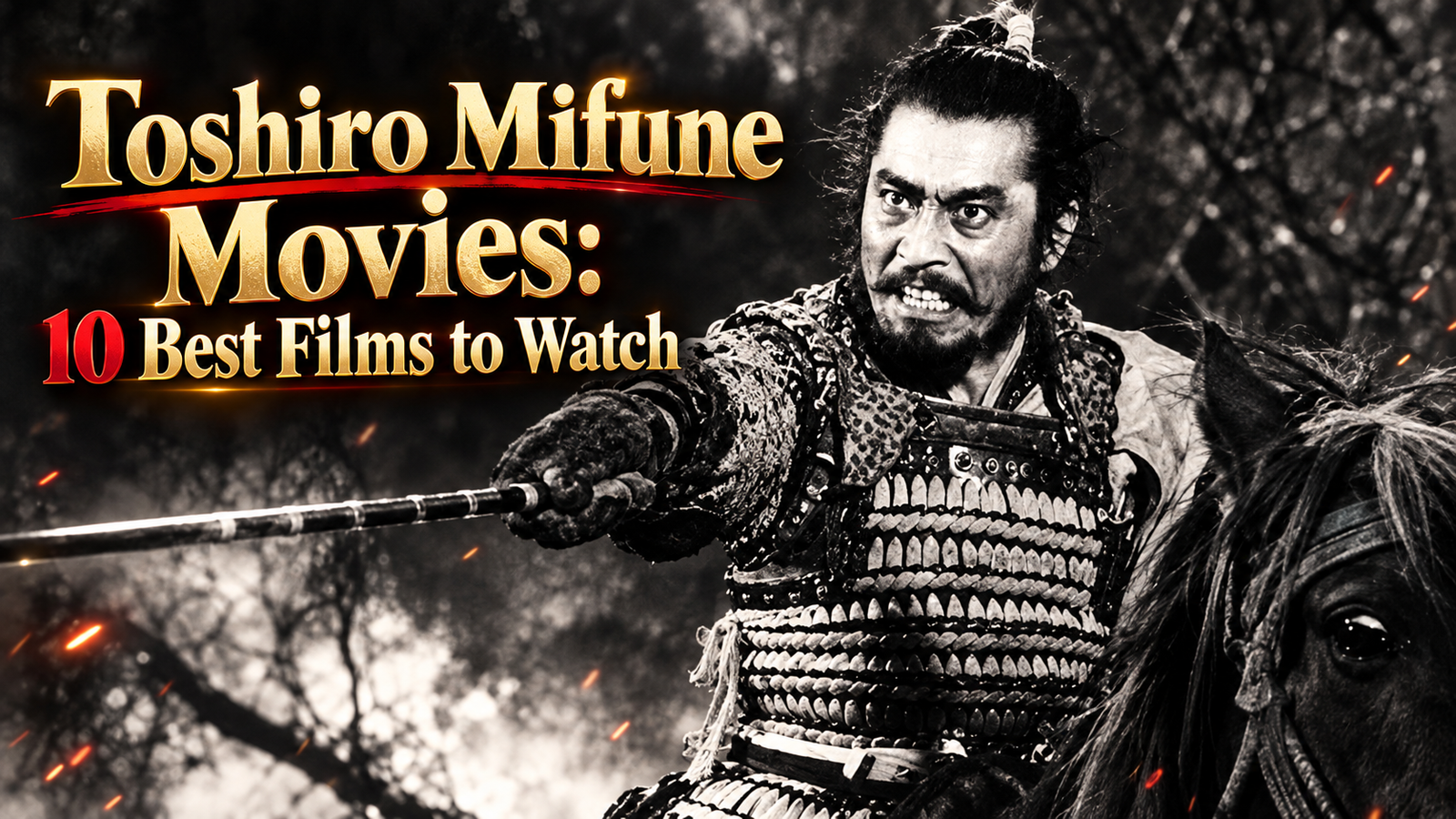
Toshiro Mifune remains one of the most celebrated actors in Japanese cinema. Known for his powerful screen presence, expressive performances, and remarkable versatility, he helped introduce Japanese films to audiences around the world. His work includes legendary samurai adventures, psychological dramas, crime thrillers, and deeply moving human stories.
Many film fans recognize him from Seven Samurai and Yojimbo, but his career extends far beyond these classics. He worked with some of Japan’s most respected directors and created characters that continue to influence actors and filmmakers today.
One of the most important partnerships in his career was with director Akira Kurosawa. Together, they made several influential films that combined compelling characters, striking visuals, and unforgettable storytelling. Mifune also proved his talent in films directed by Hiroshi Inagaki and Masaki Kobayashi.
If you want to discover the best Toshiro Mifune movies, this guide explores ten essential films, explains their stories, and highlights what makes each performance worth watching.
BIO
| Label | Information |
|---|---|
| Full Name | Toshiro Mifune |
| Date of Birth | April 1, 1920 |
| Place of Birth | Qingdao, China |
| Nationality | Japanese |
| Profession | Actor and Film Producer |
| Main Industry | Japanese Cinema |
| Acting Debut | 1947, in Shin Baka Jidai |
| Famous Director Partner | Akira Kurosawa |
| Notable Movie | Seven Samurai (1954) |
| Other Famous Film | Yojimbo (1961) |
| Acting Style | Powerful and expressive |
| International Recognition | Japanese and international cinema |
| Date of Death | December 24, 1997 |
Who Was Toshiro Mifune?
Toshiro Mifune was born on April 1, 1920, in Qingdao, China, to Japanese parents. He later became one of the leading stars of Japanese cinema, particularly during the years following the Second World War.
Before entering the film industry, Mifune spent part of his early life in China and worked in photography-related activities. His path into acting began when he participated in an audition at Toho Studios in Japan. His natural energy and distinctive screen presence helped him stand out.
Mifune gained wider attention through his collaboration with Akira Kurosawa, beginning with Drunken Angel in 1948. Their professional partnership eventually produced sixteen films and became one of the most important director-actor collaborations in film history.
What made Mifune special was his ability to communicate emotion through movement, facial expressions, posture, and voice. He could appear fierce and unpredictable in one scene, then reveal vulnerability and compassion in the next.
Although he became especially famous for playing samurai, his filmography includes modern crime dramas, historical epics, and character-driven stories. His international career also included the television miniseries Shogun in 1980.
Mifune died on December 24, 1997, but his performances remain an important part of world cinema.
1. Seven Samurai (1954)
Director: Akira Kurosawa
Mifune’s role: Kikuchiyo
Seven Samurai is widely regarded as one of the greatest films ever made and remains an excellent starting point for anyone exploring Toshiro Mifune movies.
Set in sixteenth-century Japan, the story follows a farming village threatened by bandits. Knowing that they cannot protect themselves, the villagers seek the help of seven samurai who agree to defend them.
Mifune plays Kikuchiyo, a wild and unpredictable man who presents himself as a samurai despite coming from a farming background. His character initially appears humorous and reckless, but the story gradually reveals deeper emotions beneath his energetic personality.
Kikuchiyo is particularly memorable because he challenges the traditional image of a disciplined warrior. He is impulsive, loud, and sometimes foolish, yet he possesses courage and a strong sense of justice.
Mifune’s physical performance gives the character a unique identity. His movements, expressions, and sudden changes in mood make Kikuchiyo feel spontaneous and human.
The film is also remarkable for its treatment of teamwork, sacrifice, social divisions, and survival. The battle sequences combine careful planning with tension, while the quieter scenes develop relationships between the villagers and their protectors.
Seven Samurai influenced generations of filmmakers and inspired the Western remake The Magnificent Seven. Its impact can still be seen in action films that bring together a group of different personalities to face a common threat.
Why watch it: Choose this film if you want an epic story, memorable characters, and one of Mifune’s most celebrated performances.
2. Rashomon (1950)
Director: Akira Kurosawa
Mifune’s role: Tajomaru
Rashomon is one of the most influential Japanese films ever released internationally. Rather than presenting a mystery with one simple answer, it examines how people remember events and how personal interests can influence the truth.
The story concerns a violent incident involving a samurai, his wife, and a bandit. Several characters describe what happened, but their accounts differ significantly. As each version unfolds, the audience is encouraged to question what can actually be trusted.
Mifune plays Tajomaru, the bandit whose personality is bold, theatrical, and unpredictable. He portrays the character with a mixture of arrogance, aggression, and nervous energy.
His performance stands out because Tajomaru is not presented as a simple villain. His account reveals how he wants others to see him, making his personality an important part of the film’s central question about truth and self-image.
The film’s storytelling was innovative for its time. Its use of different perspectives encouraged viewers to reconsider the relationship between memory, honesty, and human behavior.
The atmospheric forest setting and careful visual composition also contribute to its lasting appeal. Kurosawa creates suspense through framing, movement, light, and the gradual revelation of information.
Rashomon won the Golden Lion at the Venice Film Festival in 1951 and helped bring international attention to Japanese cinema.
Why watch it: This is an excellent choice for viewers who enjoy psychological mysteries and films that leave room for discussion after the ending.
3. Yojimbo (1961)
Director: Akira Kurosawa
Mifune’s role: Sanjuro Kuwabatake
Yojimbo is one of Toshiro Mifune’s most entertaining performances. The film combines samurai action, dark humor, suspense, and a central character who rarely behaves as expected.
The story follows a wandering ronin, a samurai without a master, who arrives in a small town divided between two rival criminal groups. Instead of immediately choosing a side, he uses his intelligence to manipulate the conflict and weaken both groups.
Mifune plays the ronin with remarkable confidence. His character appears relaxed even in dangerous situations, often relying on observation and clever decisions rather than rushing into action.
The character’s humor is an important part of the film. A glance, a shrug, or a casual reaction can communicate more than a lengthy conversation. Mifune makes Sanjuro amusing without removing the danger surrounding him.
Beneath the entertainment, Yojimbo explores greed, corruption, and the damage caused by people who value power above everything else. The divided town becomes a reflection of a society in which ordinary people suffer because of the ambitions of others.
The film’s visual style also deserves attention. Its dusty streets, carefully arranged compositions, and tense confrontations create an atmosphere that feels both theatrical and realistic.
The character returned in Kurosawa’s Sanjuro the following year. Yojimbo also became internationally influential, particularly through its relationship to the Western tradition of the lone, morally complicated hero.
Why watch it: Start here if you prefer a faster-moving samurai film with clever storytelling, dry humor, and a charismatic lead performance.
4. Throne of Blood (1957)
Director: Akira Kurosawa
Mifune’s role: Taketoki Washizu
Throne of Blood is Kurosawa’s striking adaptation of William Shakespeare’s Macbeth. Instead of using the original Scottish setting, the film places its tragic story within the world of feudal Japan.
Mifune plays Washizu, a respected warrior whose ambitions grow after a mysterious prophecy suggests that he may rise to greater power. As he begins to believe that his future is destined, his judgment becomes increasingly clouded.
The character offers Mifune an opportunity to show a different kind of intensity. Unlike the wandering hero in Yojimbo, Washizu is a man whose desire for advancement gradually overtakes his sense of security and responsibility.
Mifune’s performance communicates fear, pride, and desperation through physical expression. His changing posture and increasingly restless behavior help reveal a character losing control of his own choices.
Kurosawa draws heavily on Japanese theatrical traditions, particularly Noh, to shape the film’s movements and atmosphere. The mist-covered landscapes, imposing architecture, and carefully controlled performances create a haunting visual experience.
Rather than simply transferring Shakespeare’s dialogue into another setting, the film reimagines the tragedy through Japanese history and cinematic language.
Its final sequences are especially memorable for their visual intensity and the way they portray the consequences of ambition.
Why watch it: This film is ideal for viewers interested in Shakespeare, historical tragedy, and Mifune’s ability to portray a complicated character driven toward disaster.
5. The Hidden Fortress (1958)
Director: Akira Kurosawa
Mifune’s role: General Rokurota Makabe
The Hidden Fortress offers a lighter and more adventurous side of Mifune’s screen personality. It combines action, humor, suspense, and a journey through dangerous territory.
The story follows two ordinary men who become involved in transporting gold and helping a princess escape from enemy forces. Their journey brings them into contact with General Rokurota Makabe, a skilled warrior responsible for protecting the princess.
Mifune plays Makabe as a capable and determined military leader. The character is physically powerful, but he also needs patience, strategic thinking, and an understanding of the people around him.
Unlike the unpredictable ronin in Yojimbo, Makabe has a clear responsibility and a strong connection to the people he protects. His confidence comes from experience and commitment rather than personal amusement.
The film balances serious danger with comic moments, especially through the two ordinary men whose selfish decisions often complicate the mission. Their perspective makes the adventure accessible and gives the story a different rhythm from a conventional heroic epic.
Kurosawa’s widescreen compositions and dynamic action scenes make the journey visually engaging. The changing landscapes also help establish a sense of distance, danger, and discovery.
The film is frequently discussed in connection with Star Wars, whose creators drew inspiration from aspects of its storytelling and perspective.
Why watch it: Choose The Hidden Fortress if you enjoy historical adventures that balance heroic action with humor and memorable supporting characters.
6. Sanjuro (1962)
Director: Akira Kurosawa
Mifune’s role: Sanjuro Tsubaki
Sanjuro continues the story of the wandering samurai introduced in Yojimbo. Although it shares the earlier film’s lead character, it develops his personality through a different situation and a new group of characters.
The story begins when a group of inexperienced young samurai become involved in a struggle against corruption. Their limited experience makes them vulnerable, and they soon encounter a wandering swordsman who offers to help.
Mifune returns as Sanjuro, a practical and sharp-minded character who does not always respect the formal behavior expected of a warrior. He recognizes the difference between appearing honorable and making genuinely wise decisions.
His relationship with the younger samurai provides much of the film’s humor. They tend to rely on rules and appearances, while Sanjuro prefers to judge people by their actions.
This contrast gives the story a deeper theme. The film suggests that intelligence, patience, and a willingness to question authority can be more useful than blindly following tradition.
Mifune’s relaxed performance is central to the film’s charm. He can appear uninterested in a situation while quietly noticing details that others miss. His comic timing also makes the character engaging without turning him into a joke.
The film builds toward a memorable conclusion that contrasts with its lighter moments and reinforces the seriousness of the samurai world.
Why watch it: Watch Sanjuro after Yojimbo to enjoy more of Mifune’s distinctive humor, clever problem-solving, and confident screen presence.
7. The Bad Sleep Well (1960)
Director: Akira Kurosawa
Mifune’s role: Koichi Nishi
The Bad Sleep Well demonstrates that Mifune’s talents extended far beyond historical adventures. This modern crime drama examines corruption, corporate power, revenge, and the difficulty of challenging influential people.
The story begins at a high-profile wedding connected to a major corporation. Beneath the public celebration, however, lies a complicated situation involving suspected wrongdoing and personal motives.
Mifune plays Koichi Nishi, a man whose marriage and professional position conceal a deeper personal mission. As the story develops, his actions reveal the extent to which private grief and the desire for justice can shape a person’s choices.
Nishi is different from Mifune’s more openly expressive characters. He often needs to control his emotions, conceal his intentions, and observe the people around him carefully.
This restraint creates tension. Instead of depending on constant action, the film allows information to emerge gradually, making the audience reconsider what it knows about the characters.
Kurosawa uses the corporate environment to explore the unequal relationship between ordinary individuals and powerful institutions. The polished offices and formal gatherings provide a sharp contrast to the personal suffering beneath the surface.
The film also reflects the atmosphere of postwar Japan, when rapid economic development and corporate influence were changing everyday life.
Why watch it: This is a strong choice for viewers who prefer crime stories, moral conflicts, and suspense set in the modern world rather than historical Japan.
8. High and Low (1963)
Director: Akira Kurosawa
Mifune’s role: Kingo Gondo
High and Low is one of the finest examples of Mifune’s ability to carry a serious modern drama. The film begins with a wealthy businessman facing a devastating dilemma after receiving news of a kidnapping.
Kingo Gondo is preparing to make an important business decision when a kidnapper demands money in exchange for a child. The situation becomes especially complicated when Gondo discovers that the victim is the son of his chauffeur rather than his own child.
The businessman must consider the financial consequences of paying the ransom, the future of his company, and his responsibility toward another family. His decision becomes a test of character rather than simply a question of wealth.
Mifune portrays Gondo as intelligent, proud, and accustomed to making difficult choices. As the pressure increases, his performance reveals the emotional weight of a decision that cannot be reduced to business calculations.
The film gradually shifts from an intimate domestic drama to a detailed police investigation. This change in perspective gives the story momentum while broadening its examination of class and social inequality.
The contrast between Gondo’s comfortable home and the harsher environments explored later in the story reinforces the title’s central idea. People can inhabit the same city while experiencing very different realities.
High and Low was adapted from Ed McBain’s crime novel King’s Ransom. Its carefully constructed suspense and social commentary have made it a lasting reference point for crime filmmakers.
Why watch it: Choose this film if you enjoy intelligent thrillers that combine a gripping investigation with difficult ethical questions.
9. Red Beard (1965)
Director: Akira Kurosawa
Mifune’s role: Dr. Kyojo Niide
Red Beard is an important film because it reveals a gentler and more compassionate side of Toshiro Mifune. Rather than playing a warrior or a man caught in a crime investigation, he portrays a dedicated doctor working at a clinic for disadvantaged people.
The story follows a young doctor named Yasumoto who arrives at a rural medical clinic expecting to advance his career. He is disappointed by his assignment and initially resents the clinic’s strict director, Dr. Niide, known as Red Beard.
As Yasumoto encounters patients facing poverty, illness, and personal hardship, his understanding of medicine and responsibility begins to change.
Mifune portrays Niide as a demanding but deeply humane man. He expects discipline from his staff, yet his actions demonstrate genuine concern for people who have few other sources of support.
The character’s authority is not based only on professional knowledge. It comes from experience, compassion, and a belief that medical care must recognize the dignity of every patient.
The film develops through several connected stories, allowing the audience to see different forms of suffering and resilience. Its slower pace gives emotional moments time to develop, while the relationship between the two doctors provides a clear thread throughout the narrative.
At nearly three hours long, Red Beard requires patience, but its human themes make the experience rewarding. It also marked the final film in Mifune’s long collaboration with Kurosawa.
Why watch it: This is an excellent choice for viewers who want a thoughtful human drama about compassion, professional responsibility, and personal growth.
10. Samurai Rebellion (1967)
Director: Masaki Kobayashi
Mifune’s role: Isaburo Sasahara
Samurai Rebellion is one of the most important films featuring Mifune outside his collaboration with Kurosawa. Directed by Masaki Kobayashi, the film explores family loyalty, personal freedom, and the dangers of unquestioned authority.
Mifune plays Isaburo Sasahara, an experienced swordsman who has settled into a relatively quiet family life. His circumstances change when his clan’s ruler makes a demand that affects his son and the woman his son has married.
When the ruler later attempts to reverse the arrangement, Isaburo and his family face an impossible choice between obedience and their sense of right and wrong.
The story is compelling because its central conflict is not simply about combat. It asks what happens when a system that claims to value loyalty refuses to respect the people expected to serve it.
Mifune gives Isaburo a controlled and thoughtful presence. At first, the character appears resigned to the limits imposed by his social position. As events unfold, his growing determination reveals a man who is no longer willing to accept injustice without resistance.
The film’s dramatic power comes from the conflict between private family bonds and public obligations. Its characters must consider the cost of standing up for their beliefs in a society where authority carries enormous consequences.
Kobayashi’s restrained direction and careful compositions complement Mifune’s performance. The result is a historical drama that feels relevant because its questions about power and individual conscience remain understandable today.
Why watch it: Watch Samurai Rebellion for a powerful family drama that examines justice, loyalty, and the courage required to challenge authority.
What Makes Toshiro Mifune’s Movies Special?
A Distinctive Acting Style
Mifune had a rare ability to make characters memorable through physical expression. His movements could be quick and restless, while a small change in his face could communicate doubt, amusement, or anger.
He did not rely on one fixed performance style. Instead, he adapted to the character and the demands of each story. His samurai roles often displayed energy and unpredictability, while his modern dramas revealed patience and emotional restraint.
This flexibility helped him move between action, comedy, suspense, and serious drama without losing his distinctive identity.
His Partnership with Akira Kurosawa
Mifune’s collaboration with Kurosawa played a major role in establishing his international reputation. Their sixteen films included Rashomon, Seven Samurai, Throne of Blood, Yojimbo, and High and Low.
The director and actor brought different strengths to their work. Kurosawa’s carefully composed images and layered storytelling gave Mifune a rich setting for his performances. Mifune, in turn, brought physical energy and emotional complexity to Kurosawa’s characters.
Their partnership ended professionally after Red Beard, but the films they made together remain among the most studied works in Japanese cinema.
More Than Samurai Films
Although Mifune is strongly associated with samurai cinema, reducing his career to sword-fighting roles overlooks much of his achievement.
High and Low shows him as a businessman confronting an ethical crisis. The Bad Sleep Well presents him as a man pursuing a personal mission within a corrupt corporate world. Red Beard reveals his capacity for quiet compassion.
These performances demonstrate that his greatest strength was not a particular costume or genre. It was his ability to make complex characters believable.
Which Toshiro Mifune Movie Should You Watch First?
The best starting point depends on what kind of film you enjoy.
- For an epic adventure: Choose Seven Samurai for its memorable characters, dramatic battles, and exploration of sacrifice.
- For a psychological mystery: Watch Rashomon for its conflicting accounts and questions about human honesty.
- For action and humor: Start with Yojimbo, which combines a charismatic central character with clever storytelling.
- For crime and suspense: Choose High and Low for its kidnapping investigation and ethical dilemma.
- For a moving human drama: Watch Red Beard to experience Mifune in a compassionate and thoughtful role.
- For a story about justice: Choose Samurai Rebellion for its examination of family loyalty and resistance to unfair authority.
If you are new to Japanese cinema, Seven Samurai is a particularly rewarding introduction. If you prefer shorter, more direct storytelling, Yojimbo may be a more comfortable first choice.
Conclusion
Toshiro Mifune’s filmography offers much more than a collection of classic samurai adventures. His performances explore courage, ambition, honesty, responsibility, and the complicated choices people face when their values are tested.
From the unpredictable Kikuchiyo in Seven Samurai to the determined businessman in High and Low and the compassionate doctor in Red Beard, Mifune demonstrated a remarkable range throughout his career.
His collaboration with Akira Kurosawa produced some of the most influential films in world cinema, while his work with other directors proved that his talent extended well beyond one creative partnership.
These ten Toshiro Mifune movies provide an excellent introduction to his lasting contribution to film. Whether you enjoy historical epics, crime thrillers, psychological mysteries, or emotional dramas, his work offers something worth discovering.
Start with the film that best matches your interests, then explore the others to see how one actor could bring such different characters to life. More than half a century after many of these films were released, Mifune’s performances remain engaging, distinctive, and rewarding to watch.
Frequently Asked Questions About Toshiro Mifune Movies
1. What is Toshiro Mifune’s most famous movie?
Seven Samurai (1954) is one of Toshiro Mifune’s most famous films. Directed by Akira Kurosawa, it features his memorable performance as Kikuchiyo.
2. What are the best Toshiro Mifune movies to watch?
Some of his best films include Seven Samurai, Rashomon, Yojimbo, Throne of Blood, and High and Low. Each showcases a different side of his acting talent.
3. How many movies did Toshiro Mifune make with Akira Kurosawa?
Toshiro Mifune and Akira Kurosawa collaborated on 16 films. Their partnership produced several classics that helped introduce Japanese cinema to international audiences.
4. Was Toshiro Mifune only known for samurai movies?
No. Although he became famous for samurai roles, he also starred in crime thrillers, modern dramas, and historical films. High and Low and The Bad Sleep Well showcase his versatility.
5. Which Toshiro Mifune movie should beginners watch first?
Seven Samurai is an excellent starting point because of its engaging story, memorable characters, and influence on filmmaking. For a shorter adventure with humor and action, Yojimbo is another great choice.