







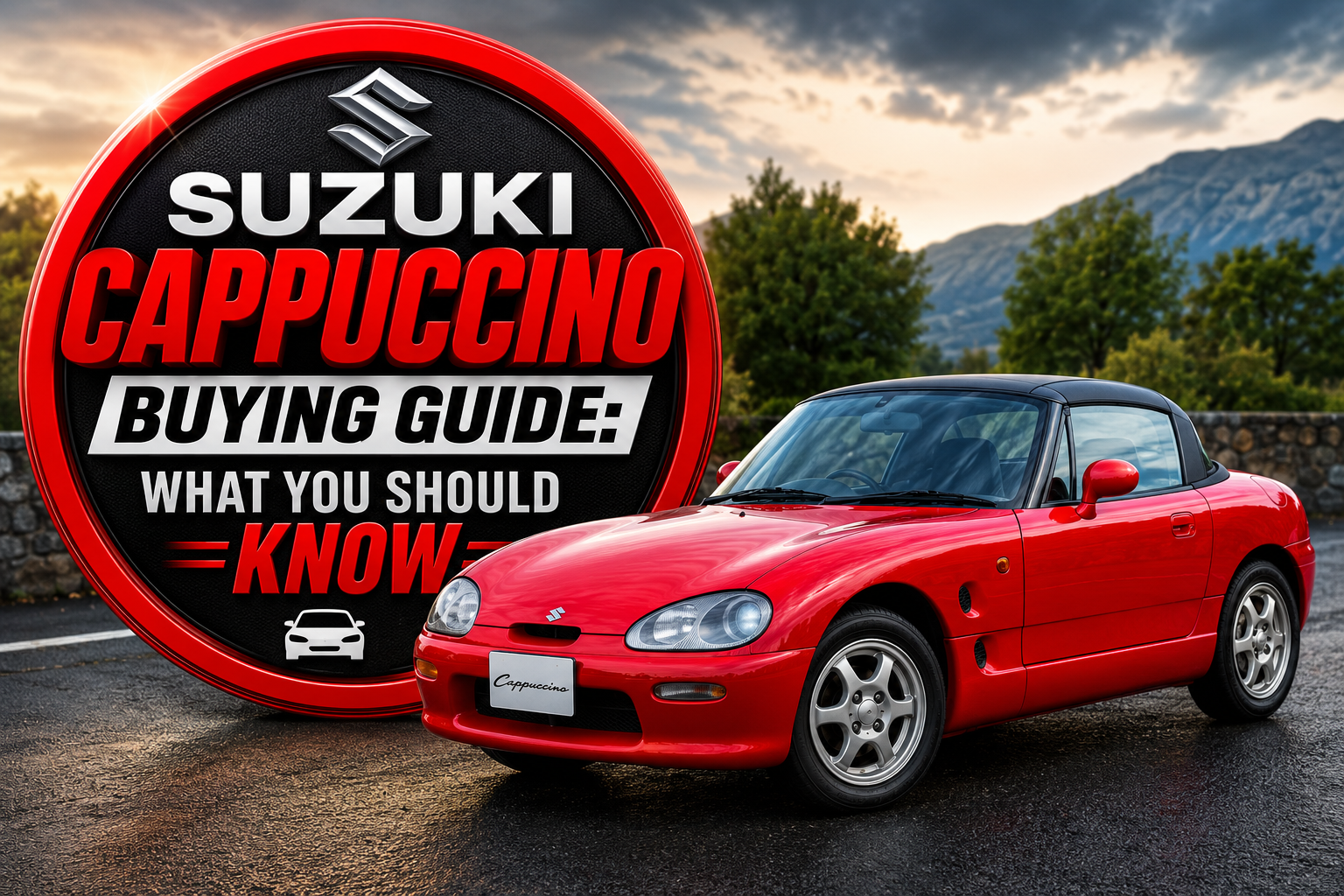
The Suzuki Cappuccino is one of those cars that makes a strong impression without needing a large engine or dramatic dimensions. Built as a Japanese kei roadster, it combines a tiny turbocharged engine, rear-wheel drive, two seats, and a clever removable roof into a package that feels very different from most modern sports cars.
Suzuki produced the Cappuccino from 1991 to 1998, and although the car was designed around Japan’s kei-car regulations, its appeal eventually reached enthusiasts outside Japan. Its compact size, low weight, balanced chassis, and unusual roof arrangement helped give it a character that has kept it interesting decades after production ended.
Buying one today, however, requires a little more thought than buying an ordinary used car. The youngest examples are now decades old, so condition matters enormously. Rust, neglected maintenance, worn seals, aging cooling components, gearbox wear, and questionable modifications can turn an attractive-looking car into an expensive project.
That does not mean you should avoid the Cappuccino. Quite the opposite: a well-maintained example can be an entertaining and distinctive classic. The key is knowing what to inspect before handing over your money.
What Is the Suzuki Cappuccino?
The Cappuccino was designed as a two-seat kei sports car. Suzuki kept the dimensions and engine within Japan’s kei-car regulations while giving it features normally associated with much larger sports cars.
Under the bonnet is a 657cc turbocharged three-cylinder engine. Early cars used the F6A engine, while later cars received the K6A. Both were designed around the kei-car power limit of 64 PS. The engine is mounted toward the front and drives the rear wheels, giving the car a traditional sports-car layout despite its extremely small footprint.
The chassis is another important part of the Cappuccino’s appeal. Suzuki used independent double-wishbone suspension and four-wheel disc brakes, helping the little roadster deliver a more serious driving experience than its dimensions might suggest.
The car’s production run ended in 1998, with sources estimating total production at roughly the high-twenty-thousand range. That relatively small production figure, combined with age and international demand, helps explain why good examples are increasingly interesting to collectors and enthusiasts.
Cappuccino Specifications
The basic numbers explain much of the car’s personality.
Engine: 657cc turbocharged three-cylinder
Engine families: F6A and K6A
Maximum power: 64 PS
Transmission: Five-speed manual; later cars also offered a three-speed automatic
Drive: Rear-wheel drive
Seats: Two
Body: Two-door roadster
Suspension: Four-wheel double wishbone
Roof: Three-piece detachable hardtop
Production: 1991–1998
Exact specifications can vary between early and later cars, so buyers should verify the chassis code and model year rather than assuming every Cappuccino is identical. The later EA21R, introduced during the 1995 update, received the K6A engine and several other revisions.
Early or Later Cappuccino?

There are two main versions worth understanding: the EA11R and EA21R.
The EA11R is the earlier version and uses the F6A engine. It has become particularly familiar among enthusiasts because it represents the original Cappuccino formula. One important maintenance consideration is its timing belt. If there is no reliable record showing when the belt was replaced, that service should be treated as an important part of the buying decision.
The later EA21R introduced the all-aluminium K6A engine. It retained the 64 PS kei-car power limit but gained changes intended to improve the engine’s character and efficiency. The K6A uses a timing chain rather than the F6A’s belt, and later cars could also be ordered with a three-speed automatic transmission.
Neither version automatically makes the better purchase. A carefully maintained EA11R can be a much better choice than a neglected EA21R. Condition, documentation, rust, and mechanical health should come before the badge or chassis code.
How Does It Drive?
The Cappuccino’s performance is less about outright speed and more about involvement.
Its small turbocharged engine produces relatively modest power, but the car’s compact dimensions and low weight mean that the driver can enjoy its performance without needing extremely high speeds. The rear-wheel-drive layout also gives the car a distinctly different character from many small front-wheel-drive kei cars.
On a winding road, the Cappuccino’s size becomes an advantage. Its steering, compact body, and relatively sophisticated suspension make it feel responsive. You sit close to the mechanical action, and the manual gearbox encourages the driver to stay involved.
The result is a car that rewards smooth inputs rather than simply demanding more horsepower. It is easy to understand why lightweight Japanese sports cars from this period have developed such a strong following.
The Clever Roof
One of the Cappuccino’s most memorable features is its three-piece removable roof.
Rather than being limited to a conventional convertible arrangement, the roof can be configured in several ways. Depending on how the panels are positioned, the car can be used as a closed coupe, a T-bar-style configuration, a targa-like setup, or with the roof completely removed.
This gives the Cappuccino an unusual amount of flexibility for such a small roadster.
However, the roof is also something you should inspect carefully when buying. Decades-old rubber seals can deteriorate, and poorly fitting or damaged components may allow water into the cabin. Check every seal, latch, panel, and storage area rather than judging the roof only by its appearance.
Check the Body First
When inspecting a used Suzuki Cappuccino, body condition should be near the top of your list.
These cars are now old enough that corrosion can be more important than mileage. Buyer guides specifically warn about rust around the sills, floorpans, and wheel arches, with some corrosion hidden behind lower plastic panels.
Look closely underneath the car rather than relying on photographs.
Check the sills for bubbling or poorly repaired areas. Inspect the floor from underneath and, where practical, look inside the cabin and luggage areas for signs of previous water entry. Examine the wheel arches and suspension mounting areas as well.
A shiny exterior does not necessarily mean the car is structurally sound. Fresh paint can sometimes hide previous repairs, so evidence of professional rust repair is more valuable than a perfectly polished body.
Inspect the Aluminium Panels
Several exterior panels were made from aluminium to help keep the Cappuccino lightweight. This was a clever engineering decision, but it creates another consideration for today’s buyer: replacement panels can be difficult and expensive to source.
Check the bonnet, boot lid, and roof panels for dents, distortion, poor repairs, and damaged mounting points.
Small imperfections may be acceptable on an older enthusiast car. Missing or badly damaged panels are another matter because sourcing suitable replacements may require patience.
Check the Engine
The Cappuccino’s small turbocharged engine is capable of providing plenty of entertainment, but age matters.
Start the engine from cold if possible. Listen carefully for unusual noises and pay attention to how it settles into idle. Look around the engine bay for evidence of oil or coolant leaks.
During the test drive, the engine should pull smoothly and the turbocharger should provide predictable performance. Excessive smoke, unusual turbo noises, poor response, or obvious hesitation deserve further investigation.
Cooling-system condition is particularly important in an older Cappuccino. Radiators, hoses, thermostats, water pumps, and other components can deteriorate with age. A cooling problem that is ignored can lead to much more serious engine damage.
Don’t Ignore the Gearbox
Most Cappuccinos were sold with a five-speed manual gearbox, although later cars also offered a three-speed automatic.
Manual cars should be tested through every gear.
Pay particular attention to the shift into second gear. Used-car guides note that synchroniser wear can occur, so a gearbox that crunches or resists shifts deserves attention before purchase.
A short test drive is not enough. Try the gearbox when the car is cold and again after it has warmed up. Listen for noises and check whether the clutch engages smoothly.
Inspect the Suspension and Brakes
The Cappuccino’s double-wishbone suspension is one of its interesting engineering features, but suspension components are now several decades old.
Look for worn bushes, tired dampers, damaged ball joints, uneven tyre wear, and unusual noises over rough surfaces. The car should track straight and respond predictably to steering inputs.
The brakes should also be checked carefully. Inspect discs, pads, lines, hoses, and the parking brake. On an imported classic, replacing ordinary service components may be straightforward, but unusual or model-specific parts can take more effort to source.
Examine the Interior
The Cappuccino’s cabin is simple, compact, and very much a product of its era.
The dashboard is straightforward, and there is not much space to spare. That’s part of the charm, but it also means buyers should be realistic about practicality.
Check the seats, dashboard, carpets, switches, instruments, heating and ventilation controls, windows, and electrical equipment. More importantly, look for damp carpets or water stains.
A wet interior is not merely a cosmetic problem. Persistent water entry can contribute to corrosion underneath the carpets and around the floor.
Think Carefully About Modifications
Modified Cappuccinos can look tempting, especially when they have attractive wheels, suspension upgrades, exhaust systems, or engine modifications.
But modifications deserve careful investigation.
A completely stock car is not automatically perfect, and a modified car is not automatically bad. The important question is how the work was carried out and whether there is documentation.
Be cautious about poorly executed wiring, questionable engine tuning, excessive boost changes, cut springs, badly fitted body parts, or modifications that make routine servicing more difficult. Buyer guides also warn that heavily modified examples can have reliability concerns when previous owners have prioritised performance without addressing supporting systems.
For a first-time Cappuccino owner, an honest and well-documented car is usually easier to understand than a heavily modified project.
Parts and Maintenance
Owning an older imported Japanese car requires some planning.
Routine maintenance items may be manageable, but certain body, roof, trim, and model-specific components can be harder to find outside Japan. Current buyer guides specifically identify roof seals, trim pieces, and some other parts as potential sourcing challenges.
That is why documentation matters so much.
A car with records showing regular servicing gives you a clearer picture of what has already been done. With an undocumented car, you may need to assume that age-related maintenance is due.
For an EA11R, verify the timing-belt history. For any Cappuccino, inspect the cooling system, turbocharger, brakes, suspension, seals, and underside carefully.
Is It Practical?
The Cappuccino is not a practical family car, and it was never intended to be one.
There are only two seats, storage space is limited, and the cabin can feel cramped for larger drivers. The tiny dimensions are wonderful on narrow roads and in urban environments, but they also limit what you can carry.
Modern cars are quieter, safer, more comfortable, and considerably easier to use every day.
The Cappuccino makes more sense as a second car, weekend roadster, or enthusiast vehicle. That role suits its strengths much better than asking it to perform like a modern commuter.
What Should You Pay?
There is no single correct price for every Suzuki Cappuccino.
Values depend heavily on country, import status, mileage, specification, condition, originality, service history, rust, and modifications. Current market guides show a wide range for surviving cars, which illustrates why comparing asking prices without comparing condition can be misleading.
A cheaper car with serious corrosion may ultimately cost considerably more than a more expensive car that has already received professional restoration and mechanical maintenance.
Instead of asking only, “What is the cheapest Cappuccino I can find?”, ask, “Which car gives me the strongest combination of condition, history, and usability for the money?”
That change in thinking can save a buyer from an expensive mistake.
A Simple Buying Checklist
Before buying a Cappuccino, work through the following list:
1. Check the history.
Look for service records, previous ownership information, and evidence of major repairs.
2. Inspect the underside.
Pay particular attention to the sills, floor, wheel arches, and structural areas.
3. Check the roof.
Test every panel, latch, seal, and storage arrangement.
4. Examine the engine.
Look for leaks, unusual noises, smoke, and cooling problems.
5. Check the turbo.
Make sure boost delivery feels normal and investigate unusual noise or smoke.
6. Test the gearbox.
Shift through every gear carefully, paying particular attention to synchronisation.
7. Inspect suspension and brakes.
Look for worn components, leaks, corrosion, and uneven tyre wear.
8. Check the electrical equipment.
Test lights, indicators, instruments, windows, heater, and other controls.
9. Investigate modifications.
Ask what was changed, who carried out the work, and whether receipts or records exist.
10. Get a professional inspection.
If you are serious about buying the car, an independent inspection can reveal problems that photographs and a short test drive cannot.
Should You Buy a Suzuki Cappuccino?
The answer depends on what you expect from the car.
If you want a modern sports car with effortless acceleration, excellent refinement, advanced safety technology, and easy parts availability, the Cappuccino is unlikely to satisfy you.
But if you appreciate lightweight engineering, rear-wheel drive, open-air motoring, and an unusual Japanese design, it becomes much more appealing.
The car’s greatest strength is not its power. It is the way all of its small details work together: the compact dimensions, turbocharged three-cylinder engine, rear-wheel-drive layout, lightweight construction, responsive suspension, and clever roof.
That combination gives the Suzuki Cappuccino a personality that is difficult to reproduce with a modern car.
Final Buying Advice
A good Cappuccino should be bought with your eyes open.
Rust should be taken seriously. Mechanical condition matters. Roof seals deserve attention. The gearbox needs a proper test. Maintenance records are valuable. Modifications should be investigated rather than admired at first glance.
Most importantly, do not let a low asking price make the decision for you.
A clean, properly maintained car with a believable history is generally a much more attractive proposition than a cheap example requiring extensive structural and mechanical work. Current buyer guides consistently place rust, cooling-system condition, turbo health, gearbox condition, and roof seals among the areas worth careful inspection.
The Suzuki Cappuccino is now a classic, but it remains a wonderfully focused one. It was built around a simple idea: make a very small car feel like a real sports car. More than three decades later, that formula still works.
For the right buyer, finding a well-preserved Cappuccino can be less about owning a powerful machine and more about owning a small, distinctive piece of Japanese automotive history that is genuinely enjoyable to drive.
Frequently Asked Questions
Is the Suzuki Cappuccino reliable?
A well-maintained Suzuki Cappuccino can be dependable, but age is the biggest factor today. Rust, cooling-system wear, seals, and neglected maintenance deserve careful attention before buying.
What engine does the Suzuki Cappuccino use?
The Cappuccino uses a 657cc turbocharged three-cylinder engine. Earlier EA11R models use the F6A, while later EA21R versions use the K6A.
What should I check when buying one?
Start with the body and underside, especially the sills, floorpans, and wheel arches. Then inspect the engine, turbo, gearbox, suspension, brakes, roof panels, and service records.
Is the Suzuki Cappuccino practical for everyday use?
It can handle occasional everyday driving, but its two-seat cabin and limited storage make it better suited to weekend use. Its small size and lightweight design are much of its appeal.
Is the Suzuki Cappuccino worth buying today?
For enthusiasts who enjoy lightweight rear-wheel-drive roadsters, it can be an excellent choice. The best purchase is usually a well-documented, rust-free example rather than simply the cheapest car available.