







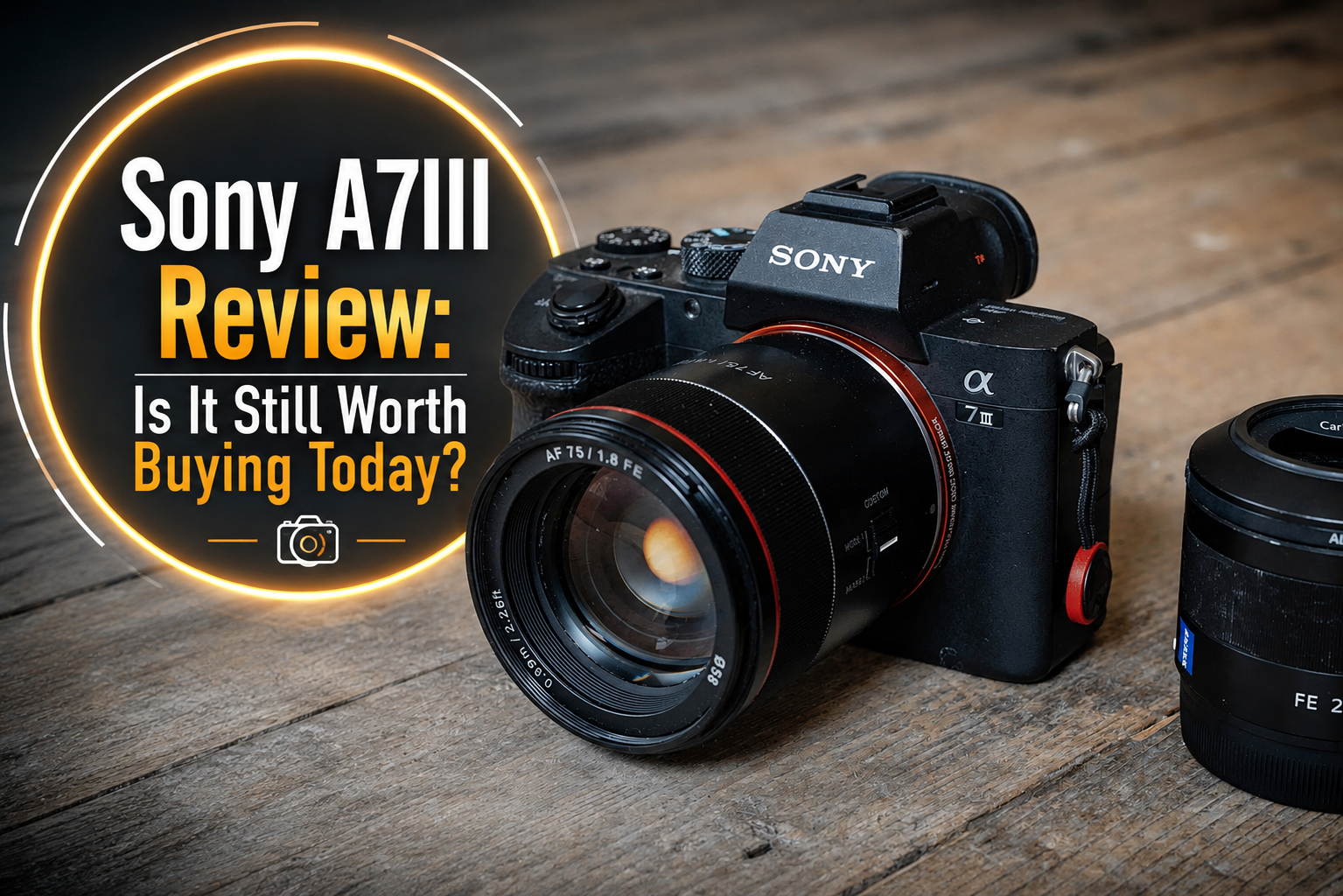
The Sony A7III has been around for several years, yet it continues to appear in conversations about full-frame cameras that offer strong value. That is not something every older camera manages to achieve. Camera technology moves quickly, particularly in autofocus, video, displays, processors, and subject recognition, but the A7III still has a combination of features that makes it relevant.
At its heart, the Sony A7III combines a 24.2-megapixel full-frame sensor, fast autofocus, 10fps continuous shooting, 5-axis image stabilization, strong battery life, dual card slots, and 4K video. Those specifications remain useful for everything from portraits and travel photography to events and everyday shooting.
But there is an important question for anyone considering it today: does an older camera still make sense when newer models offer more advanced technology?
The answer depends largely on what you photograph, how much you value modern autofocus and video features, and—perhaps most importantly—the price you can get the camera for.
BIO
| Label | Information |
|---|---|
| Model | Sony A7III |
| Type | Full-frame mirrorless camera |
| Brand | Sony |
| Sensor | 24.2MP full-frame CMOS |
| Mount | Sony E-mount |
| Processor | BIONZ X |
| Autofocus | 693 phase-detection points |
| Burst Speed | Up to 10 fps |
| Stabilization | 5-axis in-body stabilization |
| Video | 4K recording up to 30p |
| Battery | NP-FZ100 rechargeable battery |
| Card Slots | Dual SD memory card slots |
| Best For | Photography, travel, portraits, and video |
Sony A7III at a Glance
The Sony A7III is a full-frame mirrorless camera built around a 35mm Exmor R CMOS sensor with approximately 24.2 effective megapixels. It uses Sony’s E-mount system, giving photographers access to a very large selection of lenses.
The camera can shoot at up to 10 frames per second with autofocus and exposure tracking, making it capable of handling action as well as everyday photography. Its autofocus system uses 693 phase-detection points covering a large portion of the image area.
For video, it records UHD 4K at up to 30 frames per second and offers Full HD recording at higher frame rates for slow-motion work. It also includes features such as S-Log3 and HLG, which give video users more flexibility when processing footage.
On paper, those numbers may not sound revolutionary today. In practical use, however, the combination remains quite capable.
Design and Build Quality
The A7III follows the familiar compact full-frame mirrorless design that Sony has developed over several generations. It is relatively small for a full-frame camera, while still providing a substantial grip and a good collection of physical controls.
The body weighs approximately 650 grams with the battery and memory card installed. That makes it portable enough for travel without feeling like an ultra-light camera that sacrifices too much handling comfort.
The grip is particularly important when larger lenses are attached. With a compact prime lens, the camera can feel quite manageable. Pair it with a larger professional zoom, and the setup becomes considerably heavier, but the body still provides a secure foundation.
The controls also allow photographers to change important settings without constantly entering the menu. This becomes increasingly useful when photographing moving subjects or working in changing light.
One area where its age becomes more obvious is the user interface. Sony’s older menu system can feel less straightforward than the interfaces found on some newer mirrorless cameras.
That does not make the A7III difficult to use, but beginners may need some time to become comfortable with its menus and customization options.
Display and Viewfinder
The camera features a tilting rear LCD rather than the fully articulating screens found on many newer hybrid cameras.
For conventional photography, the tilting design is useful. It helps with low-angle compositions and can make certain shooting positions more comfortable.
For video creators, however, the lack of a fully articulating screen is a more noticeable limitation. If you regularly record yourself, shoot from unusual angles, or need the display to face forward, newer cameras offer a more convenient experience.
The electronic viewfinder remains perfectly usable for general photography, although newer models have pushed resolution, refresh performance, and overall viewing experience further.
This is one of those areas where the A7III shows its age without becoming unusable.
Image Quality
Image quality is one of the strongest reasons the Sony A7III remains interesting.
Its 24.2-megapixel full-frame sensor provides enough resolution for portraits, landscapes, travel photography, events, and many professional applications. You do not need an extremely high-resolution sensor to produce detailed photographs, particularly when the lens and technique are good.
The sensor also has strong dynamic-range performance. Independent testing found approximately 13.8 stops of dynamic range at base ISO, with particularly strong performance when recovering information from darker areas of RAW files.
That matters in everyday photography.
Imagine photographing a person near a bright window. The scene may contain both bright highlights and relatively dark shadows. A camera with good dynamic range gives you more flexibility when processing the RAW file and balancing those areas.
The A7III is also comfortable in difficult lighting conditions. Its full-frame sensor and BSI design help it perform well when the available light starts disappearing.
Low-Light Performance
Low-light photography is another area where the Sony A7III continues to make sense.
A full-frame sensor provides an advantage for many photographers working in dim environments, and the A7III’s sensor has a strong reputation for maintaining useful image quality at higher ISO settings.
This makes it suitable for evening street photography, indoor events, portraits in available light, and travel photography after sunset.
Of course, increasing ISO will eventually introduce noise. No camera completely avoids that. The advantage is that the A7III gives photographers a useful amount of flexibility before image quality becomes seriously compromised.
Its 5-axis in-body stabilization also helps when shooting handheld at slower shutter speeds. Sony rates the stabilization system at up to 5 stops of compensation under its specified testing conditions.
It is important to remember that stabilization primarily helps with camera movement. It cannot freeze a moving person or animal. For moving subjects in low light, shutter speed and lens aperture remain important.
Autofocus Performance
Autofocus was one of the A7III’s major strengths when it arrived, and it remains a capable system today.
The camera uses 693 phase-detection autofocus points covering approximately 93% of the frame, according to independent testing.
That broad coverage makes it easier to keep subjects under an active autofocus area without relying exclusively on the center of the frame.
Eye AF is also useful for portraits and people photography. When it works well, the camera can maintain focus on an important part of the subject instead of forcing the photographer to repeatedly move the focus point manually.
For everyday subjects, portraits, events, and moderate action, the autofocus remains dependable.
However, this is another area where newer cameras have moved ahead. Modern Sony models offer more advanced subject recognition and tracking capabilities. If your photography depends heavily on sophisticated animal, bird, vehicle, or human-subject recognition, a newer camera may provide a more refined experience.
For many photographers, though, the A7III’s autofocus is still more than adequate.
Continuous Shooting
The A7III can shoot at up to 10 frames per second with autofocus and autoexposure tracking.
That is a useful speed for photographing sports, children, pets, events, and other unpredictable subjects.
The value of 10fps is not simply the number itself. It gives you more opportunities to capture a particular moment—such as a person’s expression, a jump, or an athlete’s position.
A newer camera may provide better tracking intelligence, but the A7III does not feel like a slow camera.
For photographers upgrading from an entry-level DSLR or older mirrorless body, the difference can be substantial.
Video Performance
The Sony A7III is a hybrid camera, meaning it was designed to handle both still photography and video.
It records 4K video at up to 30p. Its 4K/24p mode is particularly notable because the footage is oversampled from a higher-resolution readout of the sensor, producing detailed video. The 4K/30p mode introduces a modest crop.
The camera also supports Full HD recording at up to 120fps, which can be used for slow-motion footage.
For more advanced video work, Sony included picture profiles such as S-Log3 and HLG. These give experienced users additional control over how footage is captured and graded.
The A7III also provides microphone and headphone connections, which is important for creators who need to monitor and improve their audio.
Still, video is probably the category where the camera’s age is most obvious.
Newer cameras offer higher frame rates, more advanced codecs, improved stabilization, better displays, and more sophisticated autofocus systems. If video is your main reason for buying a camera, it is worth comparing the A7III carefully with newer alternatives.
For someone who mainly photographs and occasionally records video, however, its 4K capabilities remain useful.
Battery Life
Battery life is one of the A7III’s underrated strengths.
Sony rates the camera at approximately 710 still images when using the LCD monitor and about 610 when using the electronic viewfinder under CIPA testing conditions.
Actual results vary depending on shooting style, autofocus usage, image review, temperature, and other settings.
Even so, the NP-FZ100 battery gives the camera considerably more endurance than many older mirrorless cameras.
For travel photographers, wedding shooters, event photographers, and people who spend long periods away from a charger, this can make a meaningful difference.
The camera also supports USB power, giving users additional flexibility during longer sessions.
Dual Card Slots
The A7III includes two memory card slots, which is a valuable feature for photographers who need additional security.
Sony specifies support for SD cards, with the first slot supporting UHS-I and UHS-II cards while the second supports UHS-I. The camera can also record to both cards depending on the selected recording configuration.
For casual photography, this may not seem important.
For paid events, weddings, or once-in-a-lifetime occasions, having two cards can provide a useful backup option. Memory cards can fail, so redundancy can be reassuring when the photographs cannot easily be recreated.
This feature also makes the A7III feel more serious than its age might suggest.
Lens Selection
One of the biggest advantages of choosing the Sony A7III is not necessarily the camera body itself. It is the E-mount lens ecosystem.
There are Sony lenses covering everything from affordable primes to professional telephoto zooms. Third-party manufacturers have also produced a broad range of E-mount options.
This gives photographers room to build a system gradually.
A beginner might start with a reasonably priced standard zoom or prime. Later, they can add a portrait lens, wide-angle lens, macro lens, or telephoto depending on their interests.
The important point is that the A7III does not lock you into a narrow selection of lenses. The system can grow with your photography.
Sony A7III for Portrait Photography
The A7III remains a strong portrait camera.
The full-frame sensor allows photographers to create shallow depth-of-field effects when paired with an appropriate lens and aperture. Eye AF can also make it easier to maintain focus on the subject.
A good portrait lens can have a larger impact on the final photograph than moving from the A7III to a much newer body.
For photographers primarily interested in portraits, the A7III can therefore be a sensible investment if the body is available at a good price.
Sony A7III for Travel
Travel photography often demands a balance between image quality, portability, battery life, and reliability.
The A7III performs well across these areas.
Its full-frame sensor provides strong image quality, the body is relatively compact, battery life is good, and the stabilization system can help with handheld shooting.
The main challenge is the lens.
A large full-frame zoom can turn a relatively portable camera into a heavy travel setup. Choosing a compact lens can make the overall system much easier to carry.
For travelers who value image quality but do not want a very large DSLR-style body, the A7III remains appealing.
Sony A7III for Sports and Wildlife
The camera’s 10fps burst rate and broad autofocus coverage make it capable of handling action photography.
However, sports and wildlife photographers should look beyond the camera body.
The lens is extremely important. A fast telephoto lens can cost significantly more than the camera itself, and autofocus performance depends partly on the subject, lens, light, and shooting conditions.
The A7III can certainly handle action, but photographers who regularly shoot fast-moving wildlife may appreciate the more advanced subject-recognition systems available in newer cameras.
For occasional action photography, there is much less reason to consider the A7III outdated.
Sony A7III for Beginners
The A7III can be an excellent learning platform, although it is not necessarily the simplest camera for someone who has never used an interchangeable-lens camera.
There are many controls and settings to understand, and Sony’s menu system takes some time to learn.
That complexity can actually become useful as a photographer develops.
A beginner can start with automatic or semi-automatic modes and gradually learn about shutter speed, aperture, ISO, autofocus modes, RAW files, and exposure compensation.
Because the camera offers serious photographic capabilities, users do not necessarily need to replace it quickly as their skills improve.
Where the A7III Shows Its Age
No honest review should ignore the weaknesses.
The biggest issue is that newer cameras have improved significantly in areas such as subject recognition, autofocus intelligence, displays, menus, video specifications, and connectivity.
The rear screen is not fully articulating, which can matter to video creators.
The camera also does not offer some of the advanced video features found on newer models.
Its autofocus is still good, but newer systems can be more intelligent when recognizing and tracking specific subjects.
The menus can also feel dated compared with Sony’s latest interface designs.
None of these limitations make the A7III a bad camera. They simply mean buyers should understand what they are giving up when choosing an older model.
What Still Makes It Special
The A7III’s strongest argument today is balance.
It does not try to win every specification category. Instead, it combines many important features into one relatively compact camera.
You get a full-frame sensor, strong RAW performance, good autofocus, 10fps shooting, image stabilization, dual card slots, long battery life, and 4K video.
That combination is still useful.
A camera does not suddenly stop producing good photographs because a newer model has been released. The fundamentals of exposure, light, composition, lenses, and timing still matter enormously.
For many photographers, spending the difference between an A7III and a much newer camera on a better lens could produce a more noticeable improvement in their work.
Is the Sony A7III Still Worth Buying?
The answer is yes, but the price matters.
If you can find a Sony A7III at an attractive price and your priorities are photography, dependable autofocus, full-frame image quality, strong battery life, and a mature lens ecosystem, it remains a very capable choice.
It is particularly appealing to photographers who do not need the newest subject-recognition technology or cutting-edge video specifications.
On the other hand, someone buying primarily for advanced video or the latest autofocus capabilities should seriously consider newer options.
The A7III is therefore not automatically the best camera for everyone. It is better described as a well-rounded full-frame camera that has aged remarkably well.
Buying a Used Sony A7III
Because the camera has been on the market for years, the used market deserves particular attention.
A used A7III can represent excellent value, but condition matters.
Before buying, check the sensor for damage or excessive dust, inspect the screen and electronic viewfinder, test the buttons and dials, verify both memory card slots, and check the camera’s ports.
The shutter count can also provide useful information about how heavily a camera has been used, although shutter count should not be treated as the only measure of condition.
Pay attention to the overall physical condition.
A camera with some cosmetic marks may still work perfectly, while a seemingly clean camera could have hidden problems. If possible, test autofocus, image stabilization, card writing, battery performance, and video recording before committing to a used body.
Final Verdict
The Sony A7III remains a capable full-frame camera, even though it is no longer a new model.
Its 24.2MP sensor delivers excellent image quality, its autofocus system remains useful, and its 10fps continuous shooting makes it flexible enough for more than simple everyday photography. Its battery life, stabilization, dual card slots, and E-mount lens compatibility further strengthen the package.
Its limitations are mostly connected to the passage of time.
Newer cameras offer better subject recognition, more sophisticated autofocus, improved screens, stronger video specifications, and more modern interfaces. Those improvements are real and worth paying for if they directly affect the kind of work you do.
But if your main goal is taking high-quality photographs, the A7III still has the fundamentals that matter.
So, is the Sony A7III still worth buying today?
For the right photographer and at the right price, absolutely. It may no longer be the newest camera in Sony’s lineup, but its combination of image quality, performance, reliability, and lens options means it has not become irrelevant.
Sometimes the best value is not the camera with the newest specification sheet. It is the camera that gives you the tools you actually need without making you pay for features you will rarely use.
Frequently Asked Questions
Is the Sony A7III still good in 2026?
Yes. Its full-frame sensor, 10fps continuous shooting, capable autofocus, stabilization, long battery life, and 4K recording remain useful. Newer cameras are more advanced, but the A7III is still capable of producing high-quality photographs.
Is the Sony A7III good for beginners?
Yes, although beginners may need some time to learn Sony’s controls and menu system. It offers enough manual control and customization to remain useful as a photographer’s skills develop.
Is the Sony A7III good for photography?
Yes. Photography remains one of its strongest areas. The 24.2MP full-frame sensor provides strong detail and dynamic range, while the autofocus and burst shooting make it suitable for a wide range of subjects.
Can the Sony A7III shoot 4K video?
Yes. The camera records UHD 4K video at up to 30p and supports additional video features including S-Log3 and HLG. Its 4K/24p mode is particularly detailed because of its oversampled sensor readout.
Is the Sony A7III worth buying used?
It can be. A well-maintained used A7III can offer a strong combination of full-frame image quality and performance. Condition, shutter count, battery health, card slots, sensor condition, and the overall asking price should all be considered.
How long can a Sony A7III last?
There is no fixed lifespan for every camera. How long an A7III lasts depends on usage, maintenance, storage, and individual component condition. A carefully maintained camera can remain useful for many years.