




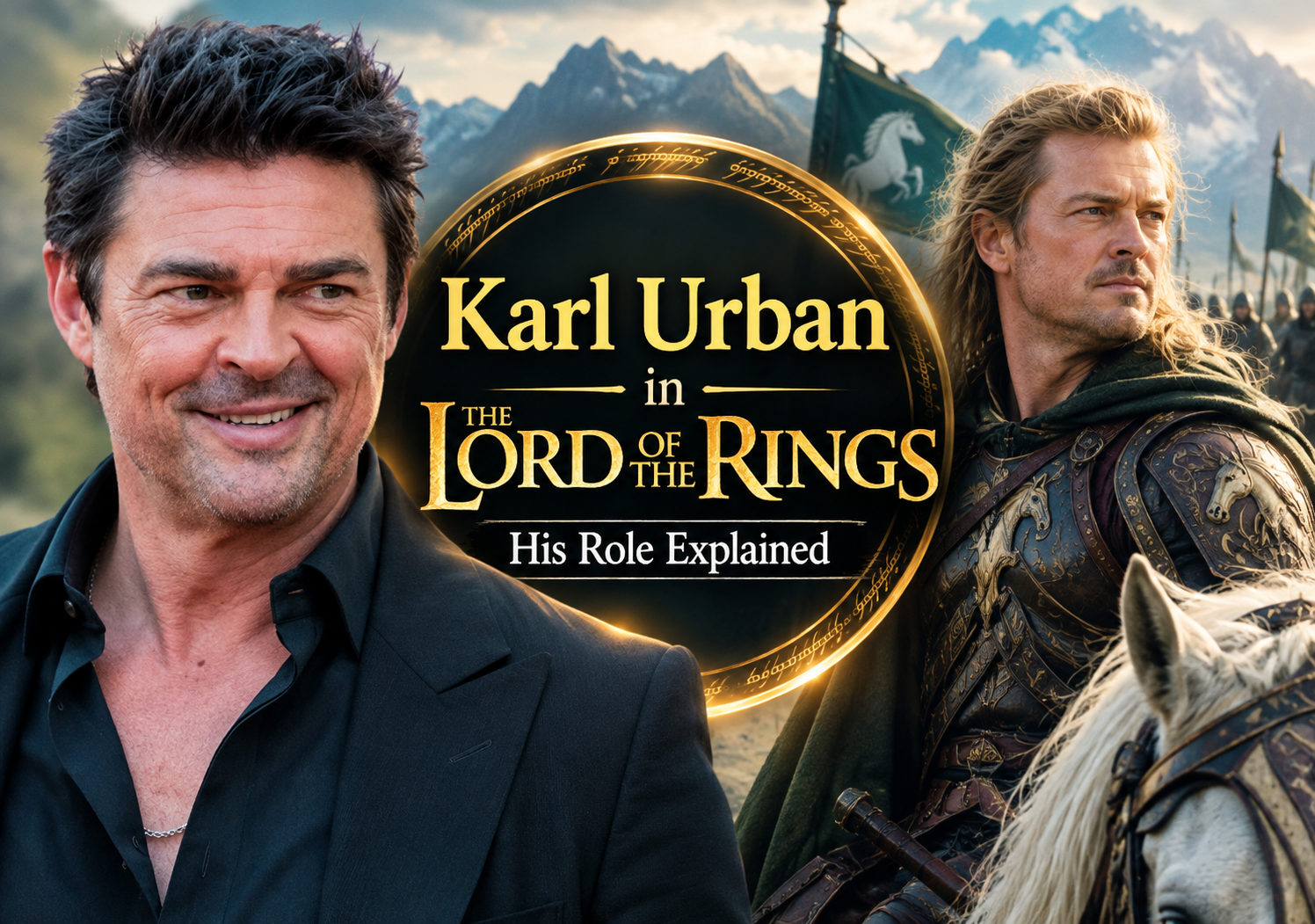
Karl Urban Lord of the Rings is a search that often leads fans to one memorable character: Éomer, the skilled warrior and future King of Rohan. Played by New Zealand actor Karl Urban, Éomer became an important part of Peter Jackson’s film trilogy, especially during the events surrounding the kingdom of Rohan.
Urban’s performance helped give Éomer a strong presence despite the character having less screen time than central figures such as Aragorn, Frodo, Gandalf, or Legolas. His character represents the strength, loyalty, and fighting spirit of Rohan during one of Middle-earth’s darkest periods.
From his first appearance in The Two Towers to his major moments in The Return of the King, Éomer develops from an exiled rider into one of Rohan’s most important leaders. Here is a closer look at Karl Urban’s role, his character, and his place in the wider Lord of the Rings story.
BIO
| Label | Information |
|---|---|
| Actor | Karl Urban |
| Character | Éomer |
| Franchise | The Lord of the Rings |
| First Appearance | The Two Towers |
| Final Appearance | The Return of the King |
| Kingdom | Rohan |
| Character Type | Warrior and Rider |
| Family | Brother of Éowyn |
| Uncle | King Théoden |
| Major Battle | Pelennor Fields |
| Character Arc | Warrior to King |
| Director | Peter Jackson |
Who Is Karl Urban?
Karl Urban is a New Zealand actor who built his career across film and television before becoming internationally recognized through major Hollywood productions.
Before The Lord of the Rings, Urban had already worked extensively in New Zealand television and film. His experience in dramatic and action-oriented roles made him a natural fit for the world of Middle-earth.
His portrayal of Éomer became one of the early international highlights of his career. The role also introduced him to a worldwide audience at a time when Peter Jackson’s trilogy was becoming one of the most widely recognized film productions of its generation.
Urban later appeared in projects such as The Bourne Supremacy, Star Trek, Dredd, and The Boys. His career eventually moved across science fiction, action, drama, television, and blockbuster filmmaking.
However, for many fantasy fans, Éomer remains one of the roles that helped establish his screen identity.
Karl Urban’s Role in The Lord of the Rings
Karl Urban played Éomer, a member of the royal family of Rohan and an important warrior in the kingdom.
Éomer is the son of Éomund and Théodwyn. He is also the nephew of King Théoden and the brother of Éowyn. This family connection gives him a direct relationship with the leadership of Rohan.
At the beginning of The Two Towers, Rohan is facing a serious political and military crisis. King Théoden has fallen under the influence of Saruman’s forces through the manipulation of Gríma Wormtongue.
Éomer remains loyal to his homeland, but his loyalty puts him into conflict with the king’s court.
Eventually, Éomer and his followers are removed from Rohan. Rather than abandoning his people, he continues fighting enemies threatening the kingdom.
His first major meeting with Aragorn, Legolas, and Gimli is an important introduction to the character. Éomer initially treats the three travelers with suspicion, but the encounter establishes his identity as a proud and determined warrior.
Éomer Explained
Éomer is one of the leading warriors of Rohan, a kingdom famous for its horsemen.
His personality is direct and confident. He is not someone who easily trusts strangers, especially when his homeland is surrounded by enemies and political deception.
At the same time, his actions demonstrate that his loyalty is not simply to a particular ruler. His deeper commitment is to Rohan and its people.
This becomes especially important because Théoden is temporarily unable to lead effectively. Éomer understands that something is wrong within the kingdom and refuses to simply accept the situation.
His relationship with Éowyn also adds another dimension to his character. Both characters are members of Rohan’s royal family, but they face different expectations and responsibilities.
Éomer is allowed to embrace the warrior role expected of him, while Éowyn struggles against the restrictions placed on her.
Karl Urban in The Two Towers
Éomer becomes an important supporting character in The Two Towers, the second film in Peter Jackson’s trilogy.
His introduction comes during a period when Rohan is under increasing pressure from Saruman’s forces. Éomer leads a group of Riders who are committed to defending their homeland.
When Aragorn, Legolas, and Gimli encounter Éomer, the scene immediately establishes his personality. He is suspicious of the travelers and prepared to defend himself if necessary.
The meeting also reveals what has happened to Éomer. He explains that he and his riders have been banished from Rohan despite their loyalty to the kingdom.
This moment helps the audience understand the political situation surrounding Théoden.
Éomer is not simply another warrior waiting for orders. He recognizes the danger facing Rohan and acts according to what he believes will protect his people.
Éomer and the Battle for Rohan
One of Éomer’s most important contributions to the story comes during the defense of Rohan.
As Saruman’s army advances, the people of Rohan are forced to seek protection. The kingdom eventually prepares for a major confrontation at Helm’s Deep.
Although Éomer is not present for every stage of the defense in the theatrical version, his earlier actions establish him as one of Rohan’s important military figures.
His return later in the battle becomes one of the memorable moments associated with the defense of Helm’s Deep.
Karl Urban’s physical performance contributes significantly to these scenes. Éomer looks and moves like a warrior who belongs naturally among the Riders of Rohan.
The character’s armor, horse, sword, and riding style all reinforce the culture of the kingdom.
Karl Urban in The Return of the King
Éomer has a larger military role in The Return of the King.
By this point, the war has expanded far beyond the immediate threat to Rohan. Gondor is under attack, and the forces opposing Sauron must work together if Middle-earth is to survive.
Éomer and the Riders of Rohan answer the call for aid.
The character becomes particularly important during the Battle of the Pelennor Fields, one of the largest and most dramatic battles in the trilogy.
Éomer arrives with the forces of Rohan and takes part in the battle alongside Théoden and the other riders.
The battle also becomes deeply personal for him because of what happens to members of his family.
His reaction to Éowyn’s condition is one of the film’s more emotional moments. The confident warrior seen earlier in the trilogy is suddenly faced with the possibility of losing someone close to him.
Urban brings a noticeable change in tone to these scenes, allowing Éomer’s personal grief to sit alongside his responsibilities as a warrior and leader.
Éomer at the Battle of the Pelennor Fields
The Battle of the Pelennor Fields is central to Éomer’s story.
Rohan arrives at a crucial moment to support Gondor against Sauron’s armies. The Riders charge into the battle, creating one of the trilogy’s most recognizable large-scale action sequences.
Éomer is at the center of this military effort.
His role is not simply about fighting. He represents Rohan’s commitment to its allies and demonstrates how the kingdom becomes part of the larger struggle against Sauron.
One of the most significant moments comes after Théoden falls.
With the king gone and the battle still raging, Éomer must deal with personal loss while continuing to lead.
His response demonstrates the qualities that have defined him throughout the story: courage, loyalty, determination, and responsibility.
Karl Urban’s Performance as Éomer
Karl Urban’s portrayal of Éomer works largely because he does not make the character feel like a one-dimensional warrior.
Éomer is tough, but he is also protective of his family and deeply connected to his homeland.
Urban gives the character a serious and grounded presence. His performance fits naturally into the visual world created by Peter Jackson and the production team.
The actor’s physicality is also important. Éomer is supposed to be an experienced Rider of Rohan, so the role requires confidence on horseback and an imposing presence during battle scenes.
Urban’s performance communicates much of the character through his expressions and body language, particularly during scenes where Éomer has little dialogue.
His portrayal also benefits from the contrast between Éomer and Aragorn. Both are capable warriors and leaders, but they approach their responsibilities differently.
Aragorn is often portrayed as reluctant to accept his destiny, while Éomer is more immediately connected to the traditions and military culture of Rohan.
Karl Urban and the Cast
Éomer shares important scenes with several major characters in the trilogy.
His relationship with Éowyn, played by Miranda Otto, is especially important. Their connection gives the story a family dimension and helps show what is at stake for Rohan beyond the battlefield.
Urban also shares memorable scenes with Viggo Mortensen, who plays Aragorn.
The relationship between Éomer and Aragorn develops from suspicion to mutual respect. Their different backgrounds initially create tension, but the larger war eventually brings them together.
Éomer also interacts with Legolas and Gimli. His first meeting with the pair provides one of the lighter moments in an otherwise serious part of the story.
These relationships help prevent Éomer from becoming merely another background warrior.
Karl Urban and Peter Jackson’s Trilogy
Peter Jackson’s Lord of the Rings trilogy placed enormous attention on the cultures and kingdoms of Middle-earth.
Rohan received a particularly distinctive visual identity.
The kingdom is closely associated with horses, open landscapes, wooden architecture, traditional warrior culture, and a strong sense of loyalty. Éomer fits naturally into this environment.
Karl Urban’s performance helps reinforce that identity.
His costume and armor make him visually recognizable, while his riding and combat scenes emphasize his position among Rohan’s elite warriors.
The trilogy also benefited from New Zealand locations and large-scale practical filmmaking. The result gave characters such as Éomer a physical world that felt connected to the history of Middle-earth.
What Happened to Éomer?
Éomer survives the events of the War of the Ring.
After the death of King Théoden, Éomer eventually becomes King of Rohan.
This is an important part of his character arc. He begins the story as a warrior dealing with exile and political uncertainty, but he eventually becomes the ruler of his people.
His rise to the throne reflects the qualities that have been visible throughout the trilogy.
He has demonstrated loyalty to Rohan, courage during battle, and a willingness to protect his people during times of crisis.
His story therefore extends beyond the major battles. Éomer represents the continuation of Rohan after the war.
The kingdom loses many important people during the conflict, but Éomer remains to lead it into a new period.
Karl Urban After The Lord of the Rings
The success of The Lord of the Rings helped introduce Karl Urban to a much wider international audience.
After the trilogy, his career continued to expand across different genres.
He appeared in The Bourne Supremacy and later became part of the Star Trek film series, where he played Dr. Leonard “Bones” McCoy.
He also took the lead role in Dredd, a science-fiction action film that developed a strong following.
Urban later gained another major television role as Billy Butcher in The Boys. That series introduced him to a new generation of viewers and demonstrated his ability to handle a very different kind of character.
Despite these later successes, his role as Éomer remains an important part of his early international film career.
Why Fans Remember Karl Urban as Éomer
Éomer is not the central hero of The Lord of the Rings, but his character has remained memorable.
Part of that comes from the strength of Rohan as a fictional culture. The Riders of Rohan are among the most recognizable groups in the trilogy, and Éomer is one of their most prominent representatives.
Another reason is the character’s progression.
He begins as a warrior who has been pushed away from his kingdom. He later returns to help defend Rohan and ultimately becomes its king.
That gives Éomer a complete character journey even though the trilogy focuses on many other characters.
Karl Urban’s performance also helped make the role distinctive. His serious expression, physical presence, and confident portrayal fit the character without making him overshadow the central heroes.
Karl Urban Lord of the Rings: Key Facts
Actor: Karl Urban
Character: Éomer
Kingdom: Rohan
Character’s Family: Nephew of Théoden and brother of Éowyn
First Film Appearance: The Lord of the Rings: The Two Towers
Final Film Appearance: The Lord of the Rings: The Return of the King
Director: Peter Jackson
Based On: J.R.R. Tolkien’s Middle-earth novels
Character Role: Warrior and Rider of Rohan
Later Status: King of Rohan
Major Battle: Battle of the Pelennor Fields
Played By: Karl Urban
Frequently Asked Questions
Who did Karl Urban play in The Lord of the Rings?
Karl Urban played Éomer, a warrior of Rohan and a member of King Théoden’s family. Éomer becomes an important military leader during the War of the Ring.
Was Karl Urban in all three Lord of the Rings movies?
No. Karl Urban does not appear as Éomer in The Fellowship of the Ring. He appears in The Two Towers and The Return of the King.
What happened to Éomer?
Éomer survives the War of the Ring and eventually becomes King of Rohan after Théoden’s death.
Is Éomer related to Éowyn?
Yes. Éomer and Éowyn are siblings. They are both members of Rohan’s royal family and are closely connected to King Théoden.
Why is Éomer important to the story?
Éomer represents Rohan’s military strength and loyalty during the War of the Ring. His journey from an exiled warrior to the future king gives the character an important role in the story of Rohan.
Conclusion
Karl Urban’s role in The Lord of the Rings may not have been as large as those of the trilogy’s central heroes, but Éomer became one of the memorable warriors of Middle-earth.
His character is closely connected to the story of Rohan, from the kingdom’s political troubles in The Two Towers to the massive battles of The Return of the King.
Urban brought a strong physical presence and a grounded performance to the role. He portrayed Éomer as a proud warrior, loyal family member, and determined leader rather than simply another soldier in the background.
The character’s journey ultimately leads to the throne of Rohan, giving Éomer a satisfying place in the larger history of Middle-earth.
For Karl Urban, the role was also an important step in a career that would later include major film franchises and successful television projects. Years after the trilogy, Éomer remains one of the roles that many fans immediately associate with the actor.
That lasting connection explains why Karl Urban Lord of the Rings continues to attract interest from viewers discovering the trilogy, revisiting Rohan’s story, or simply looking back at one of Urban’s earliest major international roles.