




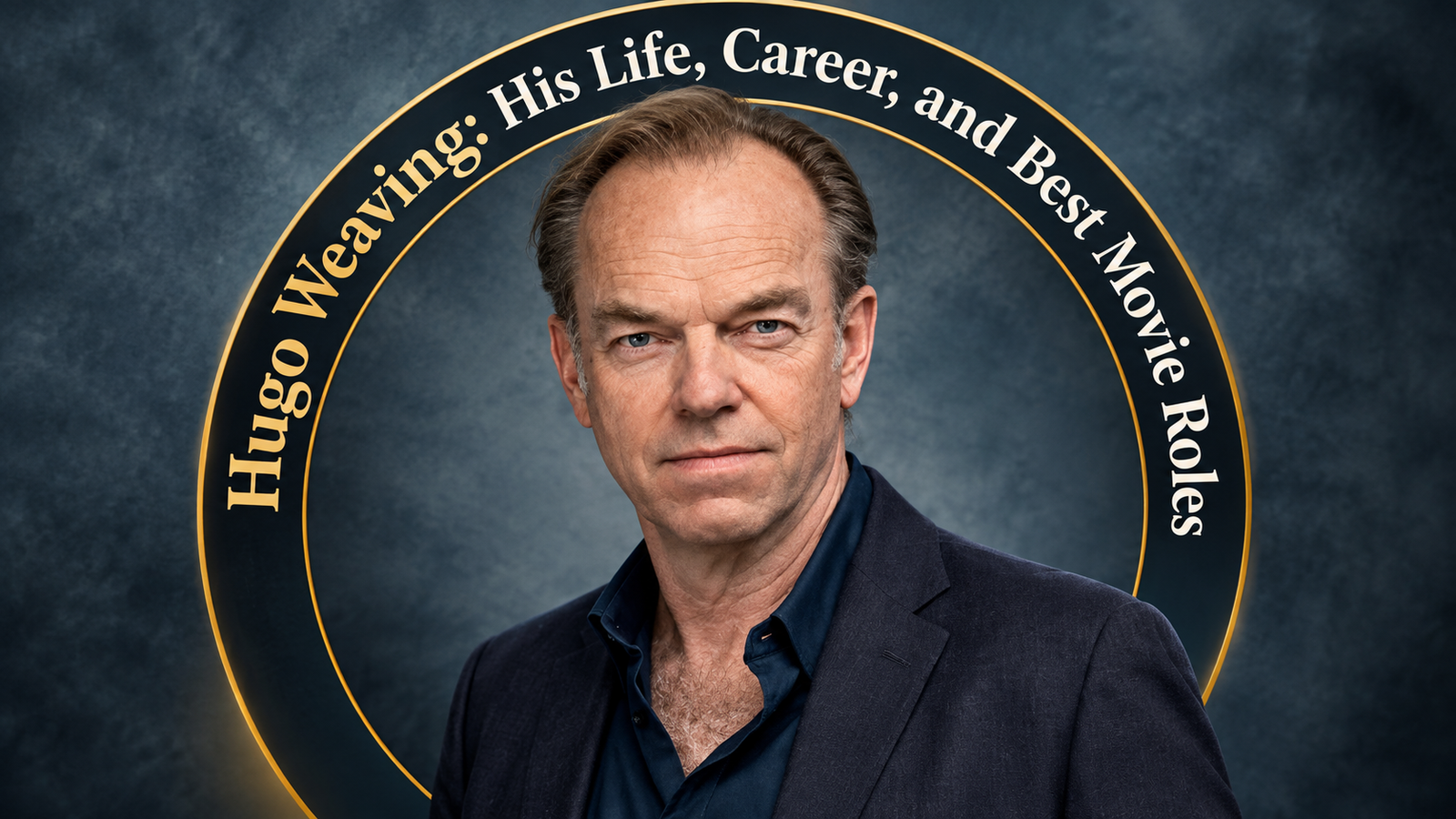
Hugo Weaving is one of the most recognizable actors to emerge from Australian cinema and build a major international career. Known for his controlled performances, distinctive voice, and ability to move between very different genres, Weaving has played everything from complex dramatic characters to unforgettable science-fiction villains and fantasy heroes.
For many moviegoers, he is best known as Agent Smith in The Matrix, Elrond in The Lord of the Rings, and V in V for Vendetta. Yet those famous roles represent only part of his career. Long before becoming an international star, Weaving established himself through Australian film, television, and theater.
His career also includes acclaimed performances in films such as Proof, The Adventures of Priscilla, Queen of the Desert, The Interview, and Cloud Atlas. More recently, his work has continued to include Australian productions and character-driven dramas.
BIO
| Label | Information |
|---|---|
| Full Name | Hugo Wallace Weaving |
| Profession | Actor |
| Nationality | Australian |
| Birth Date | April 4, 1960 |
| Birthplace | Ibadan, Nigeria |
| Known For | Film, television, and theater |
| Breakthrough Film | Proof |
| Famous Role | Agent Smith in The Matrix |
| Fantasy Role | Elrond in The Lord of the Rings |
| Other Major Role | V in V for Vendetta |
| Marvel Role | Red Skull in Captain America: The First Avenger |
| Recent Film | The Rooster |
| Acting Range | Drama, action, fantasy, comedy, and science fiction |
Who Is Hugo Weaving?
Hugo Wallace Weaving is an Australian actor whose career has covered several decades. Although international audiences often associate him with major Hollywood productions, much of his professional foundation was built in Australia.
Weaving developed a reputation for taking on challenging characters rather than limiting himself to one particular type of role. His filmography includes science fiction, fantasy, comedy, drama, action, historical stories, and animation.
That range is one of the most interesting parts of his career. The calm authority he brought to Elrond is very different from the intimidating presence of Agent Smith, while his performance in The Adventures of Priscilla, Queen of the Desert showed a much lighter and more comedic side.
His work has also been recognized by Australian film and television organizations. Screen Australia records major acting honors for performances including Proof, The Interview, The Turning, and The Rooster.
Early Life and Acting Journey
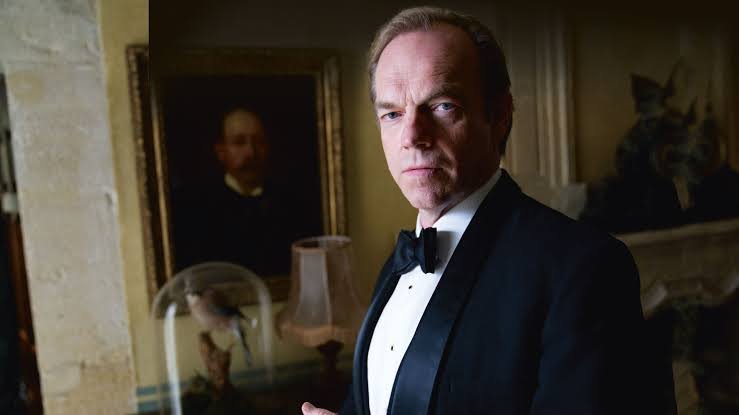
Before becoming internationally famous, Weaving spent years developing his craft through Australian productions.
His early screen work included television and film appearances, giving him experience across different formats. One notable early credit was the Australian television miniseries Bodyline, completed in 1984. Screen Australia lists Weaving among the cast and records a Television Society of Australia Certificate of Commendation for him in connection with the production.
This early period was important because it allowed Weaving to establish himself as a serious performer before Hollywood became a major part of his career.
Rather than arriving on the international scene overnight, he built his reputation gradually. Australian cinema and television gave him opportunities to work with different directors, performers, and genres.
That foundation would become particularly valuable when he later moved into productions with much larger international audiences.
The Breakthrough Years
One of the important films in Weaving’s early career was Proof, directed by Jocelyn Moorhouse. The film gave him an opportunity to play a more intimate and dramatically demanding character.
Screen Australia records that Weaving received the Australian Film Institute Hoyts Group Award for Best Actor for Proof, as well as a Film Critics’ Circle of Australia Best Male Actor award. The film itself also received substantial recognition at international festivals.
Another significant Australian production was The Interview, where Weaving played Eddie Rodney Fleming. The performance earned him the Best Actor award at the Montreal World Film Festival and the Australian Film Institute award for Best Performance by an Actor in a Leading Role.
These performances demonstrated that Weaving’s career was not built only on large-scale franchises. He had already established himself as a respected dramatic actor before some of his most famous international roles arrived.
The Matrix
For a worldwide audience, The Matrix became a defining moment in Hugo Weaving’s career.
Released in 1999, the film introduced audiences to a futuristic world in which reality is revealed to be radically different from what people believe. Weaving played Agent Smith, a powerful program within the Matrix who becomes one of Neo’s principal enemies.
The British Film Institute describes Agent Smith as a black-suited program working for the machines and identifies Weaving as the actor behind the character. The film became notable for its innovative action sequences, visual effects, and philosophical ideas about technology and reality.
Weaving’s performance helped make Agent Smith memorable because the character was not simply a conventional action villain. His controlled delivery, formal manner, and distinctive presence gave Smith an identity of his own.
Weaving returned for The Matrix Reloaded and The Matrix Revolutions, expanding the character’s importance within the trilogy.
The role also demonstrated one of his greatest strengths: he could create tension without relying on exaggerated performances. Agent Smith often appears controlled and precise, which makes his confrontations with Neo particularly memorable.
Elrond in The Lord of the Rings
Another defining chapter in Hugo Weaving’s career came when he joined Peter Jackson’s The Lord of the Rings trilogy.
Weaving played Elrond, the influential Elf lord of Rivendell. The character is connected to some of the most important events in the story and acts as an important link between the ancient history of Middle-earth and the events surrounding Frodo’s journey.
Weaving appeared in The Fellowship of the Ring, The Two Towers, and The Return of the King.
Elrond required a very different approach from Agent Smith. Instead of creating a threatening technological figure, Weaving portrayed a character with age, authority, history, and emotional restraint.
His performance helped establish Rivendell as a place of wisdom and importance within the trilogy. The role also allowed him to work within a large ensemble featuring actors such as Ian McKellen, Viggo Mortensen, Cate Blanchett, Orlando Bloom, and Elijah Wood.
The Hobbit
Weaving later returned to Middle-earth as Elrond for The Hobbit trilogy.
His appearance in The Hobbit: An Unexpected Journey connected the later trilogy with the world established in The Lord of the Rings. He also appeared in The Desolation of Smaug and The Battle of the Five Armies.
Returning as the same character gave audiences another opportunity to see Weaving’s interpretation of Elrond.
Although the character is not the central figure of The Hobbit, Elrond’s presence helps expand the story’s connection to the larger history of Middle-earth.
V for Vendetta
Another memorable performance came with V for Vendetta, released in 2006.
Weaving played V, a masked figure living in a dystopian version of Britain. One unusual challenge of the role was that the character’s face remains hidden behind a Guy Fawkes mask for most of the film.
That meant Weaving had to communicate much of the character through his voice, movement, timing, and physical performance.
The British Film Institute identifies Weaving as V and describes the film as an adaptation involving a totalitarian future London, with V positioned as a figure of resistance against the government.
The role is particularly interesting because it demonstrates how an actor can remain central to a performance even when his face is largely absent from the screen.
Weaving’s voice became an important part of V’s identity, giving the character a distinctive rhythm and presence.
Priscilla, Queen of the Desert
Before The Matrix and The Lord of the Rings, Weaving had already shown his ability to handle comedy and dramatic material in The Adventures of Priscilla, Queen of the Desert.
Released in 1994, the film follows three performers traveling across the Australian Outback. Weaving played Anthony “Tick” Belrose, also known by his stage name Mitzi Del Bra.
The film starred Weaving alongside Terence Stamp and Guy Pearce and became an important Australian production with international recognition. Screen Australia lists the film’s extensive festival history and numerous awards, including Academy and BAFTA recognition for its costume work.
The film also gave Weaving a chance to show a warmer and more humorous side of his acting.
His performance is an important reminder that his career has never been limited to serious villains or imposing dramatic figures.
Captain America: The First Avenger
Weaving entered the Marvel universe with Captain America: The First Avenger, where he played Johann Schmidt, also known as the Red Skull.
The role placed him in another large-scale franchise and once again used his ability to create a strong screen presence.
Red Skull is very different from Agent Smith, but both characters benefit from Weaving’s controlled delivery and ability to create an imposing atmosphere.
His participation in the film also added another major international franchise to an already impressive filmography.
Cloud Atlas
In Cloud Atlas, Weaving took on several different characters.
The film uses an unusual narrative structure in which multiple stories and time periods are connected. Several members of the cast portray different characters throughout the movie.
For an actor, that format provides a very different challenge from playing one consistent role across a traditional narrative.
Weaving’s involvement further demonstrated his willingness to work on ambitious projects that experiment with structure, character, and storytelling.
Other Notable Performances
Hugo Weaving’s filmography contains many performances that are worth exploring beyond his most famous franchises.
His work in Proof remains an important part of his Australian career, particularly because of the recognition he received for the performance.
His role in The Interview further established his reputation as a leading dramatic performer.
He also appeared in Happy Feet, lending his voice to the animated film. Screen Australia lists Weaving among the film’s voice cast alongside Elijah Wood, Robin Williams, Brittany Murphy, Hugh Jackman, and Nicole Kidman. The film later won the Academy Award for Best Animated Feature.
Another notable project was The Turning, an Australian anthology film based on stories by Tim Winton. Screen Australia records a Film Critics Circle of Australia award for Weaving for Best Actor in a Supporting Role.
More recently, he appeared in The Rooster, a 2023 Australian drama and mystery film. Screen Australia records that Weaving received the AACTA Award for Best Supporting Actor in Film for his performance.
15 Best Hugo Weaving Movies to Watch
There is no single official ranking of Weaving’s best films, but the following selection covers the major stages of his career and gives viewers a useful starting point.
1. The Matrix
This is arguably the role most closely associated with Weaving’s international screen career. Agent Smith became one of modern science fiction’s recognizable antagonists.
2. The Lord of the Rings: The Fellowship of the Ring
Weaving’s first major appearance as Elrond introduced audiences to his interpretation of one of Middle-earth’s important leaders.
3. The Lord of the Rings: The Two Towers
The second installment continued Elrond’s story while expanding the larger world around him.
4. The Lord of the Rings: The Return of the King
The trilogy’s conclusion gave Weaving another opportunity to portray Elrond within the final stages of the story.
5. V for Vendetta
A distinctive performance because Weaving’s face remains hidden for much of the film. His voice and physical presence become central to the character.
6. The Adventures of Priscilla, Queen of the Desert
A standout Australian film that shows Weaving’s ability to combine comedy, emotion, and character work.
7. The Interview
An important dramatic performance that earned Weaving major acting recognition in Australia and at the Montreal World Film Festival.
8. Proof
One of his important early dramatic performances and a film closely associated with his rise as a respected Australian actor.
9. The Hobbit: An Unexpected Journey
A return to Middle-earth in which Weaving once again played Elrond.
10. The Hobbit: The Desolation of Smaug
The second Hobbit film continued his appearance as the Elf lord.
11. The Hobbit: The Battle of the Five Armies
The final Hobbit film brought Weaving back for another Middle-earth performance.
12. Captain America: The First Avenger
Weaving’s portrayal of Red Skull added a Marvel villain to his collection of major franchise characters.
13. Cloud Atlas
A challenging ensemble film that allowed Weaving to portray multiple characters.
14. The Turning
An Australian anthology film that featured Weaving in a supporting role recognized by the Film Critics Circle of Australia.
15. The Rooster
A more recent Australian production that earned Weaving the AACTA Award for Best Supporting Actor in Film.
His Acting Style
One of Hugo Weaving’s most recognizable qualities is his controlled screen presence.
He often avoids overly expressive performances. Instead, he can create a character through posture, voice, timing, and subtle changes in expression.
This approach works particularly well for characters who possess authority or mystery.
Agent Smith is a good example. The character rarely needs to shout to dominate a scene. His measured speech and rigid behavior make him feel different from the other characters around him.
Elrond requires another kind of restraint. The character carries the weight of centuries of history, and Weaving’s performance reflects that through a formal and deliberate style.
V represents another variation. Because his face is hidden, the voice becomes one of the primary tools of characterization.
These performances show why Weaving has been able to move successfully between very different genres.
Work Beyond Film
Although international audiences often associate Weaving with blockbuster movies, his career extends beyond major theatrical releases.
He has worked in television, theater, animation, documentary narration, and Australian independent productions.
Screen Australia records his involvement in projects such as Frontier, a historical documentary series in which he served as one of the readers, as well as After the Deluge and Seven Types of Ambiguity.
His work outside Hollywood is important when looking at his career as a whole. It shows that his success has not depended solely on major franchises.
Instead, he has repeatedly returned to Australian productions and character-focused projects.
Awards and Recognition
Hugo Weaving has received recognition from several Australian and international organizations throughout his career.
His performance in Proof received major Australian acting honors, while The Interview brought him Best Actor recognition at the Montreal World Film Festival and another major Australian acting award.
His later work continued to receive attention. Screen Australia records an AACTA Best Supporting Actor award for The Rooster, demonstrating that his career has continued to earn recognition well beyond his blockbuster years.
His television work has also been recognized. For Seven Types of Ambiguity, Screen Australia records an AACTA award for Best Lead Actor in a Television Drama and a TV Week Logie Award for Most Outstanding Actor.
These achievements help put his career into perspective. His reputation rests not only on popular characters but also on performances that received critical and industry recognition.
Personal Life and Privacy
Weaving has generally maintained a relatively private public profile compared with many Hollywood stars.
Much of the attention surrounding him has focused on his professional work rather than celebrity culture.
That fits the nature of his career. His filmography shows an actor who has moved between major international productions and smaller Australian projects without being defined entirely by one franchise.
For audiences, this makes his body of work particularly interesting to explore because there is considerably more to his career than Agent Smith or Elrond.
What Is Hugo Weaving Doing Now?
Hugo Weaving continues to work in film and television, particularly in Australian productions.
One recent example is The Rooster, completed in 2023. The film premiered at SXSW Sydney and screened at several Australian film festivals. Weaving’s performance earned the AACTA Award for Best Supporting Actor in Film.
His more recent work illustrates an important feature of his career: he continues to take on character-driven projects rather than relying only on the franchises that made him internationally famous.
That gives his filmography a useful balance between major commercial productions and smaller stories.
Conclusion
Hugo Weaving’s career is much broader than his most famous characters. Agent Smith, Elrond, and V are undoubtedly among his defining roles, but they represent only a portion of the work that established him as a respected actor.
His journey began with Australian film, television, and theater before leading to international success. Performances in Proof and The Interview demonstrated his dramatic ability, while The Adventures of Priscilla, Queen of the Desert highlighted his range.
Then came the roles that introduced him to audiences around the world. Agent Smith in The Matrix, Elrond in The Lord of the Rings and The Hobbit, and V in V for Vendetta each required a different style of performance.
What makes Weaving’s career particularly notable is his ability to move between these worlds without becoming limited to a single type of character. He has worked in independent Australian cinema, major fantasy and science-fiction franchises, television, animation, and contemporary drama.
For anyone exploring Hugo Weaving’s best movies, his filmography offers much more than a collection of blockbuster appearances. It is the story of an actor who built his career through variety, discipline, and a willingness to take on very different kinds of characters.
FAQs About Hugo Weaving
1. Who is Hugo Weaving?
Hugo Weaving is an Australian actor known for major roles in The Matrix, The Lord of the Rings, V for Vendetta, and The Adventures of Priscilla, Queen of the Desert.
2. What is Hugo Weaving best known for?
He is particularly known for playing Agent Smith in The Matrix series, Elrond in The Lord of the Rings and The Hobbit, and V in V for Vendetta.
3. What are the best Hugo Weaving movies?
Some of his notable films include The Matrix, The Lord of the Rings: The Fellowship of the Ring, V for Vendetta, Proof, and The Adventures of Priscilla, Queen of the Desert.
4. Did Hugo Weaving play Red Skull?
Yes. Hugo Weaving played Johann Schmidt, also known as Red Skull, in Captain America: The First Avenger.
5. Is Hugo Weaving still acting?
Yes. Weaving has continued to work in film and television, including Australian productions such as The Rooster.