






Heath Ledger built a film career that was remarkably varied for an actor whose time in Hollywood was relatively short. He moved comfortably between romantic comedies, historical dramas, independent films, fantasy adventures, and major studio productions. Along the way, he developed a reputation for choosing characters that allowed him to move beyond the image of a conventional young leading man.
From his early Australian work to internationally recognized performances in Brokeback Mountain and The Dark Knight, Ledger continually changed the kind of roles he accepted. His filmography shows an actor who was willing to experiment, take creative risks, and approach very different characters with care.
This guide looks at 15 Heath Ledger movie roles that helped define his career, from his early appearances to the performances that became central to his legacy.
BIO
| Label | Information |
|---|---|
| Full Name | Heath Andrew Ledger |
| Born | April 4, 1979 |
| Birthplace | Perth, Western Australia |
| Profession | Actor and Filmmaker |
| Nationality | Australian |
| Career Start | Began acting in Australian productions |
| Hollywood Breakthrough | 10 Things I Hate About You |
| Notable Movie | Brokeback Mountain |
| Famous Role | The Joker in The Dark Knight |
| Academy Award | Best Supporting Actor |
| Final Film | The Imaginarium of Doctor Parnassus |
| Known For | Versatile and memorable performances |
Heath Ledger’s Acting Career
Heath Ledger was born in Perth, Western Australia, in 1979 and began acting professionally in Australia before moving toward international film work. His early appearances helped him gain experience across television and cinema, eventually leading to larger Hollywood opportunities.
One of the most interesting aspects of Ledger’s career was the way it developed. His first internationally recognizable roles often placed him in romantic or youthful settings, but he gradually sought more complicated characters.
That change can be seen throughout his filmography. A Knight’s Tale presented him as an energetic and charming leading man, while Brokeback Mountain required a much more restrained dramatic performance. Later, The Dark Knight gave him the opportunity to reinterpret one of popular culture’s most recognizable villains.
The Academy eventually recognized two of his performances. Ledger received a Best Actor nomination for Brokeback Mountain at the 78th Academy Awards and later won the Academy Award for Best Supporting Actor for The Dark Knight at the 81st Academy Awards.
15 Heath Ledger Movie Roles That Defined His Career
1. Jimmy – Two Hands
Two Hands was an important early Australian film for Ledger. Released in 1999, the crime comedy gave him an opportunity to play a young man caught in increasingly complicated circumstances.
The role was significant because it showed that Ledger could carry a film without relying on the Hollywood image he would later develop. His performance had energy and humor, while the film itself allowed him to work in a distinctly Australian setting.
For anyone exploring Heath Ledger movies from the beginning, Two Hands is an important part of understanding where his career started.
2. Patrick Verona – 10 Things I Hate About You
For many viewers, 10 Things I Hate About You was their introduction to Ledger. His character, Patrick Verona, was presented as a mysterious and confident teenager who gradually reveals a softer side.
The 1999 romantic comedy became closely associated with Ledger’s early career. It also demonstrated his natural screen presence and ability to combine humor, romance, and charm.
Although the role came early in his career, it helped establish Ledger as a young actor capable of attracting considerable audience attention.
3. William Thatcher – A Knight’s Tale
In A Knight’s Tale, Ledger took on one of his most openly charismatic roles. William Thatcher is a young man who enters medieval jousting competitions while attempting to change his social circumstances.
The 2001 film combined medieval adventure with comedy, romance, music, and a modern sense of humor. Ledger had to carry much of that unusual combination, making the role an important demonstration of his versatility.
William was confident and ambitious without being completely polished, which gave Ledger room to make the character approachable. The performance helped move him further into major Hollywood leading-man territory.
4. Gabriel Martin – The Patriot
Ledger appeared alongside Mel Gibson in The Patriot, a historical war drama set during the American Revolutionary period.
His character, Gabriel Martin, gave him a more serious dramatic role than many of his earlier performances. The film placed him within a large-scale production and gave audiences an opportunity to see him in a period setting.
The role also became part of a broader pattern in Ledger’s career: he repeatedly returned to historical and period stories, often using them as opportunities to explore characters shaped by difficult circumstances.
5. Sonny Grotowski – Monster’s Ball
Monster’s Ball marked another step toward more mature dramatic material. Ledger played Sonny Grotowski, a troubled young man living within a difficult family environment.
The role was considerably darker than the romantic and adventurous parts that had helped establish him. Rather than presenting Ledger as a traditional leading man, the film used him as part of a complicated dramatic story.
His appearance in the movie demonstrated that he was increasingly interested in challenging material and supporting stories built around difficult emotional circumstances.
6. Jack Eichelberger – The Four Feathers
In The Four Feathers, Ledger played Jack Eichelberger in a story set against the backdrop of British military history.
The film gave him another opportunity to work within a large period production. By this stage, Ledger had already demonstrated that he was comfortable with historical settings, costumes, and characters whose lives were shaped by social expectations.
His work in these types of films helped prepare the way for the more demanding character work that would become a major part of his later career.
7. Ned Kelly – Ned Kelly
Playing the title character in Ned Kelly was especially significant because Kelly is a famous and controversial figure in Australian history.
Ledger portrayed the outlaw in the 2003 film directed by Gregor Jordan. Rather than treating the character simply as an action hero, the movie explored the historical figure and the circumstances surrounding his life.
The role allowed Ledger to return to Australian subject matter after establishing himself internationally. It also showed his interest in playing characters with strong historical identities rather than simply repeating the youthful romantic roles of his early career.
8. Sonny – Lords of Dogtown
In Lords of Dogtown, Ledger took a supporting role as Skip Engblom, a skateboarding entrepreneur and influential figure around the young skaters at the center of the story.
The film was different from many of Ledger’s period dramas. Set around the Southern California skateboarding scene, it gave him a contemporary character with a distinctive personality.
Ledger’s performance added humor and unpredictability to the film. It was another example of his willingness to move between genres and character types instead of becoming associated with only one style of movie.
9. Giacomo Casanova – Casanova
Ledger played the title character in Casanova, a romantic comedy released in 2005.
Playing the famous Venetian lover could easily have resulted in a one-dimensional romantic character, but Ledger approached the part with humor and playfulness. The movie allowed him to return to the charm and romantic energy associated with some of his earlier work while giving him a more mature leading role.
Casanova is useful when looking at the range of Heath Ledger movies because it sits between his lighter early performances and the more serious dramatic work that followed.
10. Ennis Del Mar – Brokeback Mountain
Ennis Del Mar in Brokeback Mountain became one of the defining roles of Ledger’s career.
Directed by Ang Lee, the film follows the complicated relationship between Ennis Del Mar and Jack Twist, played by Jake Gyllenhaal. Ledger’s performance was notably restrained. Ennis is not a character who easily explains what he feels, so much of the performance depends on expression, silence, body language, and subtle changes in emotion.
That restraint became one of the performance’s defining qualities. Ledger avoided turning Ennis into a simple stereotype and instead presented him as a deeply conflicted individual shaped by the social environment around him.
The Academy nominated Ledger for Actor in a Leading Role for the performance at the 78th Academy Awards. Brokeback Mountain received eight nominations and won three Oscars, including awards for directing, adapted screenplay, and original score.
11. Dan – Candy
In the Australian drama Candy, Ledger played Dan, a young poet whose relationship with Candy becomes increasingly complicated.
The film was much more intimate than many of Ledger’s larger productions. It required him to carry emotionally demanding scenes while working within a relatively small-scale dramatic story.
Candy is particularly important when examining his career because it demonstrated that Ledger was not dependent on large productions or recognizable franchises. He could create a compelling performance within a personal, character-focused film.
12. William – The Brothers Grimm
Ledger appeared alongside Matt Damon in The Brothers Grimm, a fantasy adventure directed by Terry Gilliam.
He played William Grimm, one half of the famous storytelling brothers. The film gave Ledger the opportunity to work with heightened characters and an unusual visual style.
His performance also provided an interesting contrast with Damon. The two actors played brothers with different personalities, allowing Ledger to explore comedy and fantasy while maintaining a strong connection to the film’s darker atmosphere.
13. Robbie Clark – I’m Not There
I’m Not There was one of the most unconventional projects of Ledger’s career.
The film explored different fictionalized representations connected to Bob Dylan, with several actors portraying different aspects of the musician’s public persona and artistic identity. Ledger played Robbie Clark, an actor whose storyline reflects one part of this larger structure.
The role was considerably different from the characters Ledger had played in mainstream Hollywood productions. It required him to participate in a fragmented and experimental narrative.
For viewers interested in the less obvious side of Heath Ledger’s filmography, I’m Not There is an especially interesting example of his willingness to work outside traditional storytelling.
14. The Joker – The Dark Knight
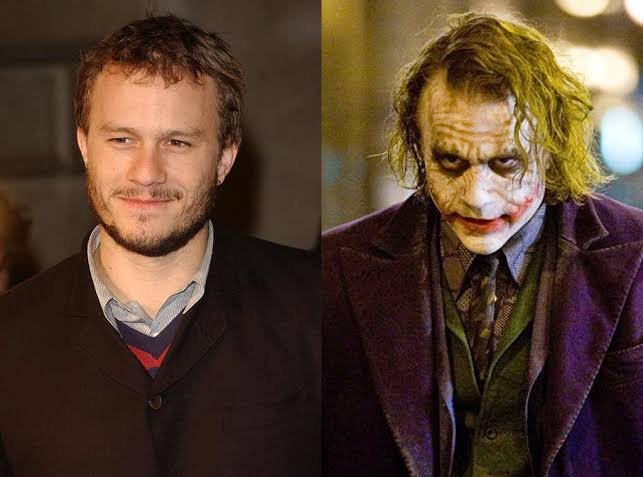
The Joker in The Dark Knight became the role most closely associated with Ledger’s name.
Christopher Nolan’s 2008 Batman film presented the Joker as an unpredictable criminal force whose actions challenge Batman and the moral structure of Gotham. Ledger’s interpretation avoided presenting the character simply as a comic-book villain. His performance emphasized unpredictability, strange humor, physical mannerisms, and an unsettling sense of control.
The performance became a major part of the film’s cultural impact. Ledger received the Academy Award for Actor in a Supporting Role for playing the Joker, becoming the winner posthumously at the 81st Academy Awards. The Academy’s records list the award specifically for his performance as the Joker in The Dark Knight.
The achievement was particularly notable because Ledger had already demonstrated substantial dramatic range before taking the role. The Joker was therefore not simply an isolated departure; it became another example of his ability to reinvent his screen presence.
15. Tony – The Imaginarium of Doctor Parnassus
Ledger’s final film role was Tony in The Imaginarium of Doctor Parnassus, directed by Terry Gilliam.
The production faced the difficult challenge of completing the character after Ledger died in 2008. Johnny Depp, Jude Law, and Colin Farrell subsequently portrayed different transformations of Tony within the film’s fantasy framework.
That unusual production history makes the movie an important part of Ledger’s filmography. It also brought together his previous collaboration with Gilliam from The Brothers Grimm and allowed audiences to see his final completed footage within an imaginative fantasy story.
What Made Heath Ledger Such a Versatile Actor?
One of the clearest characteristics of Ledger’s career was his willingness to move between very different types of characters.
He could play a romantic lead in 10 Things I Hate About You, a medieval hero in A Knight’s Tale, a historical figure in Ned Kelly, a deeply restrained dramatic character in Brokeback Mountain, and an iconic villain in The Dark Knight.
That variety is important because it shows that Ledger’s career cannot be reduced to a single performance.
His work also became increasingly character-focused as his career progressed. Instead of simply accepting roles that maintained his established image, he often moved toward projects that offered different challenges.
Heath Ledger’s Most Acclaimed Performances
Two performances stand out particularly clearly in the Academy Awards record.
For Brokeback Mountain, Ledger received an Oscar nomination for Actor in a Leading Role. His performance as Ennis Del Mar was recognized alongside the film’s broader critical success.
For The Dark Knight, he received and won the Oscar for Actor in a Supporting Role. The Academy lists the award among the film’s two wins at the 81st Academy Awards.
These two performances also demonstrate the contrast within his acting career. Ennis is quiet, internal, and emotionally restrained, while the Joker is unpredictable, theatrical, and deliberately disruptive.
Heath Ledger’s Legacy in Film
Ledger’s filmography remains memorable because of the contrast between his roles. He was not an actor who followed one predictable path from beginning to end.
His early movies established him as a young performer with strong screen presence. Later films revealed a growing interest in challenging characters and independent storytelling. Brokeback Mountain showed his dramatic range, while The Dark Knight introduced one of the most discussed performances of his career.
His Oscar history reflects that progression. Ledger was nominated for his performance in Brokeback Mountain and later won posthumously for The Dark Knight.
Perhaps the most lasting part of his legacy is the breadth of his work. Looking beyond the Joker reveals an actor who explored romantic comedy, historical drama, fantasy, independent cinema, adventure, and serious character studies.
Final Thoughts
The best way to understand Heath Ledger is to look at his entire filmography rather than focusing on one famous performance.
From Two Hands and 10 Things I Hate About You to A Knight’s Tale, Ned Kelly, Brokeback Mountain, I’m Not There, and The Dark Knight, his career was marked by constant movement and experimentation.
His performances became more challenging as his career developed, and his willingness to take on very different characters gave his relatively short filmography unusual variety.
For audiences discovering his work today, the most rewarding approach is to explore these movies across different periods of his career. Doing so reveals not only the actor remembered for the Joker, but also the versatile performer who built a distinctive body of work across Australian cinema, Hollywood productions, independent films, and major dramatic projects.
Frequently Asked Questions
What is Heath Ledger best known for?
Heath Ledger is best known for playing the Joker in The Dark Knight and Ennis Del Mar in Brokeback Mountain. Both performances became major parts of his acting legacy.
What was Heath Ledger’s first major movie role?
One of Heath Ledger’s early breakthrough movie roles was Patrick Verona in 10 Things I Hate About You. The 1999 film helped introduce him to a much wider audience.
How many movies did Heath Ledger make?
Heath Ledger appeared in a relatively small number of feature films compared with many long-career actors. His filmography includes Australian productions, Hollywood movies, independent films, and major studio projects.
Did Heath Ledger win an Oscar?
Yes. Heath Ledger won the Academy Award for Best Supporting Actor for his performance as the Joker in The Dark Knight. The award was presented posthumously in 2009.
What are some of Heath Ledger’s best movies?
Some notable Heath Ledger movies include 10 Things I Hate About You, A Knight’s Tale, Brokeback Mountain, Candy, I’m Not There, and The Dark Knight.