






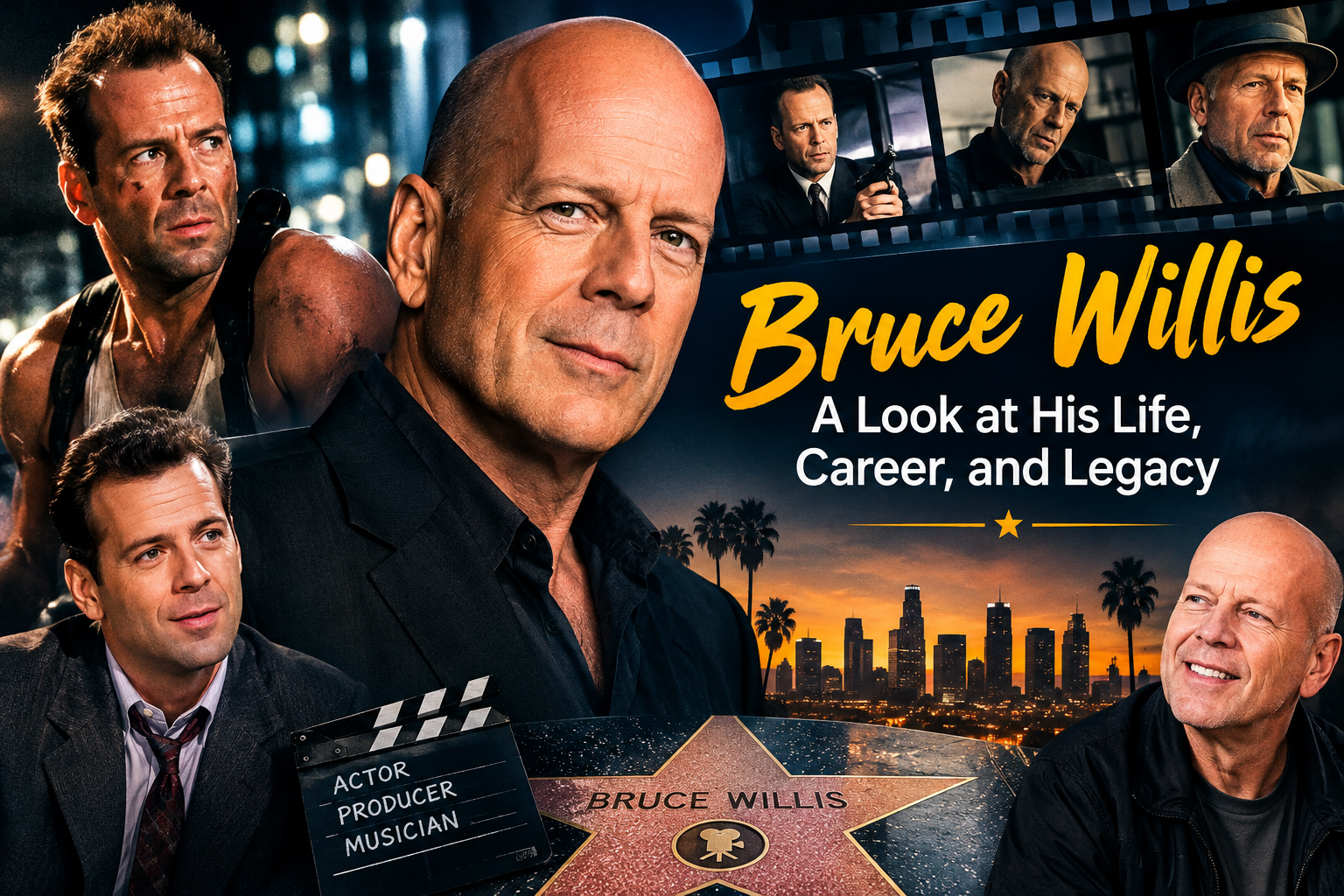
Bruce Willis is one of the most recognizable actors in modern Hollywood history. Known for his memorable performances in action movies, psychological thrillers, science fiction films, and comedies, he built a career that entertained audiences for more than four decades. From his breakthrough television role in Moonlighting to his unforgettable performance in Die Hard, Willis became a familiar face to movie fans around the world.
His career was not limited to action films. He also appeared in critically acclaimed movies such as Pulp Fiction, The Sixth Sense, 12 Monkeys, and Unbreakable. These performances demonstrated his ability to play characters with different personalities, emotions, and motivations.
Beyond his work on screen, Bruce Willis has a personal story that includes family life, musical interests, and a significant health journey. His retirement from acting following an aphasia diagnosis, followed by his family’s announcement that he had frontotemporal dementia, marked a difficult new chapter in his life.
Looking back at Bruce Willis’s biography reveals the story of an actor whose performances helped shape popular cinema and whose legacy continues to reach audiences across generations.
BIO
| Label | Information |
|---|---|
| Full Name | Walter Bruce Willis |
| Popular Name | Bruce Willis |
| Date of Birth | March 19, 1955 |
| Age | 71 years (as of 2026) |
| Birthplace | Idar-Oberstein, West Germany |
| Nationality | American |
| Profession | Actor, Producer, Musician |
| Education | Montclair State University |
| Acting Debut | The First Deadly Sin (1980) |
| Breakthrough Role | David Addison in Moonlighting |
| Famous Character | John McClane in Die Hard |
| Spouses | Demi Moore and Emma Heming Willis |
| Children | Five daughters |
Who Is Bruce Willis?
Bruce Willis, whose full name is Walter Bruce Willis, was born on March 19, 1955, in Idar-Oberstein, West Germany, where his American father was serving in the military. Although he was born outside the United States, he grew up primarily in New Jersey after his family returned to America.
Willis became famous during the 1980s through television before establishing himself as a major movie star. His natural humor, confident screen presence, and ability to portray ordinary people in extraordinary situations helped distinguish him from many other action performers of his era.
He became especially well known for playing John McClane in the Die Hard franchise. However, his filmography extends far beyond that character, including romantic comedies, crime dramas, science fiction adventures, and supernatural thrillers.
Throughout his career, Willis earned major industry recognition, including a Golden Globe Award and two Primetime Emmy Awards. His performances in both television and film helped establish his reputation as a versatile entertainer.
Bruce Willis’s Early Life and Childhood
Bruce Willis was born into a working family. His mother, Marlene, was German, while his father, David Willis, was an American serviceman who later worked in industrial jobs. After his father left military service, the family moved to Carneys Point, New Jersey.
Growing up in New Jersey gave Willis a background that would later connect with many of the grounded characters he played. His screen persona often felt approachable rather than overly polished, allowing audiences to see a believable person behind the movie hero.
As a child, Willis experienced a stutter that sometimes made communication difficult. Acting and performing in front of people became an important part of his development, and he discovered that his speech difficulties could become less noticeable when he performed.
His interest in entertainment continued during his school years. He participated in school activities and developed a sense of humor that eventually became one of his most recognizable acting qualities.
How Bruce Willis Started His Acting Career
Before becoming a professional actor, Willis worked several jobs while considering his future. He attended Montclair State University in New Jersey, where he studied drama, but eventually left college to pursue acting opportunities in New York City.
The early years were not easy. Like many aspiring performers, he faced auditions, uncertainty, and the challenge of earning enough money to support himself. He worked as a bartender while looking for opportunities in theater and television.
Willis appeared in stage productions and gradually gained experience in front of live audiences. He also secured small film and television roles, including appearances in The First Deadly Sin and The Verdict.
These early projects did not immediately make him famous, but they allowed him to develop his skills and understand the demands of professional acting.
His determination eventually led him to Hollywood, where a television audition changed the direction of his career.
Bruce Willis’s Breakthrough With Moonlighting
Bruce Willis achieved widespread recognition when he was cast as David Addison in the television series Moonlighting. The show premiered in 1985 and combined detective stories with comedy, romance, and sharp dialogue.
Willis starred opposite Cybill Shepherd, who played Maddie Hayes. Their characters operated the Blue Moon Detective Agency and became known for their entertaining exchanges and complicated relationship.
As David Addison, Willis demonstrated a style that blended confidence, sarcasm, charm, and humor. His performance made the character memorable and helped distinguish the series from more conventional detective programs.
Moonlighting became an important turning point because it showed that Willis could carry a leading role without relying on action scenes. His comic timing and relaxed screen presence attracted viewers and helped him build a loyal audience.
The role also earned him significant industry recognition. He won a Golden Globe Award and a Primetime Emmy Award for his work on the series.
By the end of the 1980s, Willis had established himself as a successful television actor. His next major challenge was proving that he could become a leading man in feature films.
Bruce Willis and the Success of Die Hard
The release of Die Hard in 1988 transformed Bruce Willis into an international movie star. He played John McClane, a New York police detective who finds himself confronting a dangerous takeover inside a Los Angeles skyscraper.
At the time, action cinema was strongly associated with physically imposing heroes. Willis offered a different approach. His character was tough and resourceful but also vulnerable, frustrated, humorous, and visibly human.
That combination helped make John McClane relatable. Instead of appearing invincible, he seemed like an ordinary person forced to respond to an extraordinary situation.
The film’s suspenseful storytelling, memorable supporting characters, and tightly constructed action sequences helped it become a major success. Willis’s performance was central to its appeal.
The success of Die Hard also changed how audiences viewed him. He was no longer simply the witty television actor from Moonlighting. He had become a credible action star capable of leading a major Hollywood production.
Willis returned as John McClane in four additional films: Die Hard 2, Die Hard with a Vengeance, Live Free or Die Hard, and A Good Day to Die Hard.
The franchise became the defining action series of his career. Its influence can still be seen in discussions about memorable action heroes and the evolution of the modern action movie.
Bruce Willis’s Best Movies and Memorable Performances
Bruce Willis appeared in a wide variety of films during his career. While the Die Hard franchise remains his most recognizable work, several other performances demonstrated his range and helped strengthen his reputation.
Pulp Fiction (1994)
Quentin Tarantino’s Pulp Fiction brought together multiple interconnected crime stories and an ensemble cast. Willis played Butch Coolidge, a boxer whose decisions draw him into a dangerous situation.
The role was different from the traditional action hero he played in Die Hard. Butch was determined and resourceful, but he also faced moral choices and personal consequences.
The film received widespread critical acclaim and became an important work in 1990s American cinema. Willis’s performance helped demonstrate that he could contribute to a complex ensemble film rather than simply lead a conventional blockbuster.
12 Monkeys (1995)
In Terry Gilliam’s science fiction film 12 Monkeys, Willis played James Cole, a prisoner sent into the past in connection with a devastating global outbreak.
The story explored memory, time, uncertainty, and the difficulty of distinguishing reality from perception. Willis brought emotional intensity to a character struggling to understand the world around him.
His performance showed a more troubled and vulnerable side, reinforcing his ability to work in demanding science fiction stories.
The Fifth Element (1997)
The Fifth Element placed Willis in a colorful futuristic adventure directed by Luc Besson. He played Korben Dallas, a former military officer who becomes involved in a mission to protect the world.
The film combined science fiction, comedy, action, and elaborate visual design. Willis’s understated humor helped balance the unusual setting and energetic performances surrounding him.
The movie later developed a lasting fan following and remains one of his most recognizable science fiction appearances.
Armageddon (1998)
In Armageddon, Willis played Harry Stamper, an experienced oil driller recruited for an extraordinary mission involving an approaching asteroid.
The film combined large-scale action with themes of sacrifice, responsibility, and family. Willis gave the central character a mixture of authority and warmth, helping the story connect with audiences beyond its spectacular effects.
The movie became a major commercial success and further established Willis as a dependable leading actor in large-scale Hollywood productions.
The Sixth Sense (1999)
One of Bruce Willis’s most celebrated dramatic performances came in M. Night Shyamalan’s The Sixth Sense. He played Malcolm Crowe, a child psychologist attempting to help a young boy experiencing frightening and confusing events.
Unlike the energetic hero of Die Hard, Crowe was quiet, thoughtful, and emotionally restrained. Willis relied on subtle expressions and measured dialogue to communicate the character’s concerns.
The film became famous for its suspenseful storytelling and unexpected conclusion. It earned major award nominations and remains an important example of Willis’s ability to succeed in psychological drama.
Unbreakable (2000)
Willis reunited with director M. Night Shyamalan for Unbreakable, playing David Dunn, a man who begins to question the meaning of his unusual survival after a serious accident.
The film approached the superhero genre through a grounded, reflective story. Rather than presenting its central character as an immediately confident hero, it explored uncertainty, identity, and personal responsibility.
Willis’s restrained performance suited the film’s atmosphere and helped create a character whose strength emerged gradually.
Sin City (2005)
In Sin City, Willis played police officer Hartigan in a stylized crime film based on stories by Frank Miller. The movie used striking black-and-white visuals, selective color, and graphic-novel-inspired storytelling.
Hartigan was a determined character guided by a strong sense of duty. The role allowed Willis to return to crime fiction while working within an unusual visual style.
The film became known for its distinctive presentation and ensemble cast.
Looper (2012)
The science fiction thriller Looper featured Willis as an older version of a character played by Joseph Gordon-Levitt. The story explored time travel, personal choices, and the consequences of decisions made across different stages of life.
Willis brought experience and intensity to the role, while the film offered a more complicated approach to the action genre than a straightforward chase story.
Together, these films illustrate why Bruce Willis’s career cannot be defined by a single franchise. He moved between different genres while maintaining a recognizable screen presence.
Bruce Willis’s Acting Style and Hollywood Influence
One of Bruce Willis’s greatest strengths was his ability to make extraordinary situations feel personal. His characters often faced overwhelming circumstances, yet they reacted with frustration, humor, fear, and determination.
This quality was especially effective in action films. Rather than presenting every hero as fearless, Willis often portrayed people who questioned their situation but continued because they had no other choice.
His comic timing was another important part of his style. Even during tense scenes, a short remark or understated reaction could reveal a character’s personality and give the audience a moment of relief.
Willis also demonstrated considerable flexibility. He could play a detective, a troubled psychologist, a science fiction protagonist, a criminal, or a family-oriented character without making every performance feel identical.
His success helped popularize a more relatable kind of action hero. John McClane was skilled and courageous, but he was not presented as a perfect figure who could effortlessly overcome every obstacle.
That approach influenced audience expectations and helped make room for action characters who relied on persistence, intelligence, and personality as much as physical strength.
Bruce Willis’s Awards and Career Achievements
Bruce Willis earned recognition from both television and film organizations throughout his career.
His early success with Moonlighting brought major awards attention and helped establish him as a respected television performer. He won a Golden Globe for Best Actor in a Television Series — Musical or Comedy and received a Primetime Emmy Award for his work on the show.
He later won another Primetime Emmy Award for his guest appearance on the television sitcom Friends, where he played Paul Stevens, the father of a character dating Ross Geller.
His film career also received recognition through award nominations and popular honors. The Sixth Sense was particularly important because it demonstrated his ability to lead a successful dramatic thriller.
In 2006, Willis received a star on the Hollywood Walk of Fame, recognizing his contribution to the entertainment industry.
His career achievements include much more than individual trophies. He starred in commercially successful films, worked with respected directors, and appeared in projects that became lasting parts of popular culture.
His performances across television and film helped him build a career that remained relevant to audiences for decades.
Bruce Willis’s Personal Life and Family
Although Bruce Willis became famous for his work on screen, his family has remained an important part of his personal story.
He married actress Demi Moore in 1987. The couple had three daughters: Rumer, Scout, and Tallulah. They announced their separation in 1998 and finalized their divorce in 2000.
Despite ending their marriage, Willis and Moore maintained a public connection as parents. Their family continued to receive attention because both remained involved in their daughters’ lives.
In 2009, Willis married model and entrepreneur Emma Heming. They have two daughters, Mabel and Evelyn, bringing the total number of his children to five.
Over the years, Willis’s blended family has been recognized for maintaining close connections. Moore and Heming have both publicly discussed the importance of family support, particularly following Willis’s health diagnosis.
His family life offers another perspective on the actor beyond the tough and humorous characters audiences saw in his films. It also highlights the people who have supported him through significant personal changes.
Bruce Willis’s Health Journey and Retirement
In March 2022, Bruce Willis’s family announced that he would step away from acting after receiving a diagnosis of aphasia. The condition can affect a person’s ability to communicate, including speaking, understanding language, reading, or writing, depending on its cause and severity.
The announcement marked a major change for fans who had watched his career develop over several decades. His family explained that his health challenges were affecting his ability to continue working.
In February 2023, the family shared a further update, confirming that Willis had been diagnosed with frontotemporal dementia, commonly known as FTD. They explained that the diagnosis provided greater clarity about the condition behind his communication difficulties.
FTD refers to a group of neurological disorders that affect areas of the brain associated with language, behavior, personality, and other functions. Its effects vary from person to person, and it can create significant challenges for both individuals and their families.
Willis’s diagnosis also brought increased public attention to a condition that many people knew little about. His family expressed hope that sharing their experience would encourage greater understanding and research.
It is important to approach this part of his story with respect. A health diagnosis does not define a person’s entire life, and public information cannot reveal every detail of an individual’s private experience.
His retirement marked the end of his active acting career, but it did not erase the work he had already created. His films remain available to audiences, while his family’s advocacy has helped bring attention to the challenges associated with frontotemporal dementia.
Bruce Willis’s Life Beyond Acting
Bruce Willis explored several interests outside his best-known film roles. One of them was music, particularly blues and rock-influenced performance.
In 1987, he released The Return of Bruno, a music album that reflected his interest in blues. The project included his work as a singer and performer, demonstrating that his creative interests were not limited to acting.
Willis also participated in business ventures connected to the entertainment industry. He was among the celebrity partners associated with Planet Hollywood, the restaurant chain launched in the early 1990s.
He continued working across different kinds of productions throughout his career, including independent films and projects that offered alternatives to major studio action movies.
These activities reveal a performer who explored several sides of entertainment. Although acting remained his central profession, music and business interests formed additional parts of his public career.
Interesting Facts About Bruce Willis
Several details from Bruce Willis’s life help explain his journey from a young aspiring performer to an internationally recognized star.
- His full name is Walter Bruce Willis. He was born in Germany while his father was serving in the American military.
- He grew up in New Jersey. His family moved to the United States when he was a young child.
- He studied drama at Montclair State University. He eventually left college to pursue acting professionally.
- He became famous through television. His role in Moonlighting established him as a major entertainment figure before Die Hard.
- He explored music. His album The Return of Bruno reflected his interest in blues.
- He worked across multiple genres. His filmography includes action, comedy, drama, science fiction, and supernatural thrillers.
- He received major television awards. His honors include a Golden Globe and two Primetime Emmy Awards.
- He has five daughters. His children are Rumer, Scout, Tallulah, Mabel, and Evelyn.
- His family raised awareness of FTD. Their public statements helped bring attention to frontotemporal dementia and the challenges faced by affected families.
These facts demonstrate that his life and career extend well beyond the image of an action star.
Bruce Willis’s Legacy in Hollywood
Bruce Willis’s legacy rests on a combination of memorable performances, commercial success, and a distinctive approach to screen characters.
His portrayal of John McClane remains a major part of action-film history. The character combined courage with humor and vulnerability, creating a hero who felt closer to an ordinary person than an untouchable action figure.
At the same time, films such as Pulp Fiction, 12 Monkeys, and The Sixth Sense showed that Willis could contribute to ambitious stories outside the action genre. His willingness to explore different roles helped keep his career varied and interesting.
His television success also deserves recognition. Moonlighting gave audiences an early look at his comic timing and established the personality that later became part of his movie-star identity.
For many viewers, Willis’s films are connected to particular periods of their lives, from discovering classic action movies to watching suspenseful thrillers with family and friends. His performances continue to reach new audiences through home viewing and streaming services.
His health journey has added a more personal dimension to his public story. His family’s openness about frontotemporal dementia has encouraged conversations about neurological conditions, caregiving, and the importance of treating affected people with dignity.
Ultimately, Bruce Willis’s influence cannot be measured only by box-office results or awards. It also lives in the characters he brought to the screen and the lasting memories those performances created for audiences.
Frequently Asked Questions About Bruce Willis
How old is Bruce Willis?
Bruce Willis was born on March 19, 1955. He turned 71 in March 2026. His birthplace was Idar-Oberstein, West Germany, where his father was serving in the American military.
What is Bruce Willis best known for?
He is best known for playing John McClane in the Die Hard franchise. He is also widely recognized for Pulp Fiction, The Sixth Sense, The Fifth Element, and Unbreakable.
What are Bruce Willis’s most famous movies?
Some of his best-known movies include Die Hard, Pulp Fiction, 12 Monkeys, Armageddon, The Fifth Element, The Sixth Sense, Unbreakable, and Looper.
Why did Bruce Willis retire from acting?
Willis retired from acting in March 2022 after his family announced that he had been diagnosed with aphasia, a condition that can affect communication. In February 2023, his family confirmed that he had frontotemporal dementia.
How many children does Bruce Willis have?
Bruce Willis has five daughters: Rumer, Scout, and Tallulah from his marriage to Demi Moore, and Mabel and Evelyn from his marriage to Emma Heming Willis.
What awards has Bruce Willis won?
His awards include a Golden Globe Award for Moonlighting and two Primetime Emmy Awards. He also received a star on the Hollywood Walk of Fame in 2006.
Conclusion
Bruce Willis built a remarkable career by combining humor, determination, and versatility. From his early success in Moonlighting to his defining performance in Die Hard, he became one of the most recognizable actors of his generation.
His work in Pulp Fiction, The Sixth Sense, 12 Monkeys, and many other films demonstrated that he could move comfortably between different genres and character types. Those performances helped establish a legacy that extends beyond any single movie or franchise.
His retirement and frontotemporal dementia diagnosis brought a difficult change to his life, while his family’s support and advocacy have helped raise awareness of the condition.
Today, Bruce Willis remains an important figure in Hollywood history. His films continue to entertain audiences, and his contribution to action cinema and popular entertainment ensures that his work will be remembered for years to come.