



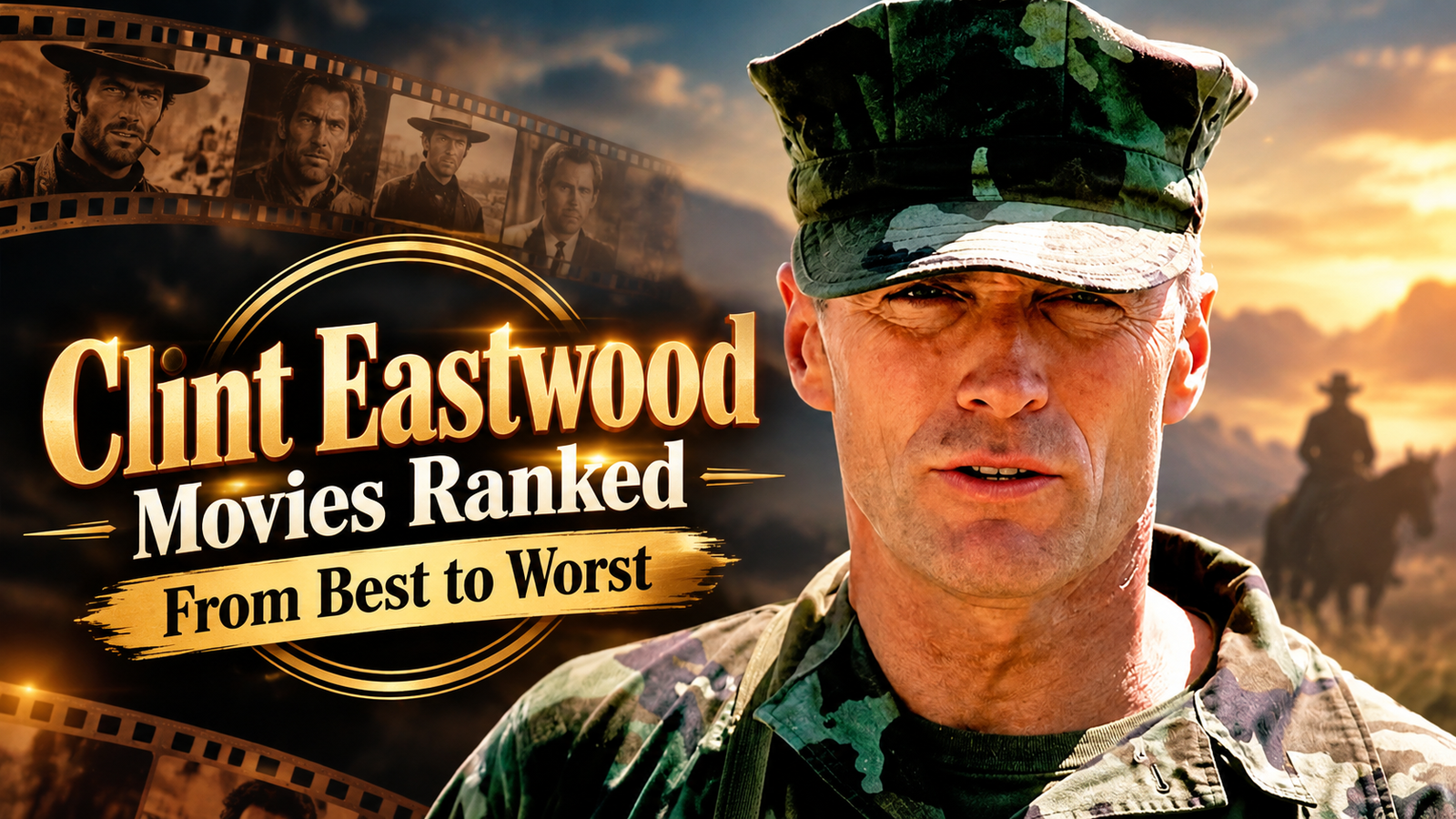

Clint Eastwood has built one of the most remarkable careers in Hollywood, earning recognition as an actor, director, producer, and filmmaker. From classic Westerns to emotional dramas and gripping crime thrillers, his movies have entertained audiences for generations. What makes his filmography special is the way he combines memorable characters with stories about justice, loyalty, regret, courage, and redemption.
In this guide, we rank some of the best Clint Eastwood movies from best to worst based on storytelling, performances, direction, cultural impact, and lasting appeal. The ranking is subjective, but every film included here offers something worth exploring.
BIO
| Label | Information |
|---|---|
| Full Name | Clint Eastwood |
| Profession | Actor, Director, Producer |
| Nationality | American |
| Birth Date | May 31, 1930 |
| Birthplace | San Francisco, California, USA |
| Main Genres | Western, Drama, Crime, Thriller |
| Acting Career | Began in the 1950s |
| Breakthrough Role | Rowdy Yates in Rawhide |
| Famous Character | The Man with No Name |
| Popular Movie | The Good, the Bad and the Ugly (1966) |
| Award-Winning Film | Unforgiven (1992) |
| Directing Achievement | Academy Award-winning director |
| Latest Directorial Film | Juror #2 (2024) |
How We Ranked Clint Eastwood Movies
The ranking considers several factors, including the quality of the story, Eastwood’s performance, his direction where applicable, critical recognition, and the film’s influence over time. We have also considered how well each movie appeals to modern viewers. The list includes Westerns, crime thrillers, historical dramas, and character-driven stories so readers can discover the full range of his work.
1. The Good, the Bad and the Ugly (1966)
The Good, the Bad and the Ugly takes the top spot for its unforgettable atmosphere, striking cinematography, memorable music, and influence on Western cinema. Directed by Sergio Leone, the film follows three men competing to find buried Confederate gold during the American Civil War. Eastwood plays Blondie, a calm and resourceful gunslinger whose actions often speak louder than his words.
The movie is famous for its long pauses, dramatic close-ups, sweeping landscapes, and carefully built tension. Ennio Morricone’s music adds another layer of personality to the story. Even viewers who do not usually enjoy Westerns can appreciate its distinctive filmmaking and larger-than-life characters. It remains one of Eastwood’s most recognizable performances and a defining entry in the Spaghetti Western genre.
2. Unforgiven (1992)
Unforgiven is among the most thoughtful Westerns ever made. Eastwood directs and stars as William Munny, a former outlaw who has left his violent past behind but accepts one final job when financial pressure pushes him back toward his old life. The story examines the cost of violence and challenges the romantic image of the fearless Western hero.
Rather than presenting its central character as an uncomplicated hero, the film explores guilt, aging, reputation, and the consequences of past choices. Gene Hackman and Morgan Freeman add considerable depth to the supporting cast. Unforgiven won Academy Awards for Best Picture and Best Director for Eastwood, cementing its place in film history. Its restrained storytelling and serious view of the Western tradition make it essential viewing.
3. Million Dollar Baby (2004)
Million Dollar Baby shows Eastwood’s ability to tell deeply personal stories outside the Western genre. He plays Frankie Dunn, an experienced boxing trainer who is initially reluctant to coach Maggie Fitzgerald, an ambitious woman determined to pursue a boxing career. Their relationship gradually develops into a moving story about trust, family, and the need to feel understood.
Hilary Swank delivers a powerful performance as Maggie, while Morgan Freeman brings warmth and reflection to his role as Eddie Dupris. The film balances the discipline of boxing with questions about responsibility, dignity, and difficult personal decisions. It received major Academy Award recognition, including wins for Best Picture, Best Director, Best Actress, and Best Supporting Actor. Its emotional weight and strong performances make it one of Eastwood’s most accomplished films.
4. A Fistful of Dollars (1964)
A Fistful of Dollars helped establish Eastwood as an international film star. Directed by Sergio Leone, this Western follows a mysterious stranger who arrives in a divided border town and becomes involved in a conflict between rival families. Eastwood’s character is economical with words, observant, and difficult to predict.
The film helped popularize a different kind of Western hero: someone who was morally complicated rather than traditionally noble. Its visual style, deliberate pacing, and tense confrontations gave the genre a fresh identity. Although later films expanded on these ideas, A Fistful of Dollars remains an important turning point in Eastwood’s career and a natural starting point for anyone exploring his classic Westerns.
5. Gran Torino (2008)
In Gran Torino, Eastwood plays Walt Kowalski, a retired factory worker whose views are challenged by the changing community around him. Walt initially keeps his neighbors at a distance, but an unexpected connection with a young Hmong teenager gradually changes his outlook. The story explores prejudice, loneliness, responsibility, and the possibility of personal growth.
Eastwood gives Walt a rough exterior without making him a simple character. His gradual change is central to the film’s appeal, as the story asks whether people can reconsider old beliefs and make meaningful connections later in life. Gran Torino also benefits from its focus on everyday relationships rather than elaborate action. It is a strong choice for viewers who want a modern drama with a memorable central performance.
6. The Outlaw Josey Wales (1976)
The Outlaw Josey Wales follows a Missouri farmer whose life is changed by the violence of the American Civil War. Eastwood plays Josey, a man who becomes an outlaw and gradually encounters other people searching for safety and belonging. The journey develops into a story about survival, loyalty, and the possibility of building a new life after loss.
Eastwood directed the film as well as starring in it, giving the Western a strong sense of place and a thoughtful approach to its characters. Josey is tough, but the story also reveals his capacity for compassion. The movie stands out because it moves beyond revenge and explores the bonds that form between people who have been displaced by conflict. It remains one of Eastwood’s most respected Westerns.
7. For a Few Dollars More (1965)
The second film in Sergio Leone’s Dollars trilogy, For a Few Dollars More pairs Eastwood with Lee Van Cleef. The two characters pursue the same criminal, but their different personalities and motivations create tension throughout the story. The film combines suspense, dry humor, and carefully staged confrontations.
Eastwood once again relies on a controlled performance rather than lengthy speeches. His character observes situations closely and often reveals little about his intentions. The film develops the visual style and musical identity that made the trilogy famous. It may not be as widely celebrated as The Good, the Bad and the Ugly, but it is an excellent example of Eastwood’s early screen persona and Leone’s distinctive direction.
8. In the Line of Fire (1993)
In the Line of Fire gives Eastwood a leading role in a modern political thriller. He plays Frank Horrigan, an experienced Secret Service agent haunted by his failure to protect President John F. Kennedy. When a new threat emerges against a sitting president, Horrigan becomes personally invested in stopping it.
The film creates suspense through the conflict between professional duty and personal regret. Eastwood portrays a capable agent who must confront the emotional burden of his past while facing the demands of the present. John Malkovich provides a compelling opposing performance, helping maintain tension throughout the story. For viewers who prefer crime and political thrillers to Westerns, this is one of Eastwood’s strongest choices.
9. The Bridges of Madison County (1995)
The Bridges of Madison County reveals a quieter side of Eastwood’s career. He stars as Robert Kincaid, a photographer who meets Francesca Johnson, played by Meryl Streep, during a brief period when her family is away. Their meeting develops into an intimate story about love, responsibility, and the choices that shape a life.
Unlike Eastwood’s more confrontational films, this drama depends on subtle performances and emotional restraint. Streep brings complexity to Francesca, while Eastwood gives Robert a thoughtful, understated presence. The film asks viewers to consider the difference between personal desire and family commitments without offering easy answers. It is particularly worthwhile for audiences interested in character-driven romantic dramas.
10. High Plains Drifter (1973)
High Plains Drifter is one of Eastwood’s darker Westerns. He plays a mysterious stranger who arrives in a town whose residents are troubled by their own past actions. As the story unfolds, the stranger’s motives remain uncertain, creating an unsettling atmosphere that separates the film from more conventional Western adventures.
Eastwood also directed the movie, using the town and its landscape to reinforce its themes of guilt, fear, and moral responsibility. The central character is deliberately difficult to understand, which encourages viewers to interpret his actions rather than accept him as a traditional hero. High Plains Drifter may be too unusual for some viewers, but its distinctive mood makes it an important entry in Eastwood’s filmography.
11. Escape from Alcatraz (1979)
Escape from Alcatraz is a tense prison drama inspired by the famous 1962 escape from the island prison. Eastwood plays Frank Morris, an inmate known for his intelligence and ability to plan carefully. The film follows the preparation and uncertainty surrounding an escape attempt, using its confined setting to build suspense.
Rather than relying on constant action, the movie focuses on observation, patience, and practical problem-solving. Eastwood’s restrained performance suits the character, while the prison setting creates an atmosphere of isolation. The film is a strong example of how a simple premise can sustain a compelling story when the pacing and details are handled carefully.
12. Pale Rider (1985)
Pale Rider returns Eastwood to the Western landscape through the story of a mysterious preacher who arrives in a mining community threatened by a powerful landowner. His presence gives the miners hope as they struggle to protect their homes and livelihoods.
Eastwood directs the film with an emphasis on atmosphere, landscape, and the familiar Western conflict between ordinary people and powerful opponents. The preacher’s unclear background adds an element of mystery, while the community’s struggle provides the emotional foundation. Pale Rider is a solid choice for viewers who enjoy classic Western storytelling with a slightly mysterious central character.
13. Mystic River (2003)
Mystic River is a crime drama about three childhood friends whose lives become connected again after a tragic event affects one of their families. Eastwood directs the film, bringing a measured approach to a story about grief, suspicion, loyalty, and the lasting effects of childhood experiences.
Sean Penn, Tim Robbins, and Kevin Bacon deliver intense performances as the central characters. The film gradually reveals how old wounds and personal assumptions influence the way people respond to tragedy. Rather than offering a straightforward detective story, Mystic River examines the emotional consequences of loss and the difficulty of separating truth from belief. It is one of Eastwood’s most respected directorial efforts.
14. Dirty Harry (1971)
Dirty Harry introduced audiences to Harry Callahan, a San Francisco police inspector known for his uncompromising attitude and unconventional approach to his work. Eastwood’s performance helped establish one of the most recognizable crime-film characters of the 1970s. The movie combines police investigation, urban tension, and questions about the limits of authority.
Its influence on later crime thrillers is considerable, although its portrayal of policing and justice has also invited debate. The film is best understood in the context of the social anxieties and crime stories of its era. Eastwood’s controlled screen presence is central to its impact, making Dirty Harry a significant film in his career even for viewers who prefer his more reflective work.
15. Letters from Iwo Jima (2006)
Letters from Iwo Jima presents the Battle of Iwo Jima largely from the perspective of Japanese soldiers defending the island during World War II. Directed by Eastwood, the film focuses on individual experiences, difficult decisions, and the human cost of war rather than treating the conflict as a simple story of victory and defeat.
The film is notable for its restrained tone and attention to the people caught within a devastating historical event. Its companion film, Flags of Our Fathers, approaches the same battle from the American perspective. Together, the two films show Eastwood’s interest in exploring how different people experience the same conflict. Letters from Iwo Jima is a thoughtful choice for viewers interested in historical dramas and stories about the human consequences of war.
Other Clint Eastwood Movies Worth Watching
Eastwood’s filmography includes many other films that deserve attention. Where Eagles Dare (1968) is a memorable wartime adventure, while Kelly’s Heroes (1970) mixes military action with comedy. Thunderbolt and Lightfoot (1974) offers a different kind of crime story, and Escape from Alcatraz demonstrates his ability to carry a tightly focused drama.
Later films also show his range as a director. A Perfect World (1993) explores an unexpected relationship between a fugitive and a young boy. Space Cowboys (2000) follows older former astronauts given another chance to work together. Sully (2016) tells the story of an experienced pilot facing scrutiny after an emergency landing, while Richard Jewell (2019) examines the consequences of public suspicion and media attention.
The Mule (2018) features Eastwood as an aging man who becomes involved in drug trafficking, while Cry Macho (2021) returns him to a reflective story about age, responsibility, and personal change. Juror #2 (2024), which Eastwood directed, explores a juror facing a difficult moral dilemma during a murder trial. These films demonstrate that his work continued to evolve long after his early Western successes.
What Makes Clint Eastwood’s Movies Special?
One reason Eastwood’s movies remain popular is his distinctive approach to storytelling. As an actor, he often uses quiet expressions, measured movements, and brief dialogue to communicate what a character is thinking. This style makes his characters feel controlled on the surface while suggesting complicated emotions underneath.
As a director, he is known for economical filmmaking and a focus on performances. His stories often examine responsibility, justice, regret, and redemption. Even when the genre changes, these themes connect many of his films. His career also demonstrates a rare transition from major movie star to an acclaimed filmmaker, with recognition from the Academy for both Unforgiven and Million Dollar Baby.
Which Clint Eastwood Movie Should You Watch First?
The best starting point depends on your interests. If you enjoy classic Westerns, begin with The Good, the Bad and the Ugly or A Fistful of Dollars. For a more mature take on the genre, choose Unforgiven. Viewers looking for an emotional drama may prefer Million Dollar Baby or The Bridges of Madison County.
If crime thrillers are more appealing, In the Line of Fire and Dirty Harry offer two different approaches to the genre. Gran Torino is a strong option for anyone who wants a modern character study, while Letters from Iwo Jima is worth considering for historical drama. Each film reveals a different part of Eastwood’s long career.
FAQs About Clint Eastwood Movies
1. What is the best Clint Eastwood movie of all time?
The Good, the Bad and the Ugly is often considered one of Clint Eastwood’s greatest films because of its memorable characters, iconic music, and lasting influence on Western cinema.
2. What are the most popular Clint Eastwood movies?
Some of his best-known movies include Unforgiven, Dirty Harry, Gran Torino, Million Dollar Baby, and A Fistful of Dollars. These films showcase his range as an actor and filmmaker.
3. What is Clint Eastwood’s best Western movie?
The Good, the Bad and the Ugly and Unforgiven are two leading choices. The first is famous for its classic Western style, while the second offers a more mature look at violence and the Western hero.
4. Did Clint Eastwood direct his own movies?
Yes, Clint Eastwood has directed many films in which he also starred, including Unforgiven, Gran Torino, and The Outlaw Josey Wales. He is widely recognized for his work both in front of and behind the camera.
5. What is Clint Eastwood’s most recent movie?
Juror #2 (2024) is among his most recent films as a director. The courtroom thriller follows a juror who faces a difficult moral dilemma during a murder trial.
Conclusion
Clint Eastwood’s movies span several generations and a remarkable range of genres. His Westerns helped define his screen image, while later dramas and thrillers revealed his interest in complicated characters and difficult moral questions. Films such as The Good, the Bad and the Ugly, Unforgiven, Million Dollar Baby, and Gran Torino remain excellent starting points for new viewers.
Ranking these films will always involve personal preference, but their lasting appeal comes from memorable performances, thoughtful direction, and stories that continue to invite discussion. Whether you prefer classic Westerns, crime thrillers, or emotional dramas, exploring Clint Eastwood’s filmography offers a rewarding look at one of Hollywood’s most enduring careers.