


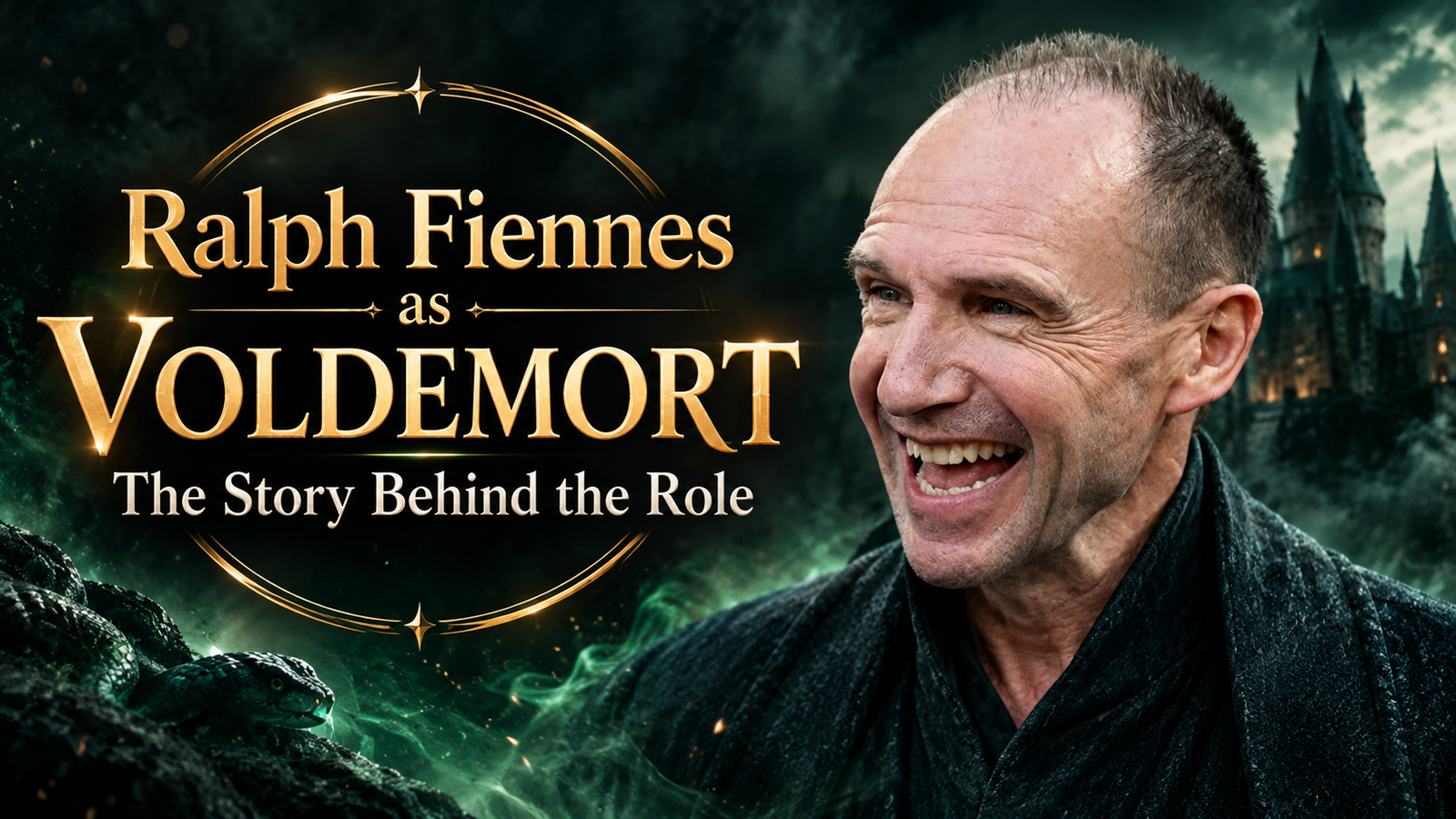
Ralph Fiennes brought one of the most recognizable villains in modern cinema to life through his portrayal of Lord Voldemort in the Harry Potter film series. With his pale appearance, unusual facial features, cold voice, and commanding presence, he created a character who could frighten audiences without relying on constant action. His performance helped turn Voldemort into more than a powerful enemy; he became a symbol of fear, ambition, and the desire to escape death at any cost.
The story of Ralph Fiennes as Voldemort is also a story about the relationship between an actor and a fictional character. Fiennes had to transform himself physically and emotionally to portray a dark wizard whose history, personality, and ambitions were already familiar to millions of readers. At the same time, he needed to make the character believable for viewers who were discovering the story through the films.
From his first full appearance in Harry Potter and the Goblet of Fire to the final confrontation in Harry Potter and the Deathly Hallows – Part 2, Fiennes gave Voldemort a distinctive identity. His performance, combined with makeup, visual effects, costume design, and the work of the wider filmmaking team, became an important part of the franchise’s lasting appeal.
BIO
| Label | Information |
|---|---|
| Actor Name | Ralph Fiennes |
| Character Name | Lord Voldemort |
| Full Name | Tom Marvolo Riddle |
| Profession | English Actor |
| Date of Birth | December 22, 1962 |
| Birthplace | Ipswich, England |
| First Film as Voldemort | Harry Potter and the Goblet of Fire |
| First Appearance | 2005 |
| Film Series | Harry Potter |
| Character Type | Dark Wizard and Main Villain |
| Distinctive Features | Pale Skin, Snake-Like Nose, Dark Robes |
| Character’s Main Goal | Achieve Immortality and Absolute Power |
| Final Film Appearance | Harry Potter and the Deathly Hallows – Part 2 (2011) |
Who Is Ralph Fiennes?
Ralph Fiennes is an English actor known for his work in historical dramas, thrillers, comedies, and major film franchises. Born on December 22, 1962, in Ipswich, England, he developed an interest in acting before building a career in theatre and film.
Fiennes trained at the Royal Academy of Dramatic Art, one of Britain’s respected drama schools. He subsequently gained experience on stage, including work with the Royal Shakespeare Company and the Royal National Theatre. His theatrical background helped him develop a strong understanding of character, movement, voice, and emotional expression.
Before becoming Voldemort, Fiennes had already earned considerable recognition for his dramatic performances. His portrayal of Amon Göth in Schindler’s List (1993) demonstrated his ability to play a deeply disturbing character without turning the performance into a simple caricature. He later starred in The English Patient (1996), which earned him an Academy Award nomination for Best Actor.
These roles showed his range and ability to explore complicated personalities. When he joined the Harry Potter franchise, he brought years of experience to a character who required both physical transformation and careful psychological interpretation.
Fiennes also continued working in other major productions. His role as Gareth Mallory, who becomes M in the James Bond films, introduced him to another internationally popular franchise. His career demonstrates that Voldemort was one important part of a much wider body of work.
How Ralph Fiennes Became Voldemort
Voldemort appeared in different forms before Ralph Fiennes portrayed the character in his most recognizable physical form. The first Harry Potter film introduced the mystery surrounding the dark wizard, while later installments gradually revealed more about his past and his return to power.
In Harry Potter and the Goblet of Fire, released in 2005, Voldemort returns to a physical body. This moment was central to the story because it transformed a distant threat into a living antagonist who could confront Harry directly.
Fiennes was cast to portray Voldemort in this film. His task was not simply to look frightening. He had to represent a character whose influence had shaped much of the wizarding world’s history, even during the years when he could not act openly.
The character also needed to feel different from the ordinary villains audiences might encounter in other fantasy films. Voldemort believes himself superior to almost everyone around him. He expects obedience, treats fear as a source of control, and views compassion as a weakness.
Fiennes approached the role with a serious dramatic sensibility. Rather than playing Voldemort as a constantly shouting villain, he often used stillness, measured speech, and small changes in expression. This approach helped create a character who seemed dangerous even when he was speaking quietly.
His casting proved important to the later films because Voldemort became increasingly central to the story. As Harry’s understanding of his enemy grew, audiences also saw more of the personality behind the dark wizard’s frightening appearance.
The Transformation Into Voldemort
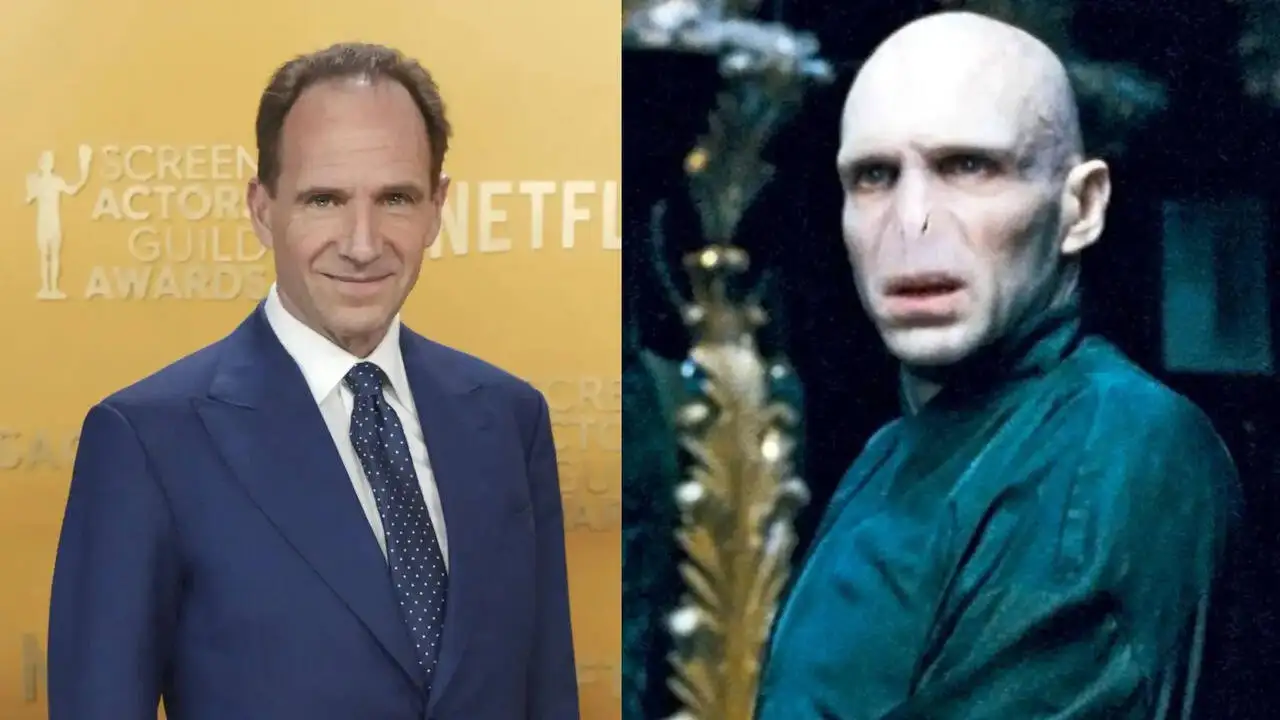
One of the most striking aspects of Ralph Fiennes as Voldemort is the character’s appearance. The dark wizard has pale skin, a flattened nose with slit-like openings, an unusually shaped face, and an overall look that separates him from ordinary human characters.
These features were developed through a combination of makeup, prosthetic work, costume design, lighting, and digital effects. The production team needed to make Voldemort look convincingly inhuman while still allowing Fiennes to communicate emotion through his face and body.
The character’s lack of a conventional nose is particularly memorable. It creates a snake-like quality that connects visually with Voldemort’s interest in snakes and his relationship with Nagini. The design also reflects his gradual separation from ordinary human life.
Fiennes’s physical performance was just as important as the makeup. His posture, head movements, hand gestures, and way of approaching other characters all contributed to Voldemort’s identity. He often moved with deliberate control, making even a simple gesture feel purposeful.
Costume design supported the same effect. Voldemort’s dark robes created a severe silhouette and helped distinguish him from the students, teachers, and other members of the wizarding world. His appearance was simple in colour but dramatic in shape.
The transformation demonstrates how a successful screen character is rarely created by one person alone. Fiennes supplied the acting, while the makeup artists, costume designers, cinematographers, visual-effects artists, and directors helped build the final image that audiences recognize.
How Fiennes Played the Dark Wizard
The most important part of Fiennes’s portrayal was not the makeup. It was the personality he gave to Voldemort.
Voldemort is convinced that he deserves power and that ordinary rules should not apply to him. He sees other people as tools, obstacles, or followers. His confidence comes from his magical abilities, his reputation, and his belief that he has discovered ways to overcome death.
Fiennes communicated this arrogance through his delivery and behaviour. Voldemort often speaks as though his decisions cannot be questioned. Even when he is threatening someone, he may appear calm and controlled, making the threat more unsettling.
His voice is another defining feature. Fiennes uses changes in pace, volume, and emphasis to give Voldemort a distinctive manner of speaking. He can sound almost conversational one moment and intensely threatening the next. This variation keeps the character from becoming one-dimensional.
His body language also reveals Voldemort’s need for control. He often moves into another character’s personal space, watches people closely, and uses gestures to reinforce his authority. These choices make his relationships with Harry, his followers, and his enemies feel unequal.
At the same time, Fiennes gives the character moments of vulnerability, particularly when Voldemort encounters something that challenges his sense of superiority. These moments matter because Voldemort is not truly free from fear. His desire for immortality is itself evidence of how deeply he fears death.
The contrast between his apparent power and his underlying insecurity adds depth to the performance. Voldemort can dominate a room, but he cannot fully control the future or eliminate every threat to his existence.
Voldemort Across the Harry Potter Films
Ralph Fiennes portrayed Voldemort in several of the later Harry Potter films. Each appearance develops a different aspect of the character and his conflict with Harry.
In Harry Potter and the Goblet of Fire (2005), Voldemort returns to a physical body. The graveyard sequence establishes his appearance, his cruelty, and his determination to defeat Harry. It also gives the story a major turning point, as the threat that had haunted the earlier films becomes immediate and personal.
In Harry Potter and the Order of the Phoenix (2007), Voldemort’s conflict with Harry expands beyond their individual rivalry. The battle at the Ministry of Magic brings Voldemort into direct confrontation with Albus Dumbledore. The scene presents him as a powerful wizard who can challenge one of the few people he considers a genuine threat.
In Harry Potter and the Half-Blood Prince (2009), Voldemort’s presence is felt through the investigation of his past and the discovery of the secrets that help explain his pursuit of immortality. Although the film focuses heavily on his history, that history is essential to understanding the final conflict.
In Harry Potter and the Deathly Hallows – Part 1 (2010), Voldemort’s influence spreads throughout the wizarding world. His followers gain power, and the danger facing Harry and his friends becomes more serious. Voldemort’s search for the Elder Wand also reveals how determined he is to secure an advantage over his enemies.
Finally, Harry Potter and the Deathly Hallows – Part 2 (2011) brings the conflict to its conclusion. Voldemort’s forces confront the defenders of Hogwarts, and his rivalry with Harry reaches its decisive moment.
Across these films, Fiennes maintains a recognizable portrayal while allowing the character’s position to change. Voldemort begins with the dramatic return of a feared enemy and ends as a powerful figure whose greatest weaknesses have become impossible to ignore.
Voldemort’s Most Memorable Scenes
Several scenes stand out when discussing Fiennes’s portrayal because they show how his acting choices support the story.
The graveyard scene in Goblet of Fire is among the most significant. Voldemort returns to a body and addresses his followers, establishing his authority and revealing his cruel attitude toward Harry. Fiennes combines physical confidence with a controlled manner of speaking, making the character appear certain of his own importance.
The Ministry of Magic confrontation in Order of the Phoenix presents a different challenge. Voldemort faces Dumbledore, a wizard whose skill and composure make him difficult to intimidate. The scene highlights Voldemort’s power while also showing that he cannot simply command every situation to unfold as he wishes.
His pursuit of the Elder Wand adds another dimension to the character. Voldemort believes that possessing the most powerful wand will help guarantee victory. His search reflects his tendency to look for absolute solutions rather than recognize the limits of his own understanding.
The final confrontation with Harry in Deathly Hallows – Part 2 is particularly important because it brings together the central themes of the series. Their conflict is not only a contest of magical strength. It is also a struggle between Voldemort’s belief in domination and Harry’s willingness to act out of loyalty, courage, and concern for others.
These scenes remain memorable because Fiennes makes Voldemort’s confidence, anger, and fear part of the same character. He is intimidating, but his need to prove his superiority repeatedly creates opportunities for others to challenge him.
Voldemort in the Books and Films
Lord Voldemort originated in J. K. Rowling’s Harry Potter novels. The films adapted his story for the screen, retaining the central elements of his background while making changes to suit a visual medium.
In the books, Voldemort is born Tom Marvolo Riddle. His childhood, his time at Hogwarts, and his growing obsession with power help explain how he becomes the dark wizard known to most people by another name.
The novels also explore his use of Horcruxes, objects connected to fragments of his soul that he creates in an effort to avoid death. This part of his history is crucial because it explains why defeating him requires more than simply overpowering him in a duel.
The films communicate these ideas through dialogue, flashbacks, visual imagery, and selected scenes from the books. Some details receive less attention because a film has limited time compared with a novel. As a result, viewers may encounter a more condensed version of Voldemort’s history.
Fiennes’s performance helps connect the character’s background with his behaviour in the present. His pride, impatience, and treatment of other people reflect a person who has spent years trying to make himself exceptional by separating himself from ordinary human limitations.
The films also emphasize Voldemort’s appearance more strongly than a written description can. Through the combination of makeup and performance, audiences can see how his pursuit of power has become associated with a disturbing physical identity.
Despite the differences between the books and films, the central character remains recognizable: a gifted wizard whose fear of death and desire for control eventually become the sources of his greatest weaknesses.
Why His Performance Stands Out
The success of Ralph Fiennes as Voldemort comes from the way several elements work together. His acting gives the character personality, while the visual design makes that personality immediately recognizable.
One reason the portrayal works is that Voldemort does not need to be constantly aggressive. He can be threatening while standing still, listening to another character, or delivering a quiet line. This restraint makes his more intense moments feel more significant.
Another strength is the contrast between his public confidence and private fear. Voldemort presents himself as someone beyond ordinary limitations, yet much of his story revolves around avoiding death and eliminating anything that reminds him of his vulnerability.
Fiennes also avoids making Voldemort a simple figure of evil without recognizable motivations. The character’s actions are cruel, but his behaviour follows a consistent worldview. He believes that power justifies his decisions and that people who cannot protect themselves deserve to be controlled.
This does not make Voldemort sympathetic. Instead, it makes him understandable as a fictional antagonist whose beliefs have destructive consequences. The audience can recognize the logic he uses to justify his behaviour without accepting that logic as right.
The performance also benefits from the franchise’s gradual development. Because Voldemort appears across several films, viewers have time to understand his personality, history, and growing conflict with Harry. Fiennes’s consistent portrayal helps connect these separate chapters into one continuing story.
Interesting Facts About the Role
Ralph Fiennes’s portrayal of Voldemort contains several details worth noting for fans of the franchise.
His first full appearance came in 2005. Fiennes played Voldemort in Harry Potter and the Goblet of Fire, the fourth film in the series. The character’s return marked a major change in the story’s tone.
The character’s appearance required a team effort. Makeup, prosthetic work, costume design, lighting, and visual effects all helped create Voldemort’s distinctive look. His appearance on screen was not simply the result of an actor changing his facial expressions.
His theatrical experience supported the performance. Fiennes’s background in stage acting gave him experience with voice, movement, and controlled physical expression. These skills were useful for a character who often communicates authority through small gestures.
Voldemort’s fear of death is central to his story. Although he appears powerful, his decisions are repeatedly shaped by his desire to survive. This contradiction helps explain why he makes choices that ultimately work against him.
Fiennes has a varied film career. Beyond the wizarding world, he has appeared in dramatic films, historical productions, comedies, and the James Bond franchise. His role as Voldemort is one part of a career that spans several genres.
These details show that the character’s impact came from more than his frightening appearance. The performance combined acting, design, and storytelling to create a villain who remained important throughout the later films.
Ralph Fiennes Beyond Voldemort
Although many younger viewers recognize Fiennes primarily as Voldemort, his wider career demonstrates a broad range of acting abilities.
In Schindler’s List, directed by Steven Spielberg, he played Amon Göth, a Nazi commandant. The role earned him an Academy Award nomination for Best Supporting Actor and showed his ability to portray a deeply disturbing historical figure.
In The English Patient, he played Count László de Almásy, a character at the centre of a romantic drama set during the Second World War. The performance earned him an Academy Award nomination for Best Actor and demonstrated a very different side of his work.
Fiennes also joined the James Bond series as Gareth Mallory, eventually becoming M in Skyfall, Spectre, and No Time to Die. The role required a different balance of authority, humour, and professionalism.
His work as an actor extends beyond performing. Fiennes has also directed films, including Coriolanus and The Invisible Woman. These projects reflect his interest in adapting complex stories and exploring characters through different forms of filmmaking.
Looking at these roles helps explain why he was able to bring so much control and detail to Voldemort. His career had already involved characters with authority, complicated motivations, and difficult moral qualities.
Conclusion
Ralph Fiennes’s portrayal of Voldemort remains one of the defining performances of the Harry Potter film series. Through a distinctive voice, controlled movements, and a carefully developed screen presence, he created a villain who was frightening without becoming predictable.
His performance also gave emotional meaning to Voldemort’s appearance. The makeup and visual effects made the character look unusual, but Fiennes’s acting revealed the pride, insecurity, and fear that shaped his decisions.
Across Goblet of Fire, Order of the Phoenix, Half-Blood Prince, and the two Deathly Hallows films, Voldemort evolves from a returning enemy into the central figure in Harry’s final struggle. Fiennes keeps the character recognizable while allowing his desperation and need for control to become increasingly clear.
The wider production team deserves credit as well. The filmmakers, designers, makeup artists, and visual-effects specialists all helped translate Rowling’s fictional world to the screen. Their combined work gave audiences a memorable version of a character who had existed in readers’ imaginations for years.
Ultimately, Ralph Fiennes as Voldemort stands out because the performance goes beyond a frightening face or a powerful wizard’s abilities. It presents a character whose pursuit of absolute power becomes his defining weakness. That contradiction is a major reason Voldemort continues to fascinate audiences long after the final film’s release.
Frequently Asked Questions About Ralph Fiennes as Voldemort
1. Who played Voldemort in the Harry Potter movies?
Ralph Fiennes played Lord Voldemort in the later Harry Potter films, beginning with Harry Potter and the Goblet of Fire (2005).
2. When did Ralph Fiennes first play Voldemort?
Ralph Fiennes first portrayed Voldemort in Harry Potter and the Goblet of Fire, released in 2005, when the dark wizard returned to a physical body.
3. Why does Voldemort look different in the movies?
Voldemort’s pale skin, snake-like nose, and unusual facial features were created using makeup, prosthetics, and visual effects to reflect his dark transformation.
4. Did Ralph Fiennes play Voldemort in every Harry Potter film?
No. Fiennes portrayed Voldemort in several of the later films, but the character appeared in earlier movies in other forms, portrayed by different actors or through visual effects.