








The Pagani Zonda R is one of the most extreme cars ever created by Pagani Automobili. Unlike the road-going versions of the Zonda, the Zonda R was developed specifically around the demands of a racing circuit. Its purpose was not comfort, practicality, or everyday driving. Instead, Pagani focused on reducing weight, increasing aerodynamic performance, sharpening the chassis, and creating a powertrain capable of delivering an intense track experience.
The result was a lightweight machine combining a carbon-titanium monocoque with a naturally aspirated Mercedes-Benz AMG V12 engine. Pagani lists the engine at 750 hp and 710 Nm of torque, while the car has a quoted dry weight of just 1,070 kg. Its official specifications also include a six-speed sequential gearbox, rear-wheel drive, adjustable Öhlins suspension, carbon-ceramic brakes, and a 12-stage traction-control system.
That combination explains why the Zonda R became such an important part of Pagani’s history. It was not simply a faster Zonda. It was a separate engineering exercise built around the idea of taking the Zonda concept as far as possible on a circuit.
BIO
| Label | Information |
|---|---|
| Model | Pagani Zonda R |
| Manufacturer | Pagani Automobili |
| Vehicle Type | Track-focused hypercar |
| Engine | 5.9-liter naturally aspirated V12 |
| Power | 750 hp |
| Torque | 710 Nm |
| Transmission | 6-speed sequential gearbox |
| Drive Type | Rear-wheel drive |
| Dry Weight | 1,070 kg |
| Top Speed | Over 350 km/h |
| 0–100 km/h | 2.7 seconds |
| Chassis | Carbon-titanium monocoque |
| Production | 15 examples |
The Story Behind the Zonda R
The story of the Pagani Zonda R begins with a simple but ambitious question: what could happen if the restrictions associated with a road car were removed?
Pagani says the Zonda R was born in 2009 as a car created exclusively for the racetrack. The company describes it as a project developed beyond normal homologation requirements, allowing its engineers to concentrate on performance without designing it around conventional road use.
The project also represented a significant step away from simply improving an existing road-going Zonda. Although its design retained the recognizable character of the Zonda family, much of the engineering was developed with track performance in mind.
Pagani’s official specifications show just how serious the project was. The car uses a central carbon-titanium chassis, with the engine serving as a stressed structural member. Front and rear chrome-molybdenum space frames support the structure, while carbon-fiber bodywork helps keep weight under control.
This approach gave the Zonda R a very different personality from a conventional supercar. Every major component had a job to perform on the circuit.
Design and Aerodynamics
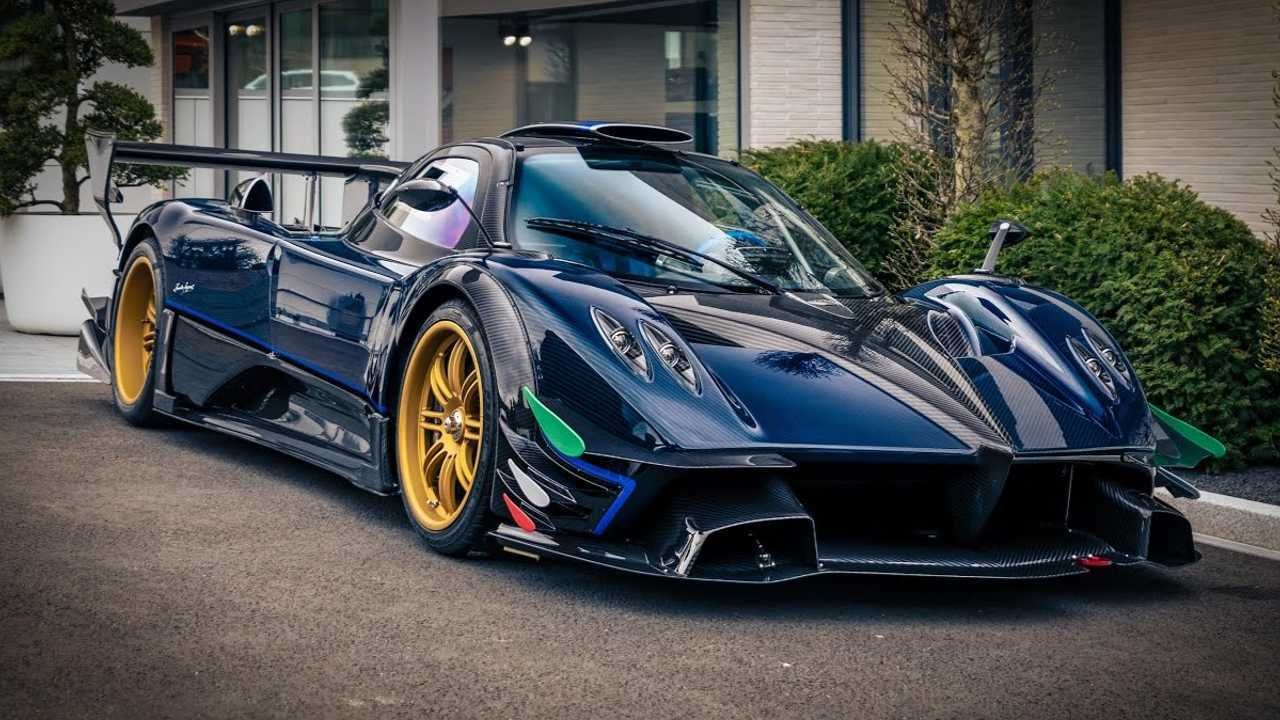
The design of the Zonda R is instantly recognizable, but its dramatic appearance is not simply about visual impact. The bodywork was developed to manage airflow and generate the aerodynamic stability needed for high-speed track driving.
The car features a long, low body with prominent aerodynamic surfaces, a large adjustable rear wing, a flat underbody, and a pronounced rear diffuser. Pagani’s own historical material describes the aerodynamic package as including a front section designed to direct airflow toward the rear wing, along with a sealed floor and rear diffuser.
These details matter because a track car needs more than a powerful engine. At high speed, aerodynamic balance becomes an important part of handling. The body must help the tires maintain contact with the track while keeping drag under control.
The Zonda R’s proportions also reflect its purpose. It measures 4,886 mm long, 2,014 mm wide, and 1,141 mm high, with a 2,785 mm wheelbase. Its low stance and wide footprint contribute to its aggressive track-oriented appearance while supporting its chassis and aerodynamic objectives.
Engine and Power
At the heart of the Zonda R is a 5,987 cc Mercedes-Benz AMG V12. It is naturally aspirated and uses a dry-sump lubrication system. Pagani’s official specification lists 750 hp at 7,500 rpm and 710 Nm of torque at 5,700 rpm.
The engine is particularly important because it is not simply a high-output version of the type of powertrain used in an ordinary luxury car. The Zonda R uses a racing-oriented AMG V12, and Pagani mounted the engine directly into its central structure.
The naturally aspirated layout also gives the engine a distinctive character. Instead of relying on turbochargers to build power, the V12 delivers its performance through displacement, high engine speed, and careful engineering.
Pagani’s technical information identifies the engine as the AMG M120, with 12 cylinders arranged in a 60-degree V configuration and 48 valves. The intake uses mechanically operated individual throttle bodies, while the exhaust system uses hydroformed Inconel with ceramic coating.
The result is an engine that fits the overall philosophy of the car: relatively simple in concept compared with a modern turbocharged hybrid powertrain, but highly specialized in execution.
Speed and Acceleration
The numbers attached to the Zonda R remain impressive because the car combines substantial power with very little weight.
Pagani officially quotes 0–100 km/h in 2.7 seconds and a top speed of more than 350 km/h. Some secondary specifications list a figure around 375 km/h, but Pagani’s own current specification page uses the more conservative “over 350 km/h” description.
Acceleration is only one part of the story, however. A car designed primarily for track use cannot be judged by straight-line speed alone.
The Zonda R weighs only 1,070 kg dry, according to Pagani. Combined with 750 hp, that creates an exceptionally strong power-to-weight relationship. The official technical data works out to roughly 1.43 kg per horsepower, a figure that helps explain the car’s ability to accelerate rapidly while also responding quickly to driver inputs.
This is one of the most important characteristics of the Zonda R. Rather than chasing performance through power alone, Pagani worked to keep the entire car light.
Track Technology
The Zonda R’s transmission and chassis systems were developed around circuit driving.
Power is sent to the rear wheels through an XTRAC 672 six-speed sequential dog-engagement gearbox with an Automac Engineering automated manual system. A self-locking differential helps manage the rear axle, while a 12-stage Bosch Motorsport traction-control system allows the driver to select different levels of electronic assistance.
This level of adjustability is particularly useful on a track because conditions can change from one circuit to another. Drivers can also adapt the electronic systems to their own preferences and the available grip.
The suspension is equally serious. The Zonda R uses independent double-A-arm suspension, forged Avional suspension components, pull-rod springs, and adjustable Öhlins dampers. Pagani also designed the aerodynamic setup to be adjustable, allowing the car to be configured for different circuit demands.
The braking system is based around Brembo carbon-ceramic discs with large six-piston front calipers and four-piston rear calipers. A 12-stage Bosch Motorsport race ABS system helps manage braking performance.
Together, these systems show that the Zonda R was engineered as a complete track machine rather than simply a powerful car with racing bodywork.
Lightweight Construction
Weight reduction is one of the central themes of the Zonda R.
The car’s carbon-titanium monocoque combines stiffness with low mass. Carbon fiber is also used extensively throughout the bodywork and interior structure. Pagani describes the central monocoque as both lighter and more rigid than earlier designs.
The 1,070 kg dry weight becomes even more significant when compared with the amount of performance equipment carried by the car. The Zonda R has a large V12 engine, sophisticated brakes, racing electronics, aerodynamic hardware, safety equipment, and a sequential transmission.
Rather than adding more power to compensate for a heavy structure, Pagani took a different approach. The engineers worked to make the entire machine lighter so that the engine, brakes, suspension, and tires would all have less mass to control.
This philosophy also improves more than acceleration. A lighter car can change direction more quickly, place less demand on its brakes, and put less stress on its tires.
Interior and Driver Focus
Inside the Zonda R, the usual priorities of a luxury grand tourer are replaced by a much more focused environment.
The cabin includes carbon-fiber seats compatible with HANS equipment, five-point harnesses, and a chrome-molybdenum steel roll cage. These are clear indications that the vehicle was designed around circuit driving rather than everyday transportation.
The materials may still have the craftsmanship associated with Pagani, but the layout is fundamentally driver-focused.
There is little reason for unnecessary equipment in a dedicated track car. Instead, the driver needs clear access to the controls, secure seating, useful information, and predictable responses from the car.
That balance between engineering and craftsmanship became one of the defining features of Pagani’s approach. Even when creating an extreme machine, the company continued to treat details such as materials, construction, and presentation as important parts of the experience.
Zonda R vs. Road-Going Zonda
The biggest difference between the Zonda R and road-going Zonda models is their purpose.
A road-going Zonda must operate within the requirements of normal road use. The Zonda R was developed without that same focus. Pagani describes it specifically as a car designed for the racetrack, allowing the engineering team to concentrate on performance without making everyday road usability the priority.
That difference can be seen throughout the vehicle.
The Zonda R has a racing-derived V12, sequential gearbox, racing traction control, adjustable suspension, extensive aerodynamic equipment, racing safety equipment, and a lightweight carbon-titanium structure.
Its longer wheelbase compared with the Zonda F was also part of the development. Pagani says the project was inspired by the F version but developed with dedicated engineering for the track.
So although the Zonda R visually belongs to the Zonda family, its engineering identity is much closer to that of a competition-inspired track machine.
Production and Exclusivity
The Zonda R was never intended to be a mass-produced performance car.
Pagani’s current official Zonda R page lists a limited production run of 15 units.
Pagani has also published later material containing different production references, so figures should be treated carefully when discussing individual examples and related Zonda R derivatives. The important point is that the model was produced in extremely limited numbers, reinforcing its position as a rare collector-focused track car.
Its rarity is only part of the story. The Zonda R also represents a particular moment in performance-car engineering when manufacturers could build extremely specialized naturally aspirated machines without the complexity of modern hybrid systems.
For collectors and enthusiasts, that gives the car significance beyond its outright performance figures.
Nürburgring Achievement
One of the most important moments in the Zonda R’s history came at the Nürburgring Nordschleife.
On 29 June 2010, driver Marc Basseng completed the 20.8-kilometer circuit in a recorded time of 6 minutes 47.50 seconds. Pagani’s own historical material identifies this as a Zonda R record lap, while the company’s press material also lists the Nürburgring achievement at approximately 6:47.
Pagani’s official video description gives the more precise figure of 6:47.5 for the 20.832 km Nordschleife, with Basseng behind the wheel.
The achievement demonstrated why the Zonda R had been developed the way it was. Its lightweight construction, aerodynamic package, racing tires, brakes, suspension, and V12 engine were designed to work together around a demanding circuit.
The Nürburgring result therefore became more than a headline number. It served as a demonstration of the engineering philosophy behind the entire project.
What Makes the Zonda R Special?
The Pagani Zonda R stands out because its performance comes from a combination of carefully developed systems rather than one headline specification.
The 750-hp V12 is obviously important, but the engine would not have the same effect without the 1,070 kg dry weight. The lightweight structure would not be as useful without the sophisticated suspension and brakes. The power would be harder to exploit without the sequential gearbox and adjustable traction control.
The aerodynamic package adds another layer. At high speeds, the car needs stability as well as acceleration, and the Zonda R’s bodywork was designed around that requirement.
This is why the Zonda R remains interesting even years after its introduction. It represents a period when Pagani could take the basic identity of an established supercar and rebuild it almost completely around circuit performance.
The Zonda R Legacy
The influence of the Zonda R can also be seen in later Pagani track cars.
The Zonda Revolución, introduced later, developed the concept further with an 800-hp AMG V12, a magnesium sequential gearbox, and a 1,070 kg weight figure. Pagani also added a Drag Reduction System and other aerodynamic and electronic developments.
The Zonda R therefore became a foundation for an even more extreme expression of Pagani’s track-car philosophy.
Years later, the Huayra R continued the same general idea with a naturally aspirated V12 and a chassis developed specifically for circuit use. Pagani describes the Huayra R as a continuation of more than two decades of research and development focused on track performance.
This gives the Zonda R an important place in the company’s history. It was not simply a special edition of the Zonda. It helped establish the idea that Pagani could create dedicated track machines that combined racing technology with the company’s distinctive approach to design and craftsmanship.
Final Thoughts
The Pagani Zonda R remains one of the clearest examples of what happens when a manufacturer builds a car around the racetrack rather than adapting a road car for occasional circuit use.
Its 750-hp naturally aspirated V12, 1,070 kg dry weight, sequential gearbox, carbon-titanium monocoque, adjustable suspension, racing brakes, and sophisticated electronic systems were all developed with the same objective: creating a highly focused track machine.
Its 2010 Nürburgring performance gave the project an important place in performance-car history, while its extremely limited production made it one of the rarest Zonda variants.
More than a collection of impressive numbers, the Zonda R represents Pagani’s willingness to explore what its engineering could achieve when normal road-car compromises were removed. That combination of power, lightweight construction, aerodynamic development, and meticulous craftsmanship is what continues to make the Zonda R such a fascinating chapter in the history of modern hypercars.
Frequently Asked Questions
1. What is the Pagani Zonda R?
The Pagani Zonda R is a track-focused hypercar developed by Pagani specifically for circuit performance. It is not designed as a conventional road car.
2. How much power does the Pagani Zonda R have?
The Zonda R produces 750 horsepower from its naturally aspirated 5.9-liter Mercedes-AMG V12 engine, with 710 Nm of torque.
3. How fast is the Pagani Zonda R?
Pagani lists a 0–100 km/h time of 2.7 seconds and a top speed of more than 350 km/h, depending on configuration.
4. How much does the Pagani Zonda R weigh?
The Zonda R has an official dry weight of approximately 1,070 kg, helping give it an exceptional power-to-weight ratio.
5. How many Pagani Zonda R cars were made?
Pagani lists the Zonda R as a highly limited model, with 15 examples produced, making it exceptionally rare.