







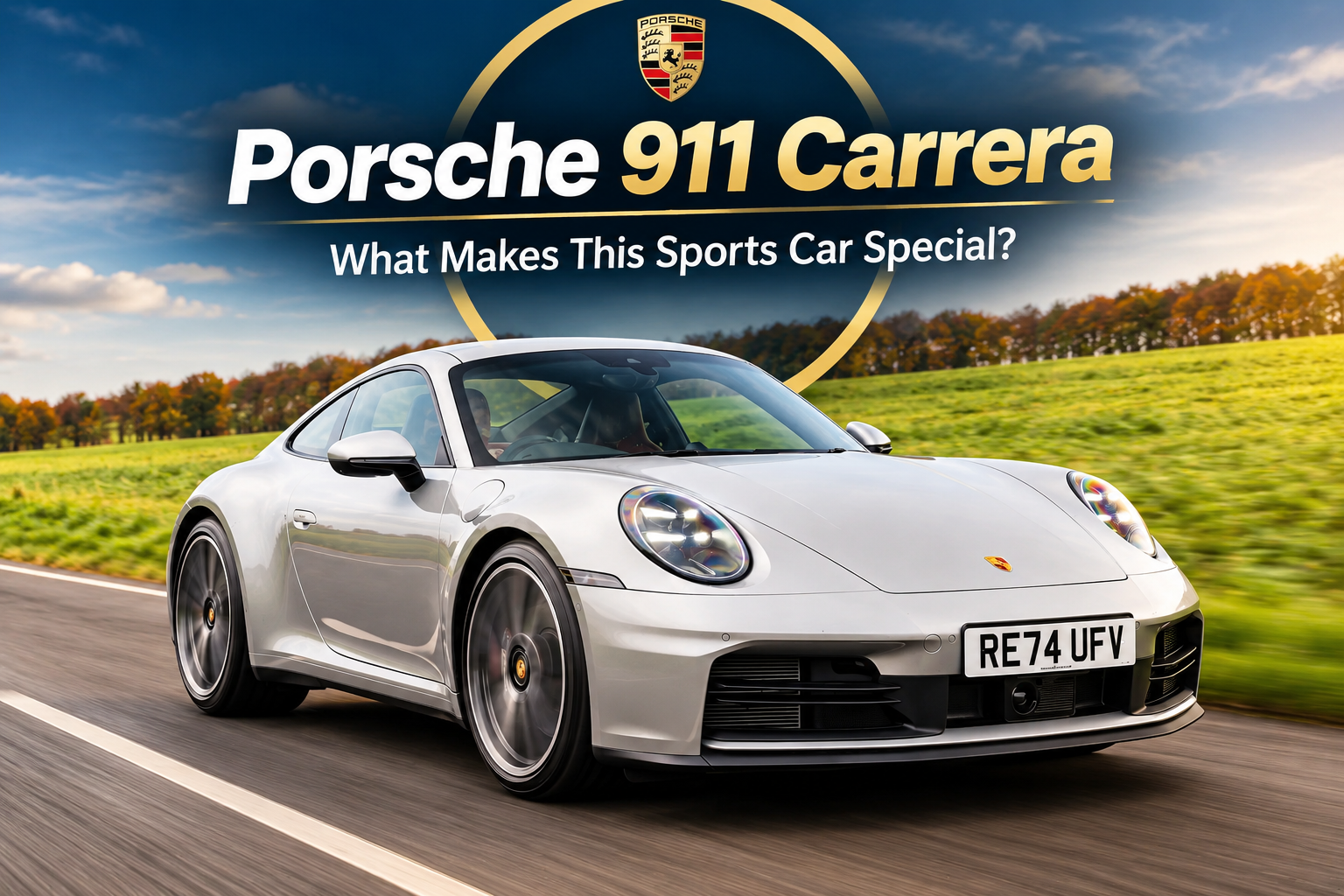
The Porsche 911 Carrera is one of those cars that does not need much introduction. Its shape is instantly recognizable, its name carries decades of history, and its reputation has been built through continuous development rather than short-lived trends. While many sports cars have come and gone, the 911 has remained remarkably consistent in its basic philosophy.
What makes the Carrera particularly interesting is the way it combines performance with everyday usability. It is not simply designed to be fast. Porsche has developed the car around a broader idea: a sports car should be exciting on a winding road while still being comfortable enough for ordinary journeys.
The current 911 Carrera continues that approach with a twin-turbocharged 3.0-liter flat-six engine, modern technology, sophisticated chassis systems, and the unmistakable 911 design. Depending on specification and market, Porsche quotes figures such as 388 hp, a 183-mph top track speed, and a 0–60 mph time of 3.9 seconds for the current Carrera.
But numbers only explain part of the story. The real appeal of the Porsche 911 Carrera comes from how its engineering, design, heritage, and driving character work together.
BIO
| Label | Information |
|---|---|
| Model | Porsche 911 Carrera |
| Type | Luxury sports car |
| Brand | Porsche |
| Engine | 3.0-liter twin-turbo flat-six |
| Cylinders | 6 |
| Power | 388 hp (U.S. spec.) |
| Torque | 331 lb-ft |
| Drivetrain | Rear-wheel drive |
| Transmission | 8-speed PDK automatic |
| 0–60 mph | 3.9 seconds |
| Top Speed | 183 mph |
| Seating | 2+2 |
| Key Strength | Performance with everyday usability |
A Legacy That Goes Back Decades
The story of the Porsche 911 began in the early 1960s. Porsche introduced the car at the Frankfurt Motor Show in 1963 as the Type 901, replacing the Porsche 356. When the car reached the market, its name became 911.
From the beginning, the 911 followed a different formula from many other sports cars. It used a rear-mounted, six-cylinder boxer engine and a compact 2+2 body. Porsche also focused on making the car practical enough for normal road use rather than creating a machine intended only for the racetrack.
That philosophy has survived through multiple generations.
The 911 has changed dramatically underneath its familiar shape, but Porsche has been careful not to erase its identity. The company describes the model as combining sportiness with day-to-day usability, tradition with innovation, and form with functionality.
That balance is a major reason the 911 Carrera remains relevant today.
The Carrera Name Has Racing Roots
The word Carrera is more than a decorative name on the rear of a Porsche. Its connection to the company’s motorsport history goes back to the Carrera Panamericana, a demanding Mexican road race that became important to Porsche’s early reputation.
Porsche later used the Carrera name on high-performance models, including the 356 Carrera. The name became especially significant with the 911 Carrera RS 2.7, introduced in 1972.
The Carrera RS 2.7 was developed with extensive attention to weight, aerodynamics, engine performance, and chassis tuning. Porsche originally planned to produce only enough examples to meet racing homologation requirements, but customer demand proved much stronger than expected.
Today’s 911 Carrera is far removed technologically from that early RS, but the name still carries that connection to Porsche’s performance heritage.
A Design That Has Stayed Recognizable
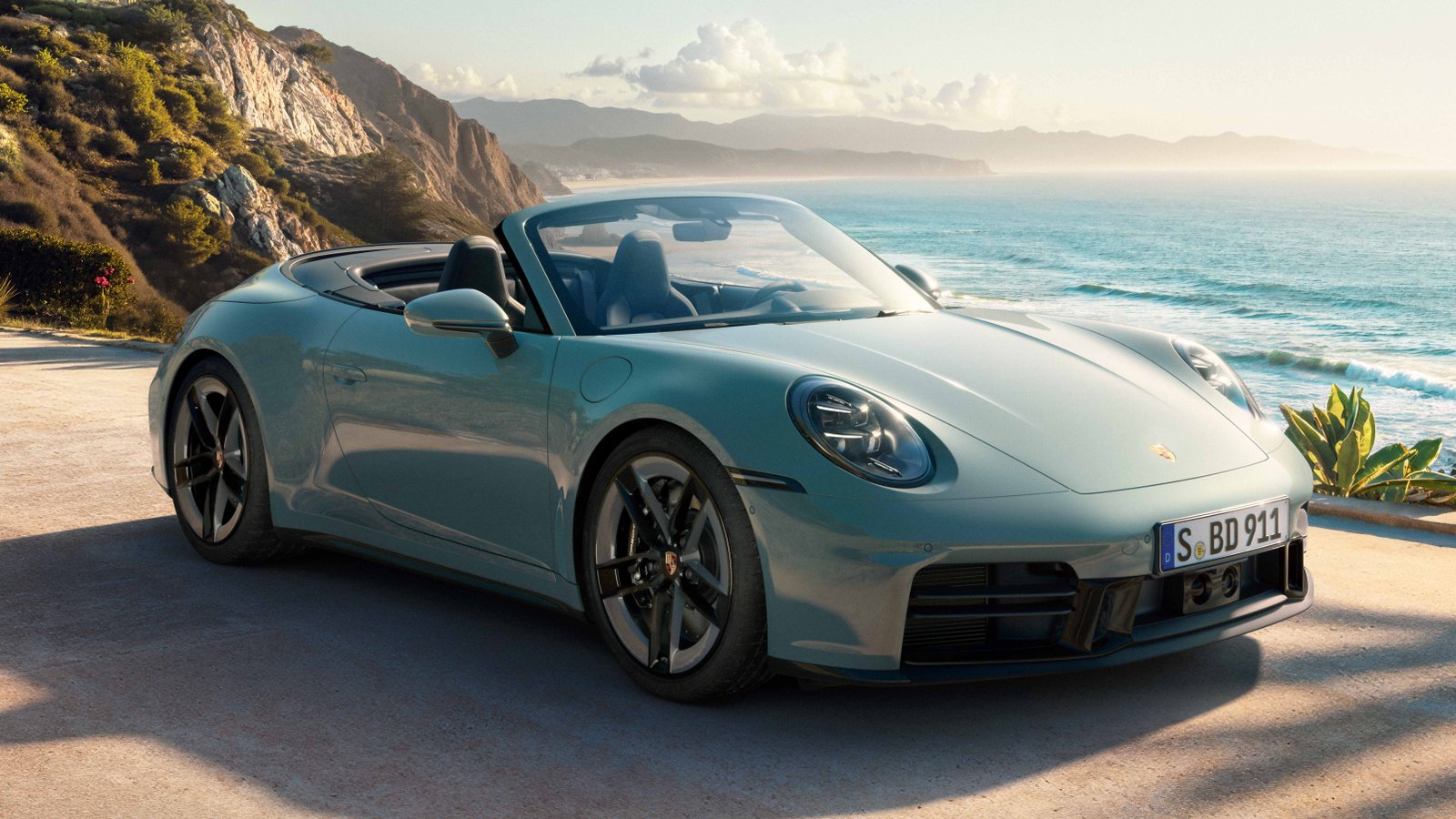
One of the most impressive things about the Porsche 911 Carrera is how recognizable its silhouette remains.
The long, low front section, rounded headlights, gently sloping roof, compact rear section, and broad stance form a design language that has evolved rather than been replaced.
Porsche could have completely redesigned the 911 many times over the decades. Instead, the company has generally chosen refinement. New generations receive sharper details, improved aerodynamics, new lighting technology, and more sophisticated body structures, but the basic visual identity remains intact.
This gives the Carrera an unusual quality. A modern 911 can look contemporary beside newer performance cars while still being immediately connected to its predecessors.
That continuity is not accidental. Porsche has described the original 911’s layout and visual DNA as foundations that continue to influence the modern car.
The Flat-Six Engine
At the heart of the current Porsche 911 Carrera is a 3.0-liter twin-turbocharged flat-six engine.
The horizontally opposed configuration is one of the defining technical features of the 911. Porsche’s official specifications for the current Carrera list six cylinders, 2,981 cc of displacement, 388 hp, and 331 lb-ft of torque in the U.S. specification.
A flat-six engine has its cylinders arranged horizontally in two opposing banks. This allows the engine to have a relatively low profile, which is useful in a sports car where weight distribution and the center of gravity matter.
The twin turbochargers add another important dimension. Instead of relying solely on naturally aspirated engine characteristics, the modern Carrera uses turbocharging to produce strong performance while maintaining the smooth delivery expected from a 911.
The result is an engine that feels very different from the four-cylinder and V8 powerplants found in other performance cars.
Why the Rear-Engine Layout Matters
Perhaps the most unusual feature of the Porsche 911 Carrera is its rear-engine layout.
Most modern performance cars use a front-engine or mid-engine configuration. Porsche has continued developing the rear-engine concept instead. The arrangement is part of the 911’s identity and has been refined considerably through decades of engineering.
Placing the engine toward the rear can provide strong traction because additional weight sits over the driven rear wheels. At the same time, the layout creates particular handling characteristics that Porsche engineers have spent generations understanding and improving.
The modern 911 is therefore not simply an old design kept alive. Its underlying concept has been continuously developed using modern suspension systems, electronic controls, aerodynamics, tires, and chassis engineering.
Porsche itself notes that the rear-mounted flat-six contributes to a low center of gravity because of the engine’s horizontally opposed construction.
Performance Without Losing Usability
The Porsche 911 Carrera’s performance figures are impressive, but what makes the car interesting is how usable that performance can be.
For the current U.S.-market Carrera, Porsche lists a 0–60 mph time of 3.9 seconds and a top track speed of 183 mph. With the Sport Chrono Package, the quoted 0–60 mph figure drops to 3.7 seconds.
Those numbers put the Carrera firmly into serious sports-car territory.
However, the car is not designed around acceleration alone. The steering, braking, suspension, transmission, tires, and electronic systems all contribute to the experience.
A good sports car should make a driver feel involved rather than simply delivering impressive numbers on paper. That is an important part of the 911 Carrera’s character.
The PDK Transmission
The current Carrera uses Porsche’s eight-speed PDK dual-clutch transmission in the automatic configuration.
PDK is designed to change gears extremely quickly while keeping power delivery smooth. Porsche describes the transmission as combining sporty ratios in the lower gears with taller, more efficient ratios in the upper gears.
This makes the Carrera versatile.
In everyday driving, the transmission can shift smoothly without demanding constant attention from the driver. When the road becomes more engaging, it can respond much more aggressively.
For drivers who enjoy changing gears themselves, Porsche also offers Carrera variants with different transmission configurations depending on model and market. The Carrera T, for example, is offered with a manual transmission in Porsche’s current U.S. lineup.
Handling and Driver Confidence
Raw power is only useful when a car can control it effectively.
The Porsche 911 Carrera has built its reputation partly on its ability to combine strong acceleration with precise handling. Its compact dimensions, low center of gravity, rear-engine configuration, suspension engineering, and electronic systems all contribute to its road manners.
The result is a car that can feel composed during ordinary driving but becomes much more responsive when the driver begins to explore its capabilities.
That dual personality is one of the reasons the 911 has such a broad appeal. A specialized track car can be thrilling in the right environment but difficult to live with every day. The Carrera aims for a different balance.
Interior and Everyday Comfort
The cabin of the Porsche 911 Carrera is another important part of the experience.
Rather than treating the interior as an afterthought, Porsche has developed the 911 around the driver. The seating position, controls, displays, materials, and overall layout are designed to create a premium environment while keeping the driver connected to the car.
The 911 is also more practical than its appearance might suggest.
It has a compact rear seating area rather than functioning like a conventional four-door vehicle, so the rear seats are not a substitute for a family sedan. Still, the 2+2 configuration and available luggage space make the Carrera more useful for everyday life than many exotic sports cars.
That distinction matters.
A car can be extremely fast and still be inconvenient. The 911 Carrera’s appeal comes partly from avoiding that extreme.
Technology Meets Tradition
Modern technology has transformed the 911 without completely changing its character.
The current Carrera incorporates digital displays, modern infotainment, connectivity features, and driver-assistance technologies. Porsche Connect also provides connected services and functions through the vehicle and My Porsche ecosystem.
The challenge for Porsche is maintaining a driver’s connection with the car while adding the technology people expect from a modern premium vehicle.
That is where the Carrera’s design philosophy becomes interesting. Technology is there to support the driving experience rather than becoming the entire reason for buying the car.
Comfort on Ordinary Roads
A sports car does not need to feel uncomfortable all the time.
The Porsche 911 Carrera has been developed to handle everyday roads as well as more demanding driving. That means its suspension and chassis have to deal with imperfections, traffic, long journeys, and changing road conditions.
This is an important distinction between the Carrera and more extreme performance variants.
The Carrera can provide a sense of occasion when driven enthusiastically, but it does not require every journey to become a performance event.
For many owners, that flexibility may be one of the strongest reasons to choose a 911.
What Makes the 911 Carrera Different?
There are many fast cars available today. Some offer more horsepower. Others use more aggressive aerodynamics or more specialized chassis systems.
So why does the Porsche 911 Carrera remain special?
The answer is not one particular specification.
It is the combination.
The Carrera has a distinctive engine configuration, a rear-engine layout, recognizable styling, strong performance, premium construction, modern technology, and decades of engineering development behind it.
Few sports cars have maintained such a clear connection between their earliest versions and their modern counterparts.
The original 911 had a six-cylinder boxer engine mounted at the rear. More than six decades later, that basic concept remains part of the modern car.
That continuity gives the Carrera something difficult to manufacture through marketing alone: genuine identity.
Strengths of the Porsche 911 Carrera
The Carrera has several qualities that stand out.
Performance is an obvious strength. Its current engine and transmission combination delivers acceleration that would have seemed extraordinary in earlier generations.
Handling is another major attraction. Porsche has spent decades refining the 911’s unusual layout rather than abandoning it.
Design gives the car an identity that is instantly recognizable without appearing stuck in the past.
Everyday usability separates the Carrera from many highly specialized sports cars. It can be used for commuting, weekend drives, highway journeys, and special occasions.
Heritage also matters. The modern Carrera is part of a model family that has been continuously developed since the 1960s.
A Few Things to Consider
The Porsche 911 Carrera is not perfect for everyone.
Price is an obvious consideration. Porsche’s U.S. site currently lists the Carrera from $135,500 before options, taxes, registration, delivery and other charges, although pricing varies by market and model year.
Options can also add significantly to the final price. Buyers may need to carefully consider which equipment matters to them rather than assuming every desirable feature comes standard.
Practicality is another limitation. The rear seats are small, and anyone looking for a spacious family vehicle would be better served by a larger car.
Ownership costs can also be higher than those of an ordinary passenger car because the Carrera is a sophisticated performance machine.
These points do not diminish the car’s strengths, but they are worth considering before viewing it purely as a dream sports car.
Is the Porsche 911 Carrera Worth Considering?
For someone looking for a sports car that can do more than simply deliver speed, the Porsche 911 Carrera makes a strong case.
It combines a distinctive mechanical layout with modern performance and technology. It can be exciting when the road opens up, yet its design philosophy allows it to remain usable outside of those moments.
The Carrera also offers something less tangible: a sense of continuity.
A modern 911 does not feel like an unrelated replacement for an older model. It feels like another chapter in a story that began more than sixty years ago.
That is difficult for any automotive manufacturer to reproduce.
Frequently Asked Questions
What makes the Porsche 911 Carrera special?
The Porsche 911 Carrera stands out for its combination of performance, distinctive rear-engine architecture, flat-six engine, recognizable design, everyday usability, and long motorsport-inspired heritage.
Is the Porsche 911 Carrera suitable for daily driving?
Yes. Everyday usability has been an important part of the 911 concept since its early years. The Carrera combines sports-car performance with a relatively practical cabin and road-oriented driving characteristics.
How powerful is the current Porsche 911 Carrera?
The current U.S.-market Carrera is rated at 388 hp and 331 lb-ft of torque. Porsche lists a 0–60 mph time of 3.9 seconds and a top track speed of 183 mph.
What engine does the Porsche 911 Carrera use?
The current Carrera uses a 3.0-liter twin-turbocharged six-cylinder boxer engine. Its horizontally opposed layout is one of the defining engineering characteristics of the 911.
Why does Porsche continue using a rear-engine layout?
The rear-engine layout is a core part of the 911’s identity and has been continuously refined. It can provide strong rear-wheel traction while the flat engine helps keep the center of gravity low.
What does Carrera mean in Porsche history?
The Carrera name has roots in Porsche’s motorsport history and is associated with the Carrera Panamericana. Porsche later used the name for high-performance road cars, making it an important part of the brand’s performance heritage.
Conclusion
The Porsche 911 Carrera is special because it has managed to evolve without losing its identity.
Its story began with the original 911 in the 1960s, and Porsche has spent generations improving the formula rather than replacing it. The modern Carrera is faster, more sophisticated, safer, and more technologically advanced than its predecessors, yet the essential ideas remain familiar.
There is still a flat-six engine. There is still a rear-engine layout. There is still the unmistakable 911 silhouette. And there is still an emphasis on making a sports car that can be enjoyed beyond a racetrack.
That combination is what gives the Porsche 911 Carrera its lasting appeal.
It is not simply a car built around impressive specifications. It is the result of decades of careful engineering, design evolution, and an unusually strong commitment to a particular idea of what a sports car should be.
For enthusiasts, that continuity may be the most special feature of all.