








The 2023 Dodge Challenger stands out as one of the most recognizable American muscle cars of its generation. With its wide stance, retro-inspired styling, powerful engines, and surprisingly practical cabin, the Challenger offers a different experience from many modern sports coupes.
The 2023 model year is especially important because it marked the final year of the current Challenger generation. Dodge used the year to celebrate the car’s history with its “Last Call” editions, special colors, badges, and a range of high-performance models.
For buyers, however, the Challenger is about more than horsepower. Different trims offer very different personalities, from the everyday-friendly V6-powered SXT to the seriously powerful SRT models. Understanding those differences can make choosing the right car much easier.
BIO
| Label | Information |
|---|---|
| Model | 2023 Dodge Challenger |
| Brand | Dodge |
| Vehicle Type | Muscle car |
| Model Year | 2023 |
| Seating | Up to 5 passengers |
| Body Style | 2-door coupe |
| Base Engine | 3.6L Pentastar V6 |
| V8 Option | 5.7L HEMI V8 |
| High-Output Engine | Supercharged 6.2L HEMI V8 |
| Transmission | 8-speed automatic or 6-speed manual |
| Drive Type | Rear-wheel drive; AWD available on select trims |
| Top Horsepower | Up to 807 hp |
| Notable Feature | Final model year of the Challenger generation |
2023 Dodge Challenger Overview
The Challenger combines traditional muscle-car character with modern equipment. Its long hood, broad body, recessed grille, and familiar rear-end design give it an unmistakable appearance.
Unlike some newer performance cars that focus heavily on cornering ability, the Challenger emphasizes straight-line performance, comfort, space, and old-school character. Its large cabin and usable rear seats also make it more practical than several of its direct competitors.
The standard Challenger SXT uses a 3.6-liter Pentastar V6, while higher trims introduce increasingly powerful HEMI V8 engines. At the top of the range, supercharged V8 models deliver extraordinary amounts of power.
That broad range is one of the Challenger’s biggest advantages. A buyer can choose a relatively comfortable daily driver or a machine built primarily around high performance.
2023 Dodge Challenger Trims
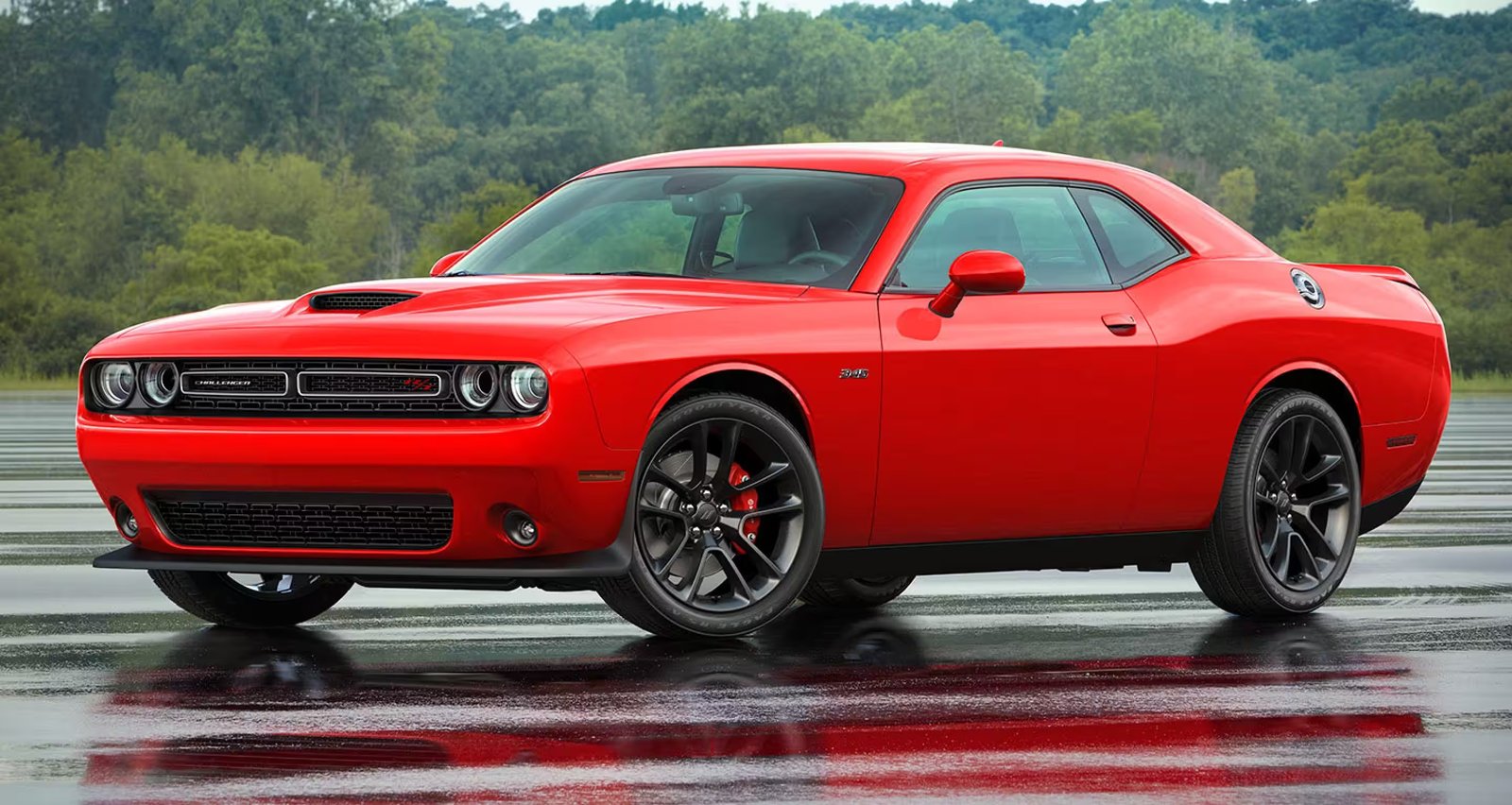
The Challenger lineup was extensive in 2023, with several trims and performance variations available.
The SXT served as an accessible entry point. It used the 3.6-liter V6 and an eight-speed automatic transmission. Rear-wheel drive was standard, while all-wheel drive was available.
The GT offered the same basic V6 powertrain but added more aggressive styling and additional equipment. It was a good choice for someone who wanted Challenger looks without stepping directly into V8 ownership.
The R/T moved into V8 territory with the 5.7-liter HEMI V8. It produced 375 horsepower and 410 lb-ft of torque and could be paired with either a six-speed manual or an eight-speed automatic.
The R/T Scat Pack took a significant step upward with a 6.4-liter HEMI V8 producing 485 horsepower and 475 lb-ft of torque. This version offered a much stronger performance experience without reaching the extreme prices and power levels of the supercharged SRT models.
At the top were the SRT Hellcat, Hellcat Redeye, Super Stock, and Jailbreak models. These versions used supercharged 6.2-liter HEMI V8 engines and were designed for buyers who wanted maximum performance.
Dodge’s official specifications list up to 807 horsepower for the high-output HEMI used in the Super Stock and Jailbreak models.
Engine and Performance
Engine choice is perhaps the most important decision when considering a 2023 Challenger.
The standard 3.6-liter V6 provides a reasonable balance between performance and everyday usability. Car and Driver lists the rear-wheel-drive version at 303 horsepower, with an eight-speed automatic transmission.
For many buyers, the 5.7-liter HEMI V8 is the sweet spot. The R/T produces 375 horsepower and offers the distinctive exhaust note and character that people expect from an American muscle car.
The 6.4-liter HEMI in the R/T Scat Pack increases output to 485 horsepower. It also provides 475 lb-ft of torque, giving the Challenger substantially more acceleration and a stronger performance-focused character.
Then there are the supercharged models. The Hellcat lineup takes the Challenger into another category entirely, with different versions producing well over 700 horsepower. The Redeye produces 797 horsepower, while the Super Stock and Jailbreak can reach 807 horsepower.
For an ordinary buyer, that much power is unnecessary. But it demonstrates why the Challenger became such an important part of modern American performance-car history.
Driving Experience
The Challenger’s driving character is closely connected to its size and weight.
It feels substantial on the road rather than lightweight and delicate. That gives it a stable, planted feeling during highway cruising, but it also means the car does not respond like a smaller sports coupe.
The Challenger is particularly comfortable when driven in a relaxed manner. Its suspension provides a relatively compliant ride, making it suitable for longer journeys. Car and Driver has also noted that the Challenger’s comfortable ride is one of its strengths.
On winding roads, however, the car’s traditional muscle-car character becomes more noticeable. The steering and handling are not as sharp as those of some versions of the Ford Mustang or Chevrolet Camaro.
That is not necessarily a weakness for every buyer. Someone looking for a comfortable muscle car with strong acceleration may actually prefer the Challenger’s personality.
Exterior Design
The exterior is one of the strongest reasons people choose the Challenger.
Instead of chasing an ultra-modern appearance, Dodge retained a design influenced by classic Challenger models. The result is a car that looks immediately recognizable even among newer vehicles.
The long hood and short rear deck give it traditional muscle-car proportions. Wide body versions add even more visual presence through flared fenders and larger wheels.
For 2023, Dodge also brought back several memorable colors and introduced special “Last Call” models to mark the end of the current generation. These included historically inspired colors such as Plum Crazy, B5 Blue, and Sublime Green.
The styling gives the Challenger a strong identity. Even buyers who are not interested in the highest-performance versions can get a car that looks considerably more aggressive than an ordinary coupe.
Interior and Comfort
Inside, the Challenger follows a relatively simple layout.
The cabin does not try to compete with luxury vehicles for premium materials, but it is functional and comfortable. The front seats are well suited to longer drives, while the rear seat is more usable than what many people expect from a performance coupe.
One of the Challenger’s most useful advantages is its interior space. Compared with competitors such as the Camaro, the Challenger offers more room for passengers and cargo. Car and Driver also notes that its trunk provides a meaningful practicality advantage over the Camaro.
The rear seats can also fold down, making it easier to carry larger items.
Visibility toward the rear is less impressive because of the car’s design, so drivers may need some time to become comfortable with its dimensions.
Overall, the interior makes the Challenger more suitable for everyday use than its aggressive exterior might suggest.
Technology and Infotainment
The 2023 Challenger was equipped with Dodge’s Uconnect infotainment system.
Apple CarPlay and Android Auto were available, making it easy for drivers to connect compatible smartphones. Depending on the trim and options, buyers could also choose upgraded audio systems.
Dodge offered available Alpine systems as well as a premium Harman Kardon setup with 18 speakers and 900 watts of power.
The infotainment system is one area where the Challenger’s age is more apparent. While it provides the features most drivers expect, the overall cabin technology does not feel as futuristic as that found in some newer vehicles.
Still, the system is straightforward and practical, which may appeal to drivers who prefer physical controls and an uncomplicated interface.
Safety Features
Safety equipment varied according to trim and options.
Available features included blind-spot monitoring, rear cross-traffic alert, adaptive cruise control, and automatic high-beam headlights.
The Challenger also benefits from its substantial size and structure, but buyers should remember that safety depends on more than vehicle size or power. Driver behavior, road conditions, tires, braking systems, and proper maintenance all matter.
For anyone considering a used 2023 Challenger, checking the individual vehicle’s history is particularly important. A clean history and evidence of proper maintenance can tell you much more about a particular used example than the model’s specifications alone.
Fuel Economy
Fuel economy depends heavily on the engine and drivetrain.
The rear-wheel-drive V6 Challenger is rated at approximately 19 mpg city and 30 mpg highway, according to Car and Driver’s reported EPA figures. All-wheel drive reduces those figures somewhat.
The 5.7-liter V8 is rated at up to about 16 mpg city and 25 mpg highway, while the 6.4-liter V8 is rated at up to approximately 15 mpg city and 24 mpg highway.
Supercharged V8 models naturally require more fuel, particularly when their performance is used frequently.
For buyers who drive long distances every day, the V6 can make more sense. Someone buying a Challenger mainly for weekend enjoyment may be more willing to accept the higher fuel costs of a V8.
Pricing
Pricing varied considerably across the 2023 Challenger lineup.
Car and Driver lists the regular 2023 Challenger range at roughly $34,395 to $58,855, depending on trim and equipment, while the SRT Hellcat lineup started considerably higher.
The original new-car price is no longer the only consideration for someone shopping today. Since the 2023 Challenger is now a used vehicle, condition, mileage, ownership history, modifications, and local market demand can have a major effect on its current value.
Special editions may also command different prices because of their limited production and collector interest.
A buyer should therefore compare several similar vehicles rather than assuming that every 2023 Challenger will have the same value.
Ownership and Maintenance
Owning a Challenger requires more than simply paying the purchase price.
Routine maintenance remains important, especially for high-performance versions. Engine oil, tires, brakes, fluids, suspension components, and other wear items should be inspected according to the manufacturer’s maintenance requirements.
Performance models can cost more to maintain because larger brakes, wider tires, and high-performance components may be more expensive to replace.
Tire condition deserves particular attention on used performance cars. A vehicle that has been driven aggressively can experience faster wear, so buyers should inspect the tires carefully and look for uneven wear.
Insurance costs can also vary significantly depending on the engine, trim, driver profile, location, and insurer. A high-powered SRT model may cost substantially more to insure than a V6-powered Challenger.
Pros and Cons
The biggest advantage of the 2023 Dodge Challenger is its character.
Few modern cars combine retro muscle-car styling, a spacious cabin, rear-seat practicality, and such a broad range of engines.
Pros
- Distinctive retro-inspired design
- Wide range of engine choices
- Strong V8 performance
- Available all-wheel drive on V6 models
- Comfortable ride
- Useful rear seats
- Large trunk for the class
- Available manual transmission on selected V8 models
- Extremely powerful SRT versions
Cons
- Large and heavy compared with some rivals
- Handling is less agile than some competitors
- V8 models use considerably more fuel
- Cabin materials are not especially luxurious
- Rear visibility can be limited
- Advanced driver-assistance technology is not as comprehensive as in some newer cars
Challenger vs. Mustang and Camaro
The Challenger competed directly with the Ford Mustang and Chevrolet Camaro, but each car took a slightly different approach.
The Mustang generally emphasizes a balance of performance and handling. It can feel more responsive on winding roads and has a broad performance lineup.
The Camaro is also known for its handling ability and driver-focused character. Its cabin, however, is less spacious than the Challenger’s.
The Challenger focuses more heavily on traditional American muscle-car qualities. It provides a large cabin, comfortable ride, strong straight-line performance, and unmistakable styling.
Therefore, there is no single winner for every driver. Someone who enjoys winding roads may prefer the driving characteristics of a Mustang or Camaro, while someone who values classic styling and V8 character may find the Challenger more appealing.
Which Trim Should You Buy?
Choosing the right trim depends on what you actually need.
The SXT makes sense for someone who wants Challenger styling and everyday usability without paying for a V8.
The GT adds more visual aggression and equipment while retaining the V6 powertrain.
The R/T is an appealing choice for buyers who specifically want a traditional HEMI V8. Its 375 horsepower provides plenty of performance without reaching the extreme levels of the Hellcat family.
The R/T Scat Pack is a strong option for enthusiasts who want serious naturally aspirated V8 performance. Its 485-horsepower 6.4-liter engine puts it firmly into performance-car territory.
The Hellcat family is aimed at a much narrower audience. With supercharged V8 power reaching 807 horsepower in certain versions, these cars offer performance far beyond what most drivers need for normal transportation.
For most buyers, choosing the car based on intended use is more sensible than simply choosing the most powerful model.
What to Check Before Buying Used
A used 2023 Challenger should be inspected carefully before purchase.
Start with the vehicle history. Look for accident records, ownership history, service records, and any signs that major components have been replaced.
Next, inspect the engine bay for leaks or obvious signs of poor maintenance. During a test drive, pay attention to the transmission, steering, brakes, suspension, and unusual noises.
The tires are also worth checking closely. Uneven wear can sometimes indicate alignment or suspension problems.
The interior should be checked for working infotainment, climate controls, windows, locks, seats, lighting, and other electronic equipment.
A professional pre-purchase inspection is a sensible step when buying a used performance vehicle. It can identify issues that are difficult to spot during a short test drive.
Is the 2023 Dodge Challenger Worth Buying?
The 2023 Dodge Challenger remains an appealing choice for buyers who want something different from a modern, technology-heavy sports car.
Its biggest strength is personality. The design looks back to classic muscle cars, while the available engines range from a practical V6 to some of the most powerful factory V8 configurations available during the model’s final year.
The Challenger also offers more everyday practicality than its appearance suggests. Its usable rear seat, relatively large trunk, and comfortable ride make it easier to live with than many traditional two-door performance cars.
However, buyers should understand its compromises. The car is large, fuel economy can be poor with V8 engines, and its handling is not as sharp as some competitors.
For someone who values classic American styling, strong acceleration, V8 sound, comfort, and personality, those compromises may be easy to accept.
Final Thoughts
The 2023 Dodge Challenger represents the closing chapter of an important era for American muscle cars. Its final model year brought together the familiar retro design, a wide engine lineup, modern connectivity, useful interior space, and some remarkable high-performance variants.
The best Challenger is not necessarily the one with the biggest horsepower number. For many buyers, the R/T or Scat Pack may offer a more balanced combination of performance and everyday usability, while the V6 models can make more sense for regular commuting.
The most important thing is to choose a trim that fits your driving habits and budget.
As a final-generation model, the 2023 Challenger also has a special place in Dodge history. For buyers who appreciate traditional muscle-car design and want a modern example of that formula, it remains a distinctive and memorable choice.
Frequently Asked Questions
Is the 2023 Dodge Challenger a good car?
Yes. The 2023 Dodge Challenger combines classic muscle-car styling, strong engine choices, comfortable seating, and useful everyday practicality. It also offers available all-wheel drive on SXT models.
What engines are available in the 2023 Dodge Challenger?
The lineup includes a 3.6-liter Pentastar V6, 5.7-liter HEMI V8, 392 HEMI V8, and supercharged 6.2-liter HEMI V8. The highest-output versions reach 807 horsepower.
How many people can the 2023 Dodge Challenger seat?
The 2023 Challenger provides seating for five passengers, giving it an advantage in practicality over many traditional performance coupes.
Does the 2023 Dodge Challenger have Apple CarPlay?
Yes. The 2023 Challenger supports Apple CarPlay and Android Auto, along with an available 8.4-inch touchscreen infotainment system.
Is the 2023 Dodge Challenger the final model year?
Yes. The 2023 model year marked the end of the Challenger’s production era. Dodge states that Challenger production ended on December 31, 2023.