





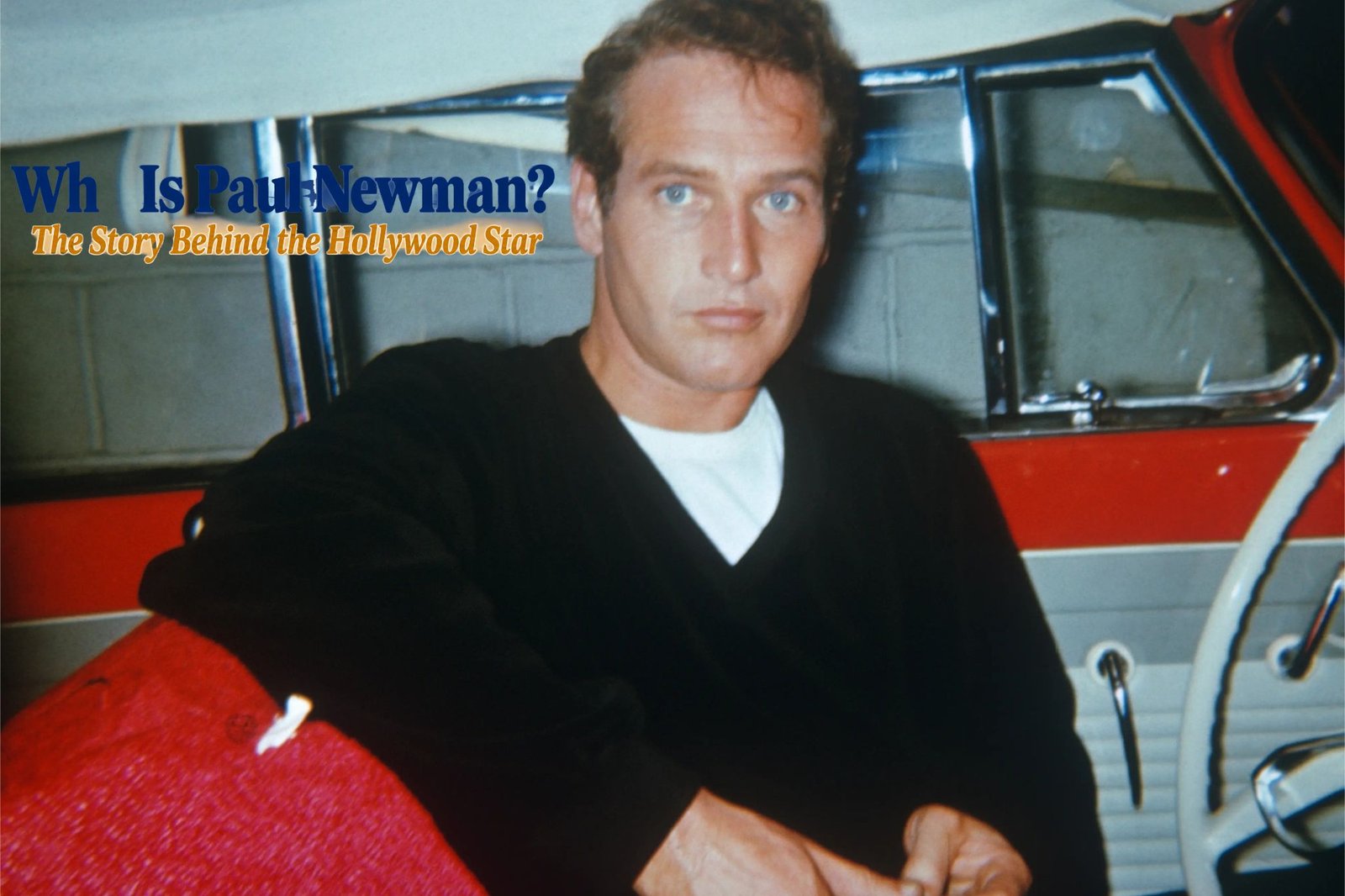
Paul Newman was one of the most respected actors in Hollywood history. Known for his striking blue eyes, natural acting style, and memorable film performances, he built a career that lasted for more than five decades. However, his life was about much more than movies. He was also a professional race car driver, film director, businessman, and philanthropist who dedicated much of his success to helping others.
From his early days in Ohio to his rise as an international movie star, Newman followed a path that brought him recognition in several different fields. Films such as Cool Hand Luke, Butch Cassidy and the Sundance Kid, and The Sting helped establish his place in cinema. Later, his work with Newman’s Own turned a simple food business into a lasting charitable enterprise.
So, who is Paul Newman, and what made his story so memorable? His life offers a fascinating look at talent, personal ambition, family, and the importance of giving back.
BIO
| Label | Information |
|---|---|
| Full Name | Paul Leonard Newman |
| Known As | Paul Newman |
| Date of Birth | January 26, 1925 |
| Birthplace | Shaker Heights, Ohio, USA |
| Date of Death | September 26, 2008 |
| Age at Death | 83 years |
| Nationality | American |
| Profession | Actor, Director, Race Car Driver, Philanthropist |
| Wife | Joanne Woodward |
| Children | Six |
| Famous Movies | Cool Hand Luke, The Hustler, The Sting |
| Academy Award | Best Actor for The Color of Money (1986) |
| Charity Work | Newman’s Own and Hole in the Wall Gang Camp |
Who Was Paul Newman?
Paul Leonard Newman was an American actor, director, race car driver, and philanthropist. He was born on January 26, 1925, in Ohio and died on September 26, 2008, at the age of 83. Over the course of his career, he became known for playing complex characters who often challenged authority or struggled with difficult personal circumstances.
Newman was not limited to one kind of role. He appeared in dramas, westerns, crime films, sports movies, and comedies. His performances often combined confidence, humor, and emotional depth, allowing him to portray characters who felt believable rather than simply heroic.
His achievements extended beyond the entertainment industry. Newman competed in professional motorsports, supported social causes, and helped establish a business that directed its profits toward charitable work. These accomplishments made him a distinctive figure whose influence reached far beyond the movie screen.
Paul Newman’s Early Life
Paul Newman grew up in Shaker Heights, Ohio, near Cleveland. His father, Arthur Newman, operated a sporting goods business, while his mother, Theresa, encouraged his early interest in the arts. He also had an older brother, Arthur, who later became involved in business.
Newman developed an interest in acting while he was young. As a child, he participated in school productions and local theater, discovering that he enjoyed performing in front of an audience. Although acting would eventually become his profession, his early life included other interests and responsibilities.
His family background also exposed him to the practical side of running a business. His father’s work helped Newman understand the effort involved in building something that could support a family. Years later, these experiences would become relevant when he established his own business and approached it with an unusual attitude toward profit.
Education and Military Service
During World War II, Newman served in the United States Navy. He trained for aviation-related duties but did not become a combat pilot. His military service took place in the Pacific theater, where he worked as a radioman and gunner.
After the war, Newman returned to civilian life and continued his education. He attended Kenyon College in Ohio, where he studied and participated in theater activities. He later received further acting training at Yale School of Drama.
These experiences helped him develop the discipline and technical skills needed for a professional acting career. Rather than relying entirely on natural charisma, Newman worked to understand the craft of performance and the demands of the stage.
How Paul Newman Started His Acting Career
Newman’s professional acting career began with theater, television, and stage performances before he became a major film star. In 1953, he made his Broadway debut in Picnic, a production that helped introduce him to a wider entertainment audience.
The experience was important for another reason: he met actress Joanne Woodward, who would later become his second wife. Their relationship eventually developed alongside their careers, and the two would work together on several projects over the years.
Newman made his film debut in The Silver Chalice in 1954. The movie did not establish him immediately as a major star, and he continued to develop his skills while searching for stronger opportunities.
His early years in Hollywood were a period of learning and adjustment. He had to prove that he could do more than attract attention with his appearance. His later performances demonstrated his ability to convey frustration, vulnerability, ambition, and humor with remarkable subtlety.
Paul Newman’s Rise to Hollywood Fame
Newman’s career gained momentum during the 1950s. One of his important early successes came with Somebody Up There Likes Me (1956), in which he played boxer Rocky Graziano. The performance helped demonstrate his ability to portray determined characters whose lives were shaped by difficult circumstances.
In 1958, he appeared in Cat on a Hot Tin Roof, an adaptation of Tennessee Williams’s play. The film brought him wider recognition and showcased his ability to handle emotionally complicated material.
Another important film from that period was The Long, Hot Summer (1958). It helped strengthen his position as a leading actor and brought him closer to the kind of career that would define the following decades.
Newman stood out because his characters were rarely simple. Even when he played a confident or rebellious man, he could suggest uncertainty and conflict beneath the surface. This combination gave his performances a distinctive quality and helped him remain relevant as Hollywood changed.
Paul Newman’s Most Famous Movies
Newman appeared in numerous films, but several performances became especially important to his reputation. These movies introduced him to different generations of viewers and demonstrated the range of his acting.
The Hustler
Released in 1961, The Hustler featured Newman as Eddie Felson, a talented pool player whose ambition and pride influence his decisions. The film examines competition, self-confidence, and the personal costs of pursuing success.
Newman’s performance earned him an Academy Award nomination for Best Actor. The character also became significant later in his career when he returned to the role in The Color of Money.
Hud
In Hud (1963), Newman played Hud Bannon, a complicated and often selfish man living on a Texas ranch. The film explored family conflict, personal responsibility, and changing values in rural America.
The performance earned Newman another Academy Award nomination. It also showed his willingness to take on characters who were difficult to admire but interesting to understand.
Cool Hand Luke
Released in 1967, Cool Hand Luke is one of Newman’s most recognizable films. He played Luke Jackson, a prisoner whose independent spirit brings him into conflict with the authorities who control his life.
The movie became widely remembered for its examination of individuality, resistance, and the human desire for dignity. Newman’s restrained performance helped make Luke a memorable screen character.
The film remains an important part of his legacy because it captured many of the qualities associated with his work: independence, quiet humor, and an unwillingness to accept easy answers.
Butch Cassidy and the Sundance Kid
In 1969, Newman starred opposite Robert Redford in Butch Cassidy and the Sundance Kid. Newman played Butch Cassidy, while Redford portrayed the Sundance Kid.
The film combined western adventure with humor and friendship. The chemistry between the two actors helped make it a major success, and their partnership became one of the best-known collaborations in American cinema.
The movie also challenged traditional western conventions by giving its leading characters a conversational, playful quality. Their performances helped create a film that audiences continued to enjoy long after its original release.
The Sting
Newman and Redford reunited for The Sting in 1973. Set during the 1930s, the crime film follows two professional con artists as they plan an elaborate scheme against a powerful criminal.
The movie received widespread acclaim and won the Academy Award for Best Picture. Newman’s role as Henry Gondorff allowed him to combine wit, confidence, and comic timing with the dramatic skills that had defined his earlier performances.
The success of The Sting further established the Newman-Redford partnership as a memorable chapter in Hollywood history.
The Verdict
In The Verdict (1982), Newman played Frank Galvin, a struggling lawyer who takes on a difficult medical negligence case. The character is far removed from the confident heroes often associated with movie stardom.
Galvin is imperfect, discouraged, and uncertain about his future. Newman portrayed these qualities with restraint, making the character’s efforts to regain his sense of purpose feel convincing.
The performance earned him another Academy Award nomination and demonstrated that his acting remained powerful as he grew older.
The Color of Money
Newman returned to his earlier character Eddie Felson in The Color of Money (1986), directed by Martin Scorsese. The story follows an older pool player who becomes involved in the career of a younger competitor.
This time, Newman won the Academy Award for Best Actor. The award recognized a performance that drew on the character’s earlier history while showing how experience and ambition can change a person.
The win was a major milestone in a career that had already included many acclaimed performances.
Road to Perdition and Cars
Newman continued acting into the 2000s. In Road to Perdition (2002), he played John Rooney, a powerful crime figure whose relationship with his son and his associates shapes the film’s emotional conflict.
He also introduced himself to a younger audience through the animated film Cars (2006), providing the voice of Doc Hudson. The character is a retired racing car whose knowledge and experience help a younger driver understand the importance of humility and friendship.
The role was especially fitting because it connected two of Newman’s major interests: storytelling and motorsports.
Paul Newman’s Awards and Achievements
Newman’s career brought him some of the entertainment industry’s highest honors. He received numerous Academy Award nominations and won the Best Actor Oscar for The Color of Money.
He also received an Honorary Academy Award in 1986 in recognition of his contributions to cinema. In 1994, he received the Jean Hersholt Humanitarian Award for his charitable work.
His honors included Golden Globe Awards, a BAFTA Award, a Primetime Emmy Award, and recognition from other film and television organizations.
These achievements reflected more than the popularity of individual movies. They demonstrated his ability to sustain a respected career across several decades while continuing to explore different kinds of characters.
Newman also worked behind the camera. His directorial debut in feature films was Rachel, Rachel (1968), which starred Joanne Woodward. The film received critical attention and an Academy Award nomination for Best Picture.
His work as a director showed that his interest in cinema extended beyond acting. He was also interested in shaping stories and helping other performers bring their characters to life.
Paul Newman’s Passion for Car Racing
Acting was not Newman’s only professional pursuit. He developed a serious interest in motorsports while preparing for the 1969 racing film Winning. The experience introduced him to the technical demands and excitement of competitive driving.
Unlike many celebrities who treat racing as a casual hobby, Newman pursued the sport with considerable commitment. He competed in Sports Car Club of America events and earned several national championships.
One of the most notable achievements of his racing career came in 1979, when he finished second overall at the 24 Hours of Le Mans. The event is one of the world’s best-known endurance races and requires drivers and teams to maintain speed and reliability over an extended competition.
Newman continued to participate in racing for years. He also became involved in racing-team ownership, working with partners to build competitive teams in professional motorsports.
His success in racing reflected qualities that also supported his acting career: patience, concentration, preparation, and a willingness to keep learning. For Newman, driving was not simply a way to extend his public image. It was a serious interest that he pursued in its own right.
Paul Newman and Joanne Woodward
Paul Newman and Joanne Woodward shared one of Hollywood’s most enduring marriages. They met while working in theater and married in 1958. Their relationship lasted until Newman’s death in 2008.
Woodward was an accomplished actress in her own right, winning the Academy Award for Best Actress for The Three Faces of Eve (1957). Their shared interest in acting created opportunities for collaboration, including Rachel, Rachel and other film projects.
Although they were well-known public figures, Newman and Woodward generally maintained a relatively private family life. They raised their children away from some of the pressures of Hollywood publicity and spent many years living in Connecticut.
Their marriage attracted public attention because it lasted for five decades in an industry often associated with short-lived relationships. However, the couple’s story was not simply a public image. It involved two working artists balancing careers, family responsibilities, and personal lives over many years.
Woodward remained an important part of Newman’s life and creative world. Their partnership was one of the defining relationships in his personal history.
Paul Newman’s Children and Family Life
Newman had six children from his two marriages. His first marriage was to Jacqueline Witte, with whom he had three children. After their marriage ended, he married Joanne Woodward, and they had three daughters together.
Although his career brought him international recognition, Newman did not make his family the center of his public image. He generally preferred to keep personal matters private and allowed his children to develop lives beyond his celebrity status.
Balancing family life with a demanding acting career was not always simple. Film production often involved travel and long working hours, while his other interests added further commitments.
Newman’s family history was also more complicated than the glamorous image associated with Hollywood. Like many families, it included both happy experiences and difficult periods. His public legacy is best understood by recognizing his professional achievements without assuming that fame made every part of his private life easy.
Newman’s Own: A Business Built Around Giving
One of the most distinctive chapters in Newman’s life began in 1982, when he and writer A. E. Hotchner launched Newman’s Own. The business grew from homemade salad dressing that Newman had shared with friends.
The product became popular, and the partners decided to direct the business’s profits toward charitable causes rather than treating the company as a conventional way to build personal wealth.
That decision became the central idea behind the brand. Newman used his public recognition to promote products while ensuring that the business supported a wider purpose.
Over time, Newman’s Own expanded beyond salad dressing into other food products. The enterprise demonstrated that a recognizable commercial brand could be used to generate resources for charitable work.
Newman’s Own Foundation was established to help carry this mission forward. According to the foundation, the enterprise has donated hundreds of millions of dollars to charitable causes since its beginning.
The business was especially meaningful because it connected Newman’s everyday interests with his belief that people who have benefited from good fortune should help others. It also gave consumers a straightforward way to support charitable work through ordinary purchases.
Paul Newman’s Philanthropy and Humanitarian Work
Newman’s charitable activities were a major part of his life. He supported causes related to children, education, social justice, and community well-being. His philanthropy was not limited to making occasional donations; he helped establish organizations designed to provide continuing support.
The Hole in the Wall Gang Camp
In 1988, Newman founded the Hole in the Wall Gang Camp in Connecticut. The camp was created for children living with serious illnesses and offered opportunities for recreation, friendship, and outdoor activities in a supportive environment.
Its purpose was to let children enjoy many of the experiences associated with a traditional summer camp while receiving care suited to their medical needs.
The organization later became part of the broader SeriousFun Children’s Network, which supports camps and programs serving children with serious illnesses and their families.
The camp reflected Newman’s practical approach to philanthropy. Instead of focusing only on fundraising, he helped create a place where children could participate in enjoyable activities and build confidence in a welcoming community.
Social Causes and Public Advocacy
Newman also supported civil rights and other social causes. He attended the 1963 March on Washington and used his public profile to draw attention to issues he considered important.
He spoke out on political and social questions throughout his life, although his acting career remained the main reason most audiences knew him.
His approach to philanthropy was closely connected to his belief that success carries responsibilities. He viewed charitable work as a way to use personal resources and public influence to make a practical difference in people’s lives.
His efforts helped establish a legacy that continued after his death, demonstrating that philanthropy can be built around long-term programs rather than one-time gestures.
Paul Newman’s Personal Style and Public Image
Newman was widely recognized for his blue eyes and understated screen presence, but his reputation rested on more than appearance. His performances often combined confidence with self-awareness, and he was particularly effective at portraying characters who resisted authority or questioned conventional expectations.
Away from the screen, he was known for his humor and his reluctance to take celebrity culture too seriously. He did not always behave like a typical Hollywood star, and he frequently directed attention toward his work, interests, or charitable projects rather than his appearance.
Newman also valued privacy. While he gave interviews and participated in public events, he did not make every aspect of his personal life available for public discussion.
This combination of professional achievement, humor, and independent thinking helped distinguish him from many other actors of his generation. His reputation developed through decades of work rather than through one successful film or a carefully maintained public image.
When Did Paul Newman Die?
Paul Newman died on September 26, 2008, at the age of 83. He died from lung cancer at his home in Westport, Connecticut.
News of his death prompted tributes from actors, filmmakers, racing colleagues, charitable organizations, and audiences around the world. Many remembered his performances, while others highlighted his commitment to philanthropy and his achievements outside the entertainment industry.
His death marked the end of a remarkable career, but it did not end the work he had helped establish. His films continued to be watched, his racing achievements remained part of motorsports history, and the organizations associated with his charitable efforts continued their work.
For many admirers, this combination of creative achievement and public service was central to what made Newman different from an ordinary movie star.
Paul Newman’s Lasting Legacy
Paul Newman’s legacy reaches across several fields. In cinema, he is remembered for performances that combined intelligence, humor, and emotional complexity. His films continue to introduce his work to new audiences, while his collaborations with actors such as Robert Redford remain important moments in Hollywood history.
In motorsports, he demonstrated that a successful acting career did not prevent him from becoming a serious competitor. His achievements as a driver and team owner earned him respect among people who valued racing for its own challenges.
His charitable work may be the part of his legacy with the most direct effect on people’s lives. Newman’s Own and the organizations connected with his philanthropy helped direct substantial resources toward causes serving children and communities.
His life also offers a broader lesson about the use of success. Newman built a distinguished career, pursued interests beyond acting, and helped create a business model in which commercial activity supported charitable giving.
He was not defined by a single role, award, or achievement. Instead, his story is the story of a person who continued exploring new opportunities throughout his life and used some of his success to support others.
Conclusion
So, who is Paul Newman? He was an award-winning American actor whose performances helped shape modern Hollywood, a dedicated race car driver, a film director, and a philanthropist who believed that success should benefit more than one person.
From The Hustler and Cool Hand Luke to Butch Cassidy and the Sundance Kid and The Color of Money, his films gave audiences characters they could remember and discuss. His racing career revealed a competitive side that existed beyond acting, while Newman’s Own demonstrated his commitment to charitable giving.
His marriage to Joanne Woodward, his family life, and his long-standing humanitarian work added further dimensions to his story. Although he died in 2008, the films he made and the organizations he helped establish continue to reflect his influence.
Paul Newman remains an important figure because his life combined artistic achievement with a genuine effort to contribute to the wider world. His story is not only about becoming a Hollywood star; it is also about finding meaningful ways to use the opportunities that success can bring.
Frequently Asked Questions
Who was Paul Newman?
Paul Newman was an American actor, film director, race car driver, and philanthropist. He became famous for films such as Cool Hand Luke, The Sting, and The Color of Money.
When was Paul Newman born?
Paul Newman was born on January 26, 1925, in Ohio, United States.
How old was Paul Newman when he died?
He was 83 years old when he died on September 26, 2008.
Who was Paul Newman married to?
Newman was married to actress Joanne Woodward from 1958 until his death in 2008. He was previously married to Jacqueline Witte.
How many children did Paul Newman have?
Paul Newman had six children from his two marriages.
Did Paul Newman win an Academy Award?
Yes. He won the Academy Award for Best Actor for his performance in The Color of Money (1986). He also received an Honorary Academy Award and the Jean Hersholt Humanitarian Award.
Was Paul Newman a race car driver?
Yes. Newman competed in professional motorsports, earned several national championships, and finished second overall at the 24 Hours of Le Mans in 1979.
What was Newman’s Own?
Newman’s Own is a food company founded by Paul Newman and A. E. Hotchner in 1982. It was established with the principle that profits would support charitable causes.
What was Paul Newman’s most famous movie?
Several films are closely associated with Newman, including Cool Hand Luke, The Hustler, Butch Cassidy and the Sundance Kid, The Sting, and The Color of Money. Which is considered his most famous can depend on the audience and the criteria used.
What is Paul Newman remembered for today?
Newman is remembered for his influential acting career, achievements in motorsports, long marriage to Joanne Woodward, and charitable work through Newman’s Own and the Hole in the Wall Gang Camp.