





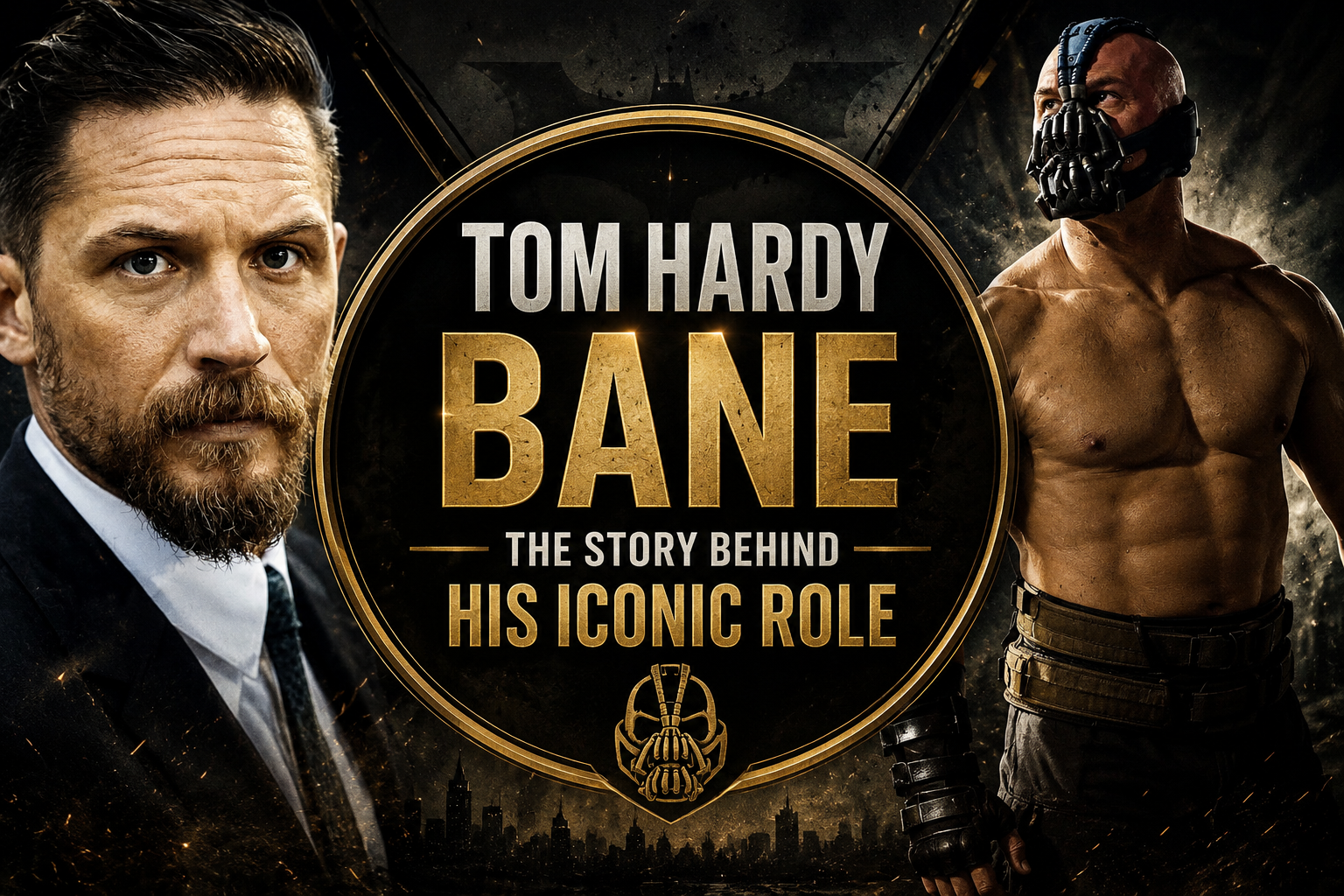
When Tom Hardy Bane is mentioned, most movie fans immediately picture the imposing villain from The Dark Knight Rises. With his distinctive mask, unusual voice, physical presence, and calm but intimidating personality, Hardy created a version of Bane that was very different from the typical comic-book villain.
Directed by Christopher Nolan, The Dark Knight Rises arrived in 2012 as the final chapter of Nolan’s Batman trilogy. Christian Bale returned as Bruce Wayne and Batman, while Tom Hardy stepped into the role of Bane, the powerful antagonist determined to bring Gotham City to its knees.
Bane’s importance in the film goes beyond his strength. He is presented as someone who understands fear, organization, politics, and psychological pressure. Hardy’s performance helped make that combination convincing. Instead of simply playing Bane as a physically powerful fighter, he gave the character a controlled personality and a distinctive way of speaking.
The result was one of the most recognizable villain performances in modern superhero cinema.
BIO
| Label | Information |
|---|---|
| Character | Bane |
| Actor | Tom Hardy |
| Film | The Dark Knight Rises |
| Release Year | 2012 |
| Director | Christopher Nolan |
| Role | Main Villain |
| Franchise | Batman |
| Character Type | Supervillain |
| Known For | Strength and intelligence |
| Signature Feature | Distinctive mask |
| Main Opponent | Batman |
| Setting | Gotham City |
Who Is Bane?
Bane is one of Batman’s most formidable enemies in DC Comics. Traditionally, the character is associated with exceptional physical strength, intelligence, and a complicated history. He has often been portrayed as someone capable of challenging Batman both physically and mentally.
For The Dark Knight Rises, however, Christopher Nolan and his creative team adapted Bane to fit the grounded world established by the earlier films.
This version of Bane is a highly organized revolutionary leader. He does not simply arrive in Gotham looking for a fight with Batman. He has a larger plan, a group of followers, and a clear understanding of how to manipulate the city.
That makes his threat feel larger than a conventional superhero battle.
Bane also has a personal connection to the film’s wider story. His relationship with Talia al Ghul and the League of Shadows ties him to the events surrounding Bruce Wayne and Gotham. This connection gives the character a deeper purpose within the trilogy.
Why Tom Hardy?
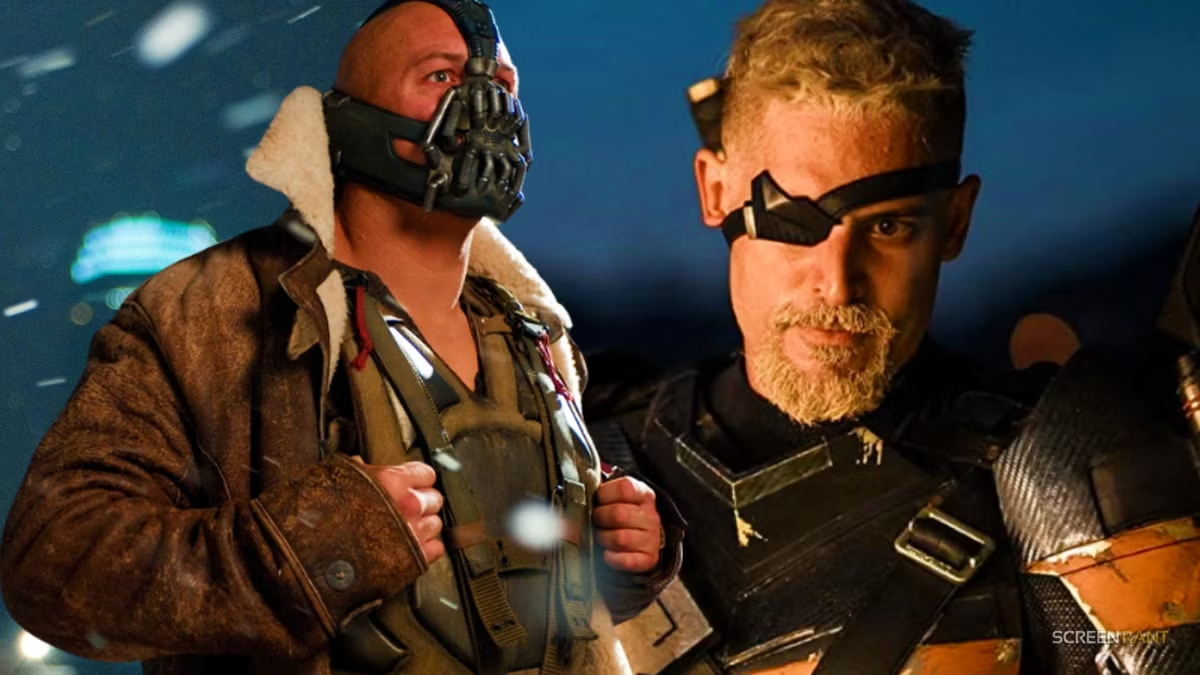
Tom Hardy was an interesting choice for Bane because he could combine physical intensity with subtle acting.
By the time The Dark Knight Rises was being made, Hardy had already demonstrated that he could disappear into very different characters. His performances had shown an ability to use voice, movement, posture, and facial expression as important parts of characterization.
That range was particularly useful for Bane.
The character spends much of the movie wearing a mask that covers a large portion of his face. Because of that limitation, Hardy could not rely on conventional facial acting in the same way another actor might.
His performance therefore depended heavily on his eyes, posture, movements, voice, timing, and physical presence.
That created an unusual challenge: how do you make a character emotionally readable when much of his face is hidden?
Hardy answered that question through restraint. Bane often speaks calmly rather than shouting. He can stand almost completely still and still dominate a scene.
That contrast became one of the most important elements of the performance.
Hardy’s Transformation
Playing Bane required more than simply putting on a costume.
Hardy changed his physical appearance to give the character a powerful silhouette. Bane needed to look physically capable of confronting Batman, particularly because the movie’s story builds toward direct confrontations between the two characters.
The transformation also worked with the film’s visual language.
Nolan’s Batman films generally attempted to give extraordinary characters a grounded appearance. Bane therefore needed to look like someone who could exist within the realistic world of Gotham rather than a brightly costumed comic-book figure.
The costume, tactical clothing, boots, gloves, and mask all contributed to that effect.
But physical size alone could not make the character frightening. Hardy’s movement completed the transformation.
Bane often walks with deliberate confidence. He does not constantly move like someone preparing for a fight. Instead, his controlled body language suggests that he already believes he has the advantage.
That confidence is an important part of what makes him unsettling.
The Mask
Bane’s mask is arguably the most recognizable part of his appearance in The Dark Knight Rises.
Within the story, the mask is connected to the pain Bane experiences and the treatment he requires. It also becomes an immediate visual identifier.
From a filmmaking perspective, however, the mask created a difficult challenge.
An actor’s face normally communicates emotion through the eyes, eyebrows, mouth, and subtle facial movements. Bane’s mask covers much of that information.
Hardy therefore had to communicate through other elements of performance.
His eyes became particularly important. So did the angle of his head, the speed of his movements, and the way he positioned his body.
The mask also changed the sound of his voice, which contributed to the character’s unusual vocal quality.
Rather than hiding the limitation, the performance made the mask part of Bane’s identity.
The Voice
Few elements of Tom Hardy Bane generated as much discussion as his voice.
Bane’s voice is deep, controlled, and highly distinctive. It does not sound like a conventional superhero villain. There is a deliberate theatrical quality to it, but Hardy still keeps the character serious.
The voice was particularly important because Bane’s face is largely covered.
When a character cannot communicate normally through facial expressions, dialogue becomes more significant. Hardy used pauses, emphasis, rhythm, and vocal texture to give Bane personality.
Interestingly, Bane does not need to constantly raise his voice to sound threatening.
In many scenes, his calm delivery makes him seem more confident.
That is a useful contrast with the chaos surrounding him. Gotham may be falling apart, but Bane often sounds as though everything is happening according to a plan he already understands.
Bane and Batman
The relationship between Bane and Batman is central to The Dark Knight Rises.
Bruce Wayne begins the movie physically and emotionally damaged after the events of The Dark Knight. His time away from crime-fighting has left him isolated, while Gotham has experienced a period of relative peace.
Bane changes that situation.
Unlike an enemy who simply attacks Gotham randomly, Bane creates circumstances designed to weaken Batman’s advantages.
Their first major confrontation demonstrates the difference between them.
Batman is experienced, determined, and highly skilled, but Bane possesses extraordinary physical power and remains composed under pressure.
The confrontation is important because it challenges the idea that Batman’s determination alone is enough.
Bane forces Bruce to confront his limitations.
That makes their rivalry more than a simple contest between hero and villain. It becomes part of Bruce Wayne’s larger journey.
Bane’s Plan
One reason Bane works as a villain is that he has a plan extending beyond Batman.
He takes control of Gotham through a combination of physical force, manipulation, fear, and political theater.
The city is isolated, and its established systems of authority are undermined. Bane then presents himself as someone who is giving Gotham’s people a new kind of order.
This creates an unsettling contradiction.
He speaks about freedom and justice while controlling the city through intimidation.
That contradiction fits one of the major themes of the movie: the difference between appearances and reality.
Bane’s revolution may appear to give ordinary people power, but the structure behind it is carefully controlled.
Memorable Moments
Bane has several scenes that define his role in the movie.
His introduction immediately establishes him as a serious threat. Rather than explaining everything about him at once, the film gradually reveals his capabilities.
The plane sequence is another important moment because it establishes Bane’s organization and willingness to carry out an ambitious plan.
His takeover of Gotham then expands his role from personal enemy to city-wide threat.
But perhaps the most important moments involve Batman.
The first major confrontation between the two characters changes the direction of Bruce Wayne’s story. Bane’s physical dominance forces Batman to recognize that his usual approach will not be enough.
Later, their final confrontation carries greater emotional weight because Bruce has changed.
The conflict is therefore not simply about who is stronger. It is about whether Bruce Wayne can overcome the limitations that have defined him.
Hardy’s Acting Style
Hardy’s Bane performance is built around control.
That may sound surprising for a character associated with physical violence and destruction, but control is precisely what makes the performance distinctive.
Bane rarely appears confused. He speaks with confidence, observes situations carefully, and often seems several steps ahead of his opponents.
Hardy uses small movements to communicate this personality.
A slight turn of the head can replace an exaggerated facial expression. A pause before speaking can create tension. A change in posture can make Bane appear more threatening without requiring a dramatic action.
The performance is therefore highly physical even when Bane is standing still.
This is particularly effective because Batman himself is a character defined by controlled movement. Bane becomes a dark reflection of that quality.
Both characters are disciplined, physically capable, and focused.
The difference is what they choose to do with that discipline.
Nolan’s Vision
Christopher Nolan’s interpretation of Bane was designed to fit the tone of his Batman trilogy.
The earlier films had established a version of Gotham that looked recognizable and relatively grounded. Even extraordinary characters were generally presented through practical environments, physical consequences, and realistic settings.
Bane follows that approach.
He is extraordinary, but he is not presented as a fantasy creature.
His power comes from his physical conditioning, intelligence, organization, and leadership.
That makes him a logical antagonist for Nolan’s version of Batman.
The Academy’s archival material for The Dark Knight Rises confirms Hardy among the film’s principal cast, alongside Christian Bale, Michael Caine, Gary Oldman, Anne Hathaway, Marion Cotillard, and others.
The production also involved a large technical and creative team, reflecting the scale of the final film. Academy records identify The Dark Knight Rises among the productions represented in its filmmaking archives.
Bane vs. the Joker
Comparing Bane with the Joker is almost unavoidable because both characters challenge Batman in very different ways.
The Joker, as portrayed by Heath Ledger in The Dark Knight, is primarily associated with chaos, unpredictability, and psychological manipulation.
Bane operates differently.
He is structured, disciplined, and strategic.
The Joker wants to demonstrate that civilization can collapse into chaos. Bane presents himself as the person capable of creating a new order.
This difference gives the two villains very different relationships with Batman.
The Joker challenges Batman’s moral boundaries and worldview.
Bane challenges his physical strength, leadership, endurance, and ability to rise after defeat.
Neither villain is simply a stronger version of the other.
They represent different kinds of threats.
The Human Side of Bane
Although Bane is primarily an antagonist, his story contains elements of tragedy.
The film connects him to Talia al Ghul and the history of the prison known as the Pit. His childhood experiences and relationship with Talia help explain why he becomes so devoted to her.
This gives the character an emotional foundation beyond simple ambition.
His loyalty is one of the more interesting aspects of the character.
Bane can appear ruthless toward almost everyone, yet his actions are deeply connected to his relationship with Talia.
That makes the later revelations about his identity and motivations more meaningful.
It also complicates the audience’s understanding of him.
He is not simply destroying Gotham because he enjoys destruction. He believes he is serving a larger purpose.
Behind the Performance
The physical demands of the role were significant, but the performance required more than preparation for action scenes.
Hardy had to make Bane recognizable from the moment he appeared on screen.
The mask limited facial expression. The costume changed his silhouette. The voice created another layer of separation from Hardy himself.
Together, these elements meant that the audience was rarely seeing the actor in an ordinary sense.
They were seeing a constructed character.
That transformation is one reason the performance has remained memorable.
The Academy’s records also show the broader importance of The Dark Knight Rises within the film industry’s technical community, with members of the production later appearing in Academy-related records and membership materials.
Why the Character Still Works
More than a decade after the movie’s release, Bane remains easy to recognize.
Part of that comes from the design.
The mask, coat, physical build, and voice create an instantly identifiable character.
But design alone does not explain the lasting interest.
Hardy’s performance gives Bane personality.
He is serious without becoming completely emotionless. He is physically imposing without constantly relying on action. He is intelligent without needing to explain every part of his plan.
Most importantly, Bane feels different from the other major villains in Nolan’s Batman universe.
That distinction matters.
A memorable villain should not feel like a replacement for another villain. Bane has his own identity, methods, philosophy, and relationship with Batman.
The Legacy of Tom Hardy Bane
Tom Hardy’s Bane became one of the defining performances of The Dark Knight Rises.
The role demonstrated how much an actor can communicate without relying heavily on facial expression. Hardy used voice, posture, movement, timing, and physical presence to build a character who could dominate a scene even when he was doing very little.
His performance also became an important part of the larger Batman legacy.
Bane had appeared in earlier adaptations, but Nolan’s version presented the character through a more grounded and politically charged world.
That interpretation helped introduce Bane to a much wider mainstream audience.
The character’s influence can also be seen in the way fans continue to discuss his voice, mask, physical presence, and confrontation with Batman.
Even viewers who have mixed opinions about individual elements of the film often remember Bane clearly.
Why Bane Remains Iconic
The lasting appeal of Tom Hardy Bane comes from several elements working together.
The design gives him a distinctive visual identity.
The mask makes him immediately recognizable.
The voice separates him from other villains.
The physical performance makes his confrontations with Batman convincing.
The writing gives him a larger purpose within the story.
And Hardy’s acting connects all of those elements.
Perhaps the most interesting quality is Bane’s confidence. He does not behave like someone trying to prove that he is powerful. He behaves like someone who already believes he has won.
That attitude gives many of his scenes their tension.
Final Thoughts
Tom Hardy’s portrayal of Bane remains one of the most recognizable villain performances in Christopher Nolan’s Batman trilogy.
What makes the character memorable is not one feature alone. It is the combination of Hardy’s physical transformation, controlled body language, distinctive voice, striking mask, and carefully developed relationship with Batman.
Bane also serves an important purpose in Bruce Wayne’s story. He forces Batman to face physical limitations and personal weaknesses that cannot be solved simply by putting on the suit.
That makes their conflict meaningful beyond the action.
Years after The Dark Knight Rises first reached theaters, Tom Hardy Bane continues to stand out because the performance feels carefully constructed rather than exaggerated. Hardy took a character known for physical strength and gave him a quiet confidence and personality that audiences could immediately recognize.
For many fans, that combination is what turned Bane from a familiar comic-book villain into an unforgettable part of modern Batman cinema.
Frequently Asked Questions
1. Who played Bane in The Dark Knight Rises?
Tom Hardy played Bane in Christopher Nolan’s The Dark Knight Rises. His performance made the character distinctive through his voice, physical presence, and controlled acting style.
2. Why does Tom Hardy’s Bane wear a mask?
Bane’s mask is an important part of his character and is connected to the pain and medical treatment described in the film. It also became one of his most recognizable features.
3. Is Tom Hardy’s Bane stronger than Batman?
Bane has a major physical advantage over Batman, while Batman relies on training, experience, and strategy. Their conflict is therefore about more than physical strength.
4. What makes Tom Hardy’s Bane memorable?
His distinctive voice, imposing appearance, controlled manner, and intense presence give the character a unique identity. Hardy also uses body language effectively despite wearing a mask.
5. When did Tom Hardy play Bane?
Tom Hardy played Bane in The Dark Knight Rises, which was released in 2012 as the final film in Christopher Nolan’s Batman trilogy.