







Introduction
Few Swiss watch brands have built such a strong identity around precision, racing, and modern design as TAG Heuer. Its story stretches back to 1860, when Edouard Heuer established a watchmaking workshop in Saint-Imier, Switzerland. From its earliest years, the company focused on technical innovation, eventually becoming particularly known for chronographs, sports timing, and watches connected with motorsport.
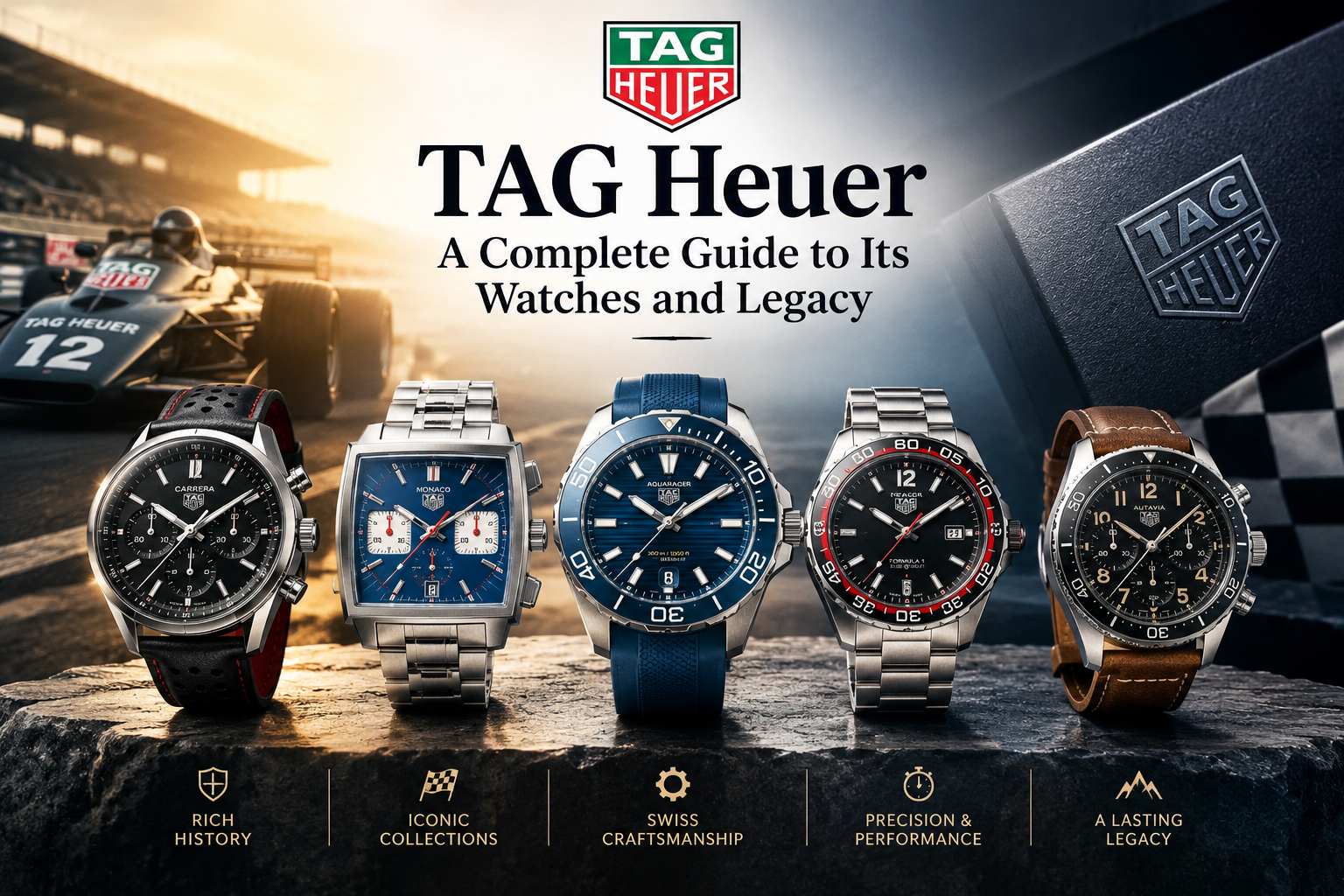
Today, TAG Heuer brings together traditional Swiss watchmaking with contemporary materials, mechanical movements, chronographs, and modern technology. Collections such as the Carrera, Monaco, Aquaracer, Formula 1, and Autavia have each contributed something different to the company’s identity.
Understanding TAG Heuer is therefore about more than looking at individual watches. Its history shows how a traditional Swiss manufacturer adapted to changing technology while maintaining a recognizable character built around precision, performance, and bold design.
BIO
| Label | Information |
|---|---|
| Brand | TAG Heuer |
| Founded | 1860 |
| Founder | Edouard Heuer |
| Origin | Switzerland |
| Industry | Swiss watchmaking |
| Known For | Chronographs and sports watches |
| Signature Collection | Carrera |
| Iconic Model | Monaco |
| Sports Collection | Aquaracer |
| Racing Collection | Formula 1 |
| Heritage Collection | Autavia |
| Key Focus | Precision, performance, and design |
The History of Tag Heuer
The foundations of TAG Heuer were established in 1860, when 20-year-old Edouard Heuer opened his watchmaking workshop in Saint-Imier. His company quickly developed a reputation for technical experimentation rather than simply following established watchmaking methods.
One important early achievement came in 1869, when Heuer patented a crown-operated, keyless winding system. Another major milestone followed in 1887 with the improvement of the oscillating pinion, an innovation that helped make chronograph mechanisms more practical and efficient.
These developments established a pattern that would remain important throughout the company’s history: use engineering to make timing more precise and useful.
During the early twentieth century, Heuer expanded beyond traditional wrist and pocket watches. In 1911, the company introduced the Time of Trip, a dashboard timer designed for automobiles and aircraft. The company’s expertise in precise timing also extended into sporting events and competition.
This connection between watches and real-world timing would eventually become one of the strongest foundations of the modern TAG Heuer identity.
From Heuer to Tag Heuer
For much of its early history, the company was known simply as Heuer. The modern TAG Heuer name emerged during a significant period of change in the Swiss watch industry.
In 1985, Techniques d’Avant-Garde, commonly known as TAG, acquired Heuer. The company officially became TAG Heuer, marking a new chapter that combined the historical Heuer name with TAG’s modern, technology-oriented identity.
The 1980s were also important because the company began developing products aimed at a changing watch market. The TAG Heuer Formula 1 collection, introduced in 1986, became an important part of this new era.
In 1999, TAG Heuer was acquired by LVMH, another major turning point in the brand’s development.
The result was a company that could draw on more than a century of watchmaking history while continuing to invest in modern design and technology.
Tag Heuer and Motorsport
Motorsport is one of the most recognizable elements of TAG Heuer’s identity. The relationship is not simply a modern marketing association; timing races has been closely connected to the company’s development for decades.
Heuer produced dashboard timers, stopwatches, and chronographs designed for demanding environments. These instruments were useful in racing because fractions of a second could matter.
The relationship became particularly influential under Jack Heuer, who joined the family company in 1958. His leadership helped push Heuer deeper into motorsport and shaped several of the watches that later became icons.
The Carrera is perhaps the clearest example. Jack Heuer encountered the name Carrera while attending the 12 Hours of Sebring in 1962. The name referred to the Carrera Panamericana road race in Mexico, and he later registered it for a new chronograph. The first Carrera was introduced in 1963.
The company also developed relationships with racing drivers and teams, including Ferrari. Its electronic timing equipment became part of professional motorsport, further connecting the Heuer name with racing performance.
This history explains why many TAG Heuer watches have a sporty character even when they are designed for everyday use.
The Carrera
The TAG Heuer Carrera is arguably the collection that best represents the brand’s traditional identity.
Introduced in 1963, the original Carrera was designed around clarity and functionality. Its clean dial, distinctive case, and strong legibility were especially appropriate for drivers who needed to read elapsed time quickly.
The Carrera was not designed simply to look like a racing watch. Its identity came from practical timing requirements and the broader world of motorsport.
Over the decades, the collection has evolved considerably. Modern Carrera watches can feature automatic chronographs, different case materials, multiple dial designs, and contemporary movements while retaining recognizable elements of the original concept.
The original Reference 2447 remains particularly influential. TAG Heuer has repeatedly drawn inspiration from its proportions and clean design when developing newer Carrera models.
That ability to evolve without completely abandoning its visual roots is one reason the Carrera has remained important to the brand.
The Monaco
The TAG Heuer Monaco took a very different approach.
Released in 1969, the Monaco immediately stood apart because of its square case. At a time when many watches followed more traditional round designs, its shape was striking and unconventional.
The original Monaco was also associated with the development of the Calibre 11 automatic chronograph. The movement was among the pioneering automatic chronograph systems of its era, and the Monaco became one of its most recognizable applications.
Its cultural importance grew even further when actor Steve McQueen wore a Heuer Monaco in the 1971 film Le Mans. That appearance helped transform the watch from an unusual racing chronograph into a lasting symbol of motorsport style.
Although the original Monaco was discontinued during the 1970s, later reissues brought the design back. TAG Heuer has continued to experiment with different materials, colors, movements, and finishes while maintaining the unmistakable square silhouette.
The Aquaracer
The TAG Heuer Aquaracer represents another side of the brand. While Carrera and Monaco are closely associated with racing, the Aquaracer is built around water, durability, and outdoor use.
Its roots can be traced to Heuer’s earlier dive watches. TAG Heuer’s history notes that dive-watch development during the late twentieth century eventually contributed to the modern Aquaracer collection.
The collection emphasizes practical features associated with diving watches, including water resistance, a rotating bezel, luminous elements, and robust construction. Over time, the Aquaracer has become one of the company’s most recognizable sports-watch families.
Its appeal extends beyond professional diving. The design works well for people looking for a durable everyday sports watch with a strong Swiss watchmaking identity.
The Formula 1
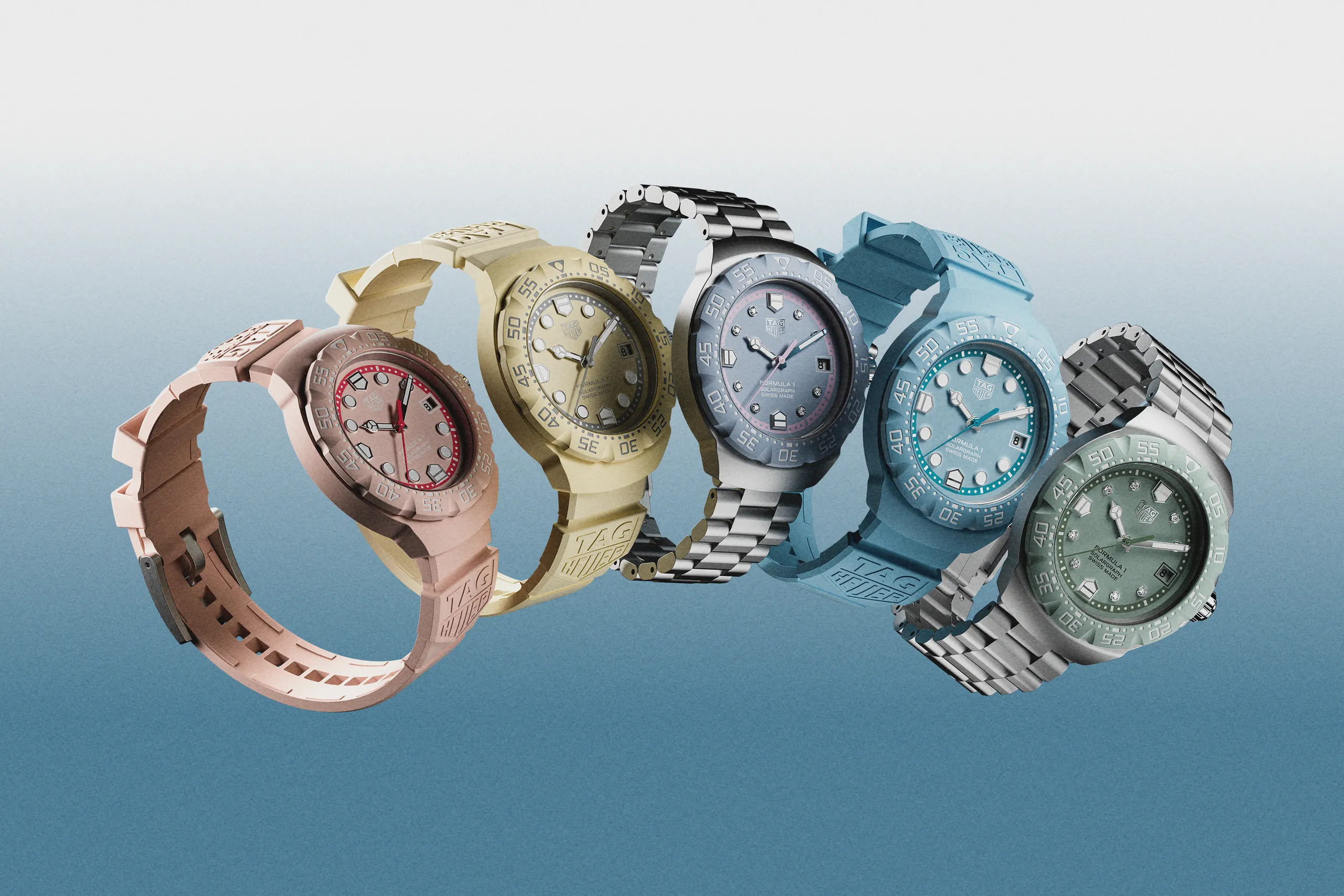
The TAG Heuer Formula 1 collection arrived in 1986 during an important period for the company.
Unlike the vintage mechanical chronographs that defined much of Heuer’s earlier reputation, the Formula 1 collection embraced the changing watch market. Its early designs used quartz movements, colorful styling, and a distinctly sporty personality.
The collection helped TAG Heuer establish a broader identity during an era when traditional Swiss mechanical watchmaking faced intense competition from quartz technology.
Its name naturally reinforced the company’s relationship with motorsport. At the same time, the collection made TAG Heuer watches more approachable for people who wanted a sporty watch without necessarily seeking a traditional mechanical chronograph.
The Autavia
The Autavia has particularly interesting historical roots. Its name combines “AUTomobile” and “AVIAtion,” reflecting its original connection to timing equipment used in cars and aircraft.
The Autavia became one of Heuer’s important chronograph names and later developed into a wristwatch collection.
Its heritage makes it especially interesting to enthusiasts who appreciate the technical side of Heuer’s history. The collection connects the company’s early dashboard timers with its later mechanical chronographs.
Modern Autavia models have interpreted this heritage in contemporary ways while preserving the collection’s association with adventure, motorsport, and aviation.
The Importance of the Chronograph
A chronograph is essentially a watch with an additional function for measuring elapsed periods of time. Pushers on the case can typically start, stop, and reset the timing function.
Chronographs became central to Heuer’s identity because the company developed many of them for practical timing applications.
One of the most important moments came in 1969, when Heuer and its partners introduced the Calibre 11, one of the pioneering automatic chronograph movements. This achievement was significant because combining automatic winding with a chronograph represented a major technical challenge at the time.
That history still influences TAG Heuer today. Modern mechanical chronographs may incorporate sophisticated movements and materials, but the basic idea remains familiar: combine accurate timekeeping with the ability to measure elapsed time.
Design and Materials
TAG Heuer’s designs cover a broad range, but several characteristics appear repeatedly.
Legibility has always been important, particularly in chronographs and sports watches. Clear markers, contrasting hands, and carefully arranged sub-dials help make the watches functional rather than purely decorative.
Case shape is another important part of the brand’s visual language. The round Carrera, square Monaco, and robust Aquaracer demonstrate how different silhouettes can exist within the same brand.
Modern models also make extensive use of materials and finishing techniques that were not available to earlier generations of watchmakers. Depending on the collection, TAG Heuer has used materials such as stainless steel, ceramic, sapphire crystal, titanium, and carbon-based materials.
These choices are not merely about appearance. Materials can influence weight, durability, scratch resistance, and the overall character of a watch.
Mechanical and Quartz Watches
One of the interesting aspects of TAG Heuer is that its history includes both mechanical and quartz technology.
Mechanical watches use an intricate system of gears, springs, and other components to measure time. Automatic mechanical watches use the movement of the wearer to wind the mechanism.
Quartz watches operate differently. They use electronic regulation based on a quartz crystal and are generally valued for their practical accuracy and convenience.
TAG Heuer has worked with both approaches throughout its modern history. The Formula 1 collection, for example, played an important role in the company’s quartz-era development, while collections such as Carrera and Monaco continue to emphasize mechanical watchmaking.
Rather than treating these technologies as competing identities, TAG Heuer’s history shows how the company has adapted to different expectations in watchmaking.
Innovation and Modern Watchmaking
Innovation has been part of TAG Heuer’s identity from its earliest days.
The company has continued experimenting with movements, materials, precision timing, and unconventional watch construction. One notable example was the Monaco V4 Concept Watch, introduced in 2004, which approached mechanical power transmission in a way inspired by automobile engineering.
Another important milestone came in 2010 with the Calibre 1887 movement. TAG Heuer later developed additional mechanical technologies and high-performance chronographs.
The brand also entered connected technology. In 2015, TAG Heuer introduced the Connected watch, described by the company as its first Swiss luxury smartwatch. This represented a very different direction from the traditional mechanical chronograph but demonstrated the brand’s willingness to explore new forms of timekeeping.
Choosing a Tag Heuer Watch
Choosing a TAG Heuer watch is easier when the decision begins with lifestyle rather than brand name alone.
Someone attracted to motorsport history and classic chronographs may naturally prefer the Carrera. A buyer who wants a distinctive case and a strong cultural connection may find the Monaco more appealing.
For outdoor activities and water-focused designs, the Aquaracer offers a different approach. The Formula 1 is another option for someone who prefers a sporty aesthetic and practical quartz or contemporary sports-watch features.
Size should also be considered. A watch can look very different on the wrist depending on its case diameter, thickness, lug design, and strap or bracelet.
Movement preference matters as well. Some people enjoy the craftsmanship and mechanical character of an automatic movement, while others value the convenience and precision of quartz.
The best choice is ultimately the one that fits the wearer’s preferences and intended use rather than simply selecting the most famous model.
Caring for a Tag Heuer Watch
Proper care can help a watch remain attractive and functional for many years.
A TAG Heuer watch should be kept clean and protected from unnecessary impacts. The bracelet or strap can accumulate dust and moisture during everyday use, so appropriate cleaning is useful.
Water resistance should never be assumed simply because a watch looks like a diving watch. Water-resistance ratings apply under specified conditions, and seals can deteriorate over time.
Mechanical watches also require professional maintenance. The appropriate service interval depends on the model, movement, age, and use. Professional inspection can help identify wear before it becomes a larger problem.
Storage is equally straightforward. Keeping the watch somewhere clean and dry and avoiding unnecessary exposure to extreme conditions is a sensible part of long-term ownership.
The Lasting Legacy of Tag Heuer
TAG Heuer’s legacy comes from the combination of technical innovation, recognizable design, and a long relationship with precision timing.
Its history began with Edouard Heuer’s nineteenth-century innovations and continued through dashboard timers, sporting stopwatches, chronographs, automatic movements, racing partnerships, and modern connected technology.
The Carrera demonstrates the company’s ability to turn a racing-inspired concept into a lasting watch design. The Monaco shows how an unconventional shape can become an icon. The Aquaracer demonstrates the brand’s strength in sports watches, while the Formula 1 reflects its adaptation to the quartz era.
Perhaps the most interesting part of TAG Heuer’s history is that the company has never been defined by only one type of watch. Its identity has changed with technology and culture while maintaining a clear connection to precision and performance.
Final Thoughts
TAG Heuer is a Swiss watchmaker with a history that reaches far beyond its most recognizable modern models. From Edouard Heuer’s first workshop in 1860 to today’s mechanical and technologically advanced watches, the company has repeatedly adapted to changing ideas about timekeeping.
Its connection with motorsport helped create some of its most memorable designs, while its technical achievements gave the brand credibility among watch enthusiasts. The Carrera, Monaco, Aquaracer, Formula 1, and Autavia each tell a different part of that story.
For anyone interested in Swiss watches, TAG Heuer offers an especially interesting combination of heritage, sport, engineering, and modern design. Its legacy is not simply about looking back at historic watches; it is about how those historic ideas continue to influence the watches being created today.
Frequently Asked Questions
1. What is TAG Heuer best known for?
TAG Heuer is best known for its Swiss watches, particularly its chronographs and strong connection with motorsport. Collections such as the Carrera and Monaco are central to its heritage.
2. When was TAG Heuer founded?
The company’s roots date back to 1860, when Edouard Heuer established a watchmaking workshop in Saint-Imier, Switzerland.
3. Which TAG Heuer watch is the most iconic?
The Carrera and Monaco are among the brand’s most recognizable models. The Carrera is closely associated with racing, while the Monaco is famous for its distinctive square case and motorsport history.
4. What is the TAG Heuer Carrera?
The Carrera is a chronograph collection introduced in 1963. It was designed with racing drivers in mind and became known for its clean dial and strong legibility.
5. What makes TAG Heuer watches distinctive?
TAG Heuer combines Swiss watchmaking with sport-focused design, chronograph expertise, technical innovation, and motorsport heritage. Its collections range from classic mechanical chronographs to modern sports watches.