





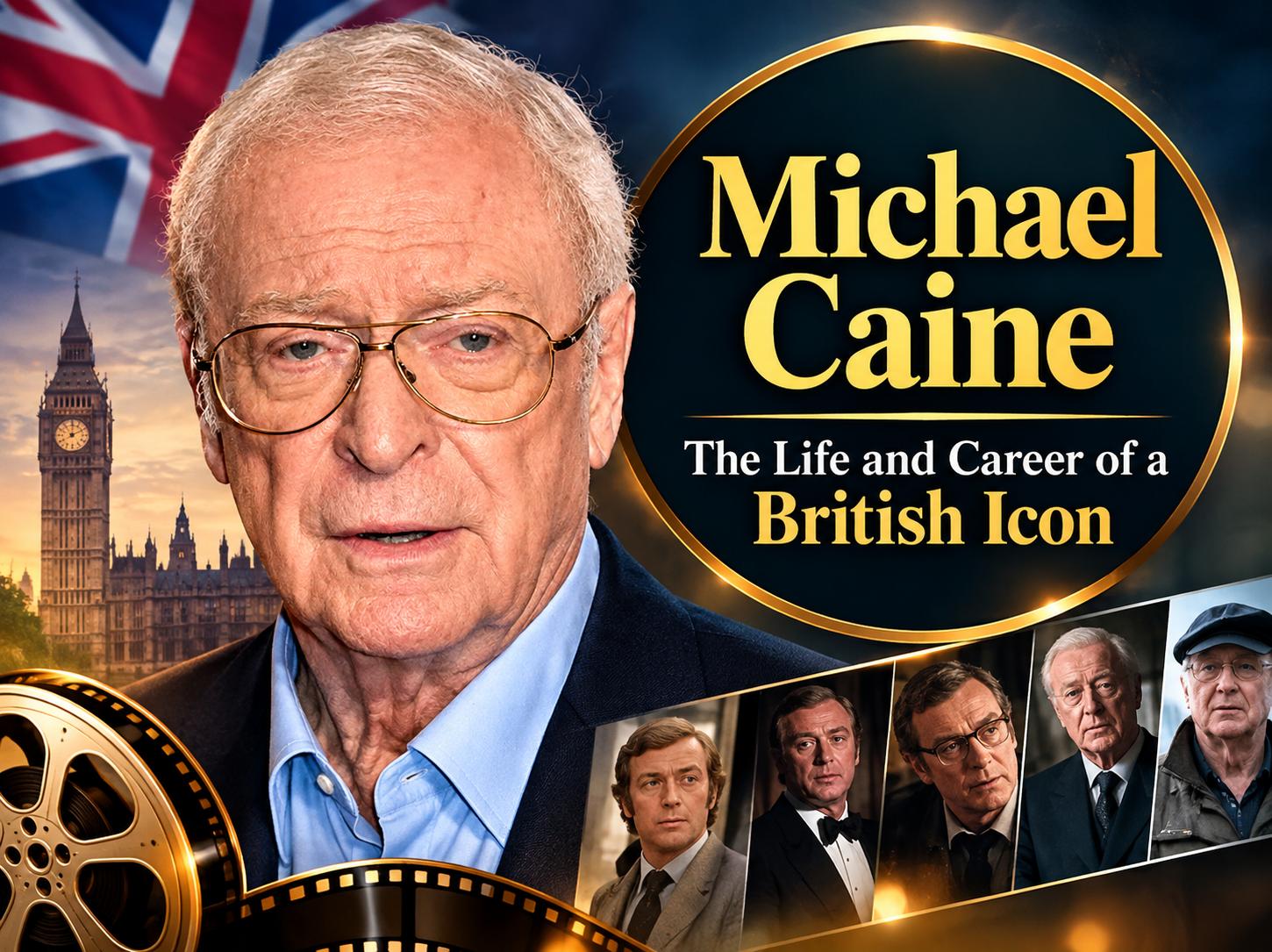
Michael Caine is one of the most recognizable and respected actors to emerge from British cinema. Across a career spanning more than six decades, he moved comfortably between serious dramas, crime films, comedies, thrillers, action movies, and major Hollywood productions. His distinctive voice, understated screen presence, and ability to make even supporting characters memorable helped turn him into a lasting figure in international cinema.
Born Maurice Joseph Micklewhite in South London in 1933, Caine came from a working-class background far removed from the world of movie stardom. His journey to the top was not immediate. Before becoming famous, he spent years working in theatre, television, and small film roles. His breakthrough eventually came during the 1960s, when films such as Zulu, The Ipcress File, and Alfie established him as one of Britain’s most exciting new actors.
Over the years, he earned two Academy Awards, multiple BAFTA honors, and recognition from audiences around the world. His career also reached younger generations through his work with filmmaker Christopher Nolan, particularly in The Dark Knight trilogy, Inception, The Prestige, and Interstellar.
BIO
| Label | Information |
|---|---|
| Full Name | Maurice Joseph Micklewhite |
| Stage Name | Michael Caine |
| Born | March 14, 1933 |
| Birthplace | Rotherhithe, London, England |
| Nationality | British |
| Profession | Actor and author |
| Active Years | 1950s–2023 |
| Breakthrough Film | Zulu |
| Famous Role | Alfred Pennyworth |
| Major Films | Alfie, The Italian Job, Get Carter |
| Academy Awards | 2 wins |
| Spouse | Shakira Caine |
| Final Film | The Great Escaper |
Early Life
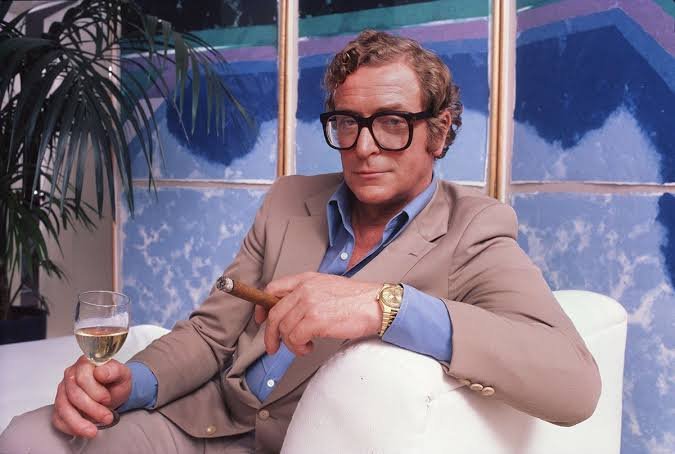
Michael Caine was born on March 14, 1933, in Rotherhithe, London. His birth name was Maurice Joseph Micklewhite. His father worked at London’s Billingsgate fish market, while his mother worked as a cook and charwoman. He grew up in South London during a period when Britain was facing economic hardship and, later, the disruption of the Second World War.
His childhood experiences became an important part of the identity he carried into his acting career. Caine never tried to hide his South London background or his distinctive accent. Instead, those qualities became part of what separated him from many of the traditionally polished leading men of British cinema.
During the war years, Caine was evacuated from London. Like many children of his generation, he experienced the disruption caused by wartime Britain at an early age. His early exposure to performance came in school, where he developed an interest in acting.
After leaving school, he worked a variety of jobs and later completed national service in the British Army. His military service included time in Korea. When he returned to civilian life, he decided to pursue acting seriously.
Finding Acting
Caine’s path into professional acting was gradual. He worked in provincial theatre and repertory companies while taking small opportunities wherever they appeared. He also appeared on British television and gradually built the experience needed to survive in a highly competitive profession.
His early years were not glamorous. He was often unknown to audiences, and major film opportunities were difficult to find. However, those years helped him develop the practical discipline that would later become one of his greatest strengths.
Caine also understood the importance of creating a memorable professional identity. He eventually adopted the stage name Michael Caine, replacing his birth name Maurice Micklewhite. The new name became associated with a screen personality that would eventually be known throughout the world.
First Film Roles
Caine began appearing in films during the 1950s, initially in small and supporting parts. These early roles gave him valuable experience, but they did not immediately make him a star.
The turning point came with Zulu, released in 1964. Caine played Lieutenant Gonville Bromhead, a role that gave audiences a much clearer sense of his ability and screen presence.
The success of the film helped move his career forward. More importantly, it showed filmmakers that Caine could handle major dramatic roles and compete for attention alongside established performers.
From that point, his career began to accelerate.
The Ipcress File
One of Caine’s major breakthroughs came with The Ipcress File in 1965. He played British intelligence agent Harry Palmer, a character quite different from the glamorous secret-agent image associated with other popular spy films of the period.
Harry Palmer was more ordinary, sarcastic, and grounded. Caine’s performance gave the character a distinctive personality and helped establish him as a leading actor.
The role also demonstrated one of Caine’s most important qualities: he could make an unconventional hero interesting without forcing the performance.
His approach was controlled and understated. Rather than relying on exaggerated gestures, he allowed the character’s attitude and voice to do much of the work.
Alfie
If The Ipcress File made Caine a rising star, Alfie helped make him internationally famous.
Released in 1966, the film centered on Alfie Elkins, a charming but emotionally complicated London man. Caine’s performance earned him his first Academy Award nomination for Best Actor.
The role was significant because it showed that he could carry an entire film. He was no longer simply a promising British performer appearing in strong supporting roles. He had become a major leading man.
Alfie also reflected the changing culture of Britain during the 1960s. Caine’s working-class accent and relaxed style helped him represent a different kind of British leading man.
The Italian Job
Caine continued his rise with a series of memorable films. Among the most beloved is The Italian Job, released in 1969.
Caine played Charlie Croker, a confident criminal planning a major robbery in Italy. The film combined comedy, action, stylish cars, and British humor.
His performance as Croker became one of the defining roles of his career. Even decades later, the film remains closely associated with Caine and his image as a charismatic British star.
The Italian Job also showed how naturally he could work within lighter material. He did not need every role to be serious or dramatic to make an impression.
Get Carter
Two years later, Caine took a much darker direction in Get Carter.
Released in 1971 and directed by Mike Hodges, the film featured Caine as Jack Carter, a London gangster who travels to the North of England to investigate the circumstances surrounding his brother’s death.
The performance was tougher and more restrained than his work in films such as Alfie or The Italian Job. Caine brought a cold intensity to the character, helping make the film one of the most respected British crime dramas of its era.
It became another example of his range. He could play a charming leading man one year and a much darker character the next.
Sleuth
In 1972, Caine starred opposite Laurence Olivier in Sleuth, directed by Joseph L. Mankiewicz.
The film was built around psychological games between two men, giving both actors opportunities to deliver highly controlled performances.
Caine received an Academy Award nomination for Best Actor for the role. The nomination further demonstrated that his reputation extended well beyond popular entertainment.
His later career would also bring him back to the material. In 2007, he appeared in a new film adaptation of Sleuth, this time playing the role originally portrayed by Olivier.
Educating Rita
The 1980s brought another important stage in Caine’s career.
In Educating Rita, released in 1983, he played Dr. Frank Bryant, a university lecturer whose life changes after meeting Rita, played by Julie Walters.
The film allowed Caine to combine humor and drama while portraying a flawed but deeply human character.
His performance earned him the BAFTA Award for Best Actor, giving him one of the most important honors of his British career. BAFTA records list Caine as the 1984 winner for Educating Rita.
The role also showed how effective Caine could be when a film depended on the chemistry between two actors.
His First Oscar
Caine won his first Academy Award for Hannah and Her Sisters, released in 1986.
Directed by Woody Allen, the film featured an ensemble cast and explored complicated relationships, family tensions, and personal uncertainty.
Caine played Elliot, a man involved in a difficult romantic situation. The performance earned him the Academy Award for Actor in a Supporting Role.
The Academy’s records confirm that Hannah and Her Sisters received seven nominations at the 59th Academy Awards, with Caine winning the supporting-actor category.
Winning an Oscar established another milestone in a career that had already lasted for decades.
The Cider House Rules
More than a decade later, Caine won his second Academy Award for The Cider House Rules.
Released in 1999, the film was directed by Lasse Hallström and based on the novel by John Irving. Caine played Dr. Wilbur Larch, an important figure who becomes a mentor and father figure to the young Homer Wells.
The role required warmth, authority, humor, and emotional depth. Caine’s performance earned him the Oscar for Actor in a Supporting Role at the 72nd Academy Awards.
The Academy’s official records list Caine as the winner for the role of Dr. Wilbur Larch.
Winning two Oscars in the same category across different generations of cinema is a remarkable achievement. It also illustrated Caine’s ability to remain relevant as filmmaking styles and audiences changed.
A New Generation of Fans
By the late 1990s and early 2000s, Caine had already established himself as a respected veteran. Yet his career was about to reach another audience.
Films such as Little Voice, The Cider House Rules, Quills, and The Quiet American demonstrated that he remained capable of delivering serious performances.
He also showed an ability to embrace comedy and mainstream entertainment. His appearance as Nigel Powers in Austin Powers in Goldmember introduced his personality to younger viewers in a very different way.
Rather than remaining associated only with classic British films, Caine became an actor who could move between generations.
Christopher Nolan
One of the most important later chapters of Caine’s career was his collaboration with filmmaker Christopher Nolan.
Their partnership began with Batman Begins in 2005, in which Caine played Alfred Pennyworth, the loyal butler and guardian of Bruce Wayne.
Alfred was much more than a traditional butler in Nolan’s films. Caine portrayed him as a mentor, protector, and emotional anchor for Bruce.
His interpretation gave the character warmth without losing the seriousness of the story.
Caine returned as Alfred in The Dark Knight and The Dark Knight Rises, completing one of the most successful screen versions of the character.
The Prestige
Caine also worked with Nolan on The Prestige, released in 2006.
The film explored rivalry, obsession, sacrifice, and illusion. Caine played John Cutter, a stage engineer and adviser connected to the world of magic.
Although the role was supporting, Caine’s presence gave the film an additional sense of authority. His calm delivery contrasted with the increasingly intense rivalry between the main characters.
It was another example of how effectively he could strengthen a film without needing to be the central character.
Inception
In 2010, Caine appeared in Inception, one of Nolan’s most ambitious films.
He played Professor Stephen Miles, a mentor and father figure connected to Leonardo DiCaprio’s character, Dom Cobb.
Although Caine’s screen time was limited compared with the main cast, his performance gave the character an important emotional dimension.
His appearance also reinforced the trust Nolan had developed in him as a performer. Caine became one of the filmmaker’s recurring collaborators.
Interstellar
The partnership continued with Interstellar in 2014.
Caine played Professor John Brand, a scientist involved in humanity’s attempt to survive a planetary crisis.
The film gave him another opportunity to work within science fiction while maintaining the thoughtful, serious tone that had become common in his later career.
His collaborations with Nolan helped introduce Caine to audiences who may have known him primarily as Alfred rather than from his earlier British films.
Other Memorable Roles
Caine’s filmography extends far beyond the roles most often associated with him.
He appeared in The Man Who Would Be King, The Eagle Has Landed, Dirty Rotten Scoundrels, Little Voice, Children of Men, Harry Brown, Kingsman: The Secret Service, Youth, and Going in Style, among many others.
He also provided voices for animated films, including Cars 2 and Gnomeo & Juliet.
The British Film Institute has described his film career as exceptionally extensive, highlighting key works such as The Italian Job, Get Carter, Educating Rita, and Hannah and Her Sisters.
Acting Style
One reason Caine remained successful for so long was his ability to create strong characters without making them feel artificial.
His voice became instantly recognizable, but his appeal went beyond his accent. He understood how to use pauses, expressions, posture, and subtle changes in tone.
Caine was particularly effective at playing people who appeared calm on the surface while carrying complicated emotions underneath.
His performances often felt conversational rather than theatrical. That quality helped him connect with audiences across very different types of films.
Awards
Caine’s career has been recognized by many major institutions.
He won the Academy Award for Supporting Actor for Hannah and Her Sisters and again for The Cider House Rules. The Academy database also records Oscar nominations for Alfie, Sleuth, Educating Rita, and The Quiet American.
He won the BAFTA Award for Best Actor for Educating Rita. BAFTA later awarded him its Fellowship in 2000, one of the organization’s highest honors.
He also received the Britannia Award, reflecting his significant contribution to film on both sides of the Atlantic.
These awards are important, but Caine’s influence cannot be measured by trophies alone. His longevity is perhaps the clearest indication of his importance.
Personal Life
Away from the screen, Caine has maintained a long family life with Shakira Caine, whom he married in 1973.
The couple have one daughter together, and Caine also has a daughter from his first marriage.
His family life has remained an important part of his story, particularly as his professional career became increasingly demanding.
Unlike many stars whose public image depends almost entirely on celebrity, Caine has often been associated with a down-to-earth personality and an appreciation for ordinary pleasures.
Later Career
Caine continued acting well into his later years, taking on roles in films ranging from dramas to comedies and historical adventures.
His later work included Kingsman: The Secret Service, Youth, Going in Style, King of Thieves, Tenet, Best Sellers, and The Great Escaper.
This stage of his career demonstrated something that had been true throughout his life: he was willing to adapt.
He did not depend entirely on the kind of role that had made him famous decades earlier. Instead, he continued working with different directors, actors, and genres.
Retirement
The Great Escaper, released in 2023, became an important late-career film for Caine. He played Bernard Jordan, an elderly Second World War veteran who leaves his care home to attend the 70th anniversary commemorations of the D-Day landings.
The role was particularly fitting for an actor whose own life had been shaped by wartime Britain and military service.
Caine subsequently stepped away from acting. His final film gave audiences an opportunity to see him in a gentle, mature performance that reflected themes of memory, age, friendship, and determination.
Lasting Legacy
Michael Caine’s legacy is larger than any single film.
He helped change the image of the British leading man by bringing his South London background, accent, humor, and working-class identity into major international productions.
His career also demonstrates unusual longevity. He could be the romantic lead in one period, a crime-film protagonist in another, an Oscar-winning supporting actor later on, and eventually a mentor figure in major Hollywood productions.
Few performers have moved through so many different eras of cinema while remaining recognizable to audiences.
His collaboration with Christopher Nolan introduced him to a younger generation, while films such as Alfie, The Italian Job, Get Carter, Educating Rita, and Hannah and Her Sisters ensured that earlier generations would continue to remember him.
Why Michael Caine Matters
What makes Michael Caine especially interesting is not simply the number of films he made or awards he received.
It is the consistency of his personality as a performer.
He could appear in a large Hollywood production without disappearing into the scale of the movie. He could appear in a small drama and immediately give the story weight. He could play a criminal, professor, mentor, comedian, gentleman, gangster, or ordinary man while retaining the qualities that made him distinctive.
That balance between recognizable personality and genuine character acting is one of the reasons his career has lasted so long.
Conclusion
Michael Caine represents one of the great success stories in British cinema. From a working-class childhood in South London to international film stardom, his career was built through persistence, adaptability, and a remarkable understanding of screen performance.
His breakthrough films of the 1960s made him a British star. His work in films such as The Italian Job, Get Carter, and Sleuth strengthened his reputation, while Educating Rita, Hannah and Her Sisters, and The Cider House Rules demonstrated his dramatic range.
Later, his work with Christopher Nolan gave him a new connection with younger audiences through characters such as Alfred Pennyworth and roles in The Prestige, Inception, and Interstellar.
With two Academy Awards, major BAFTA recognition, and a filmography stretching across more than six decades, Caine’s place in cinema is secure.
His story is ultimately one of endurance: an actor who began far from the center of the film industry and gradually became one of Britain’s most enduring screen icons.
Frequently Asked Questions
Who is Michael Caine?
Michael Caine is an English actor known for a career spanning more than six decades. He became famous through films such as Alfie, The Italian Job, and Get Carter.
What is Michael Caine best known for?
He is widely known for his roles in The Dark Knight trilogy, The Italian Job, Alfie, Get Carter, and The Cider House Rules, along with many other acclaimed films.
How many Oscars has Michael Caine won?
Michael Caine has won two Academy Awards, both for Best Supporting Actor. He won for Hannah and Her Sisters in 1987 and The Cider House Rules in 2000.
What role did Michael Caine play in Batman?
Caine played Alfred Pennyworth, Bruce Wayne’s loyal butler, guardian, and mentor, in Christopher Nolan’s The Dark Knight trilogy.
What was Michael Caine’s last film?
The Great Escaper, released in 2023, was his final film role. He played Bernard Jordan, a Second World War veteran attending the D-Day commemorations.