




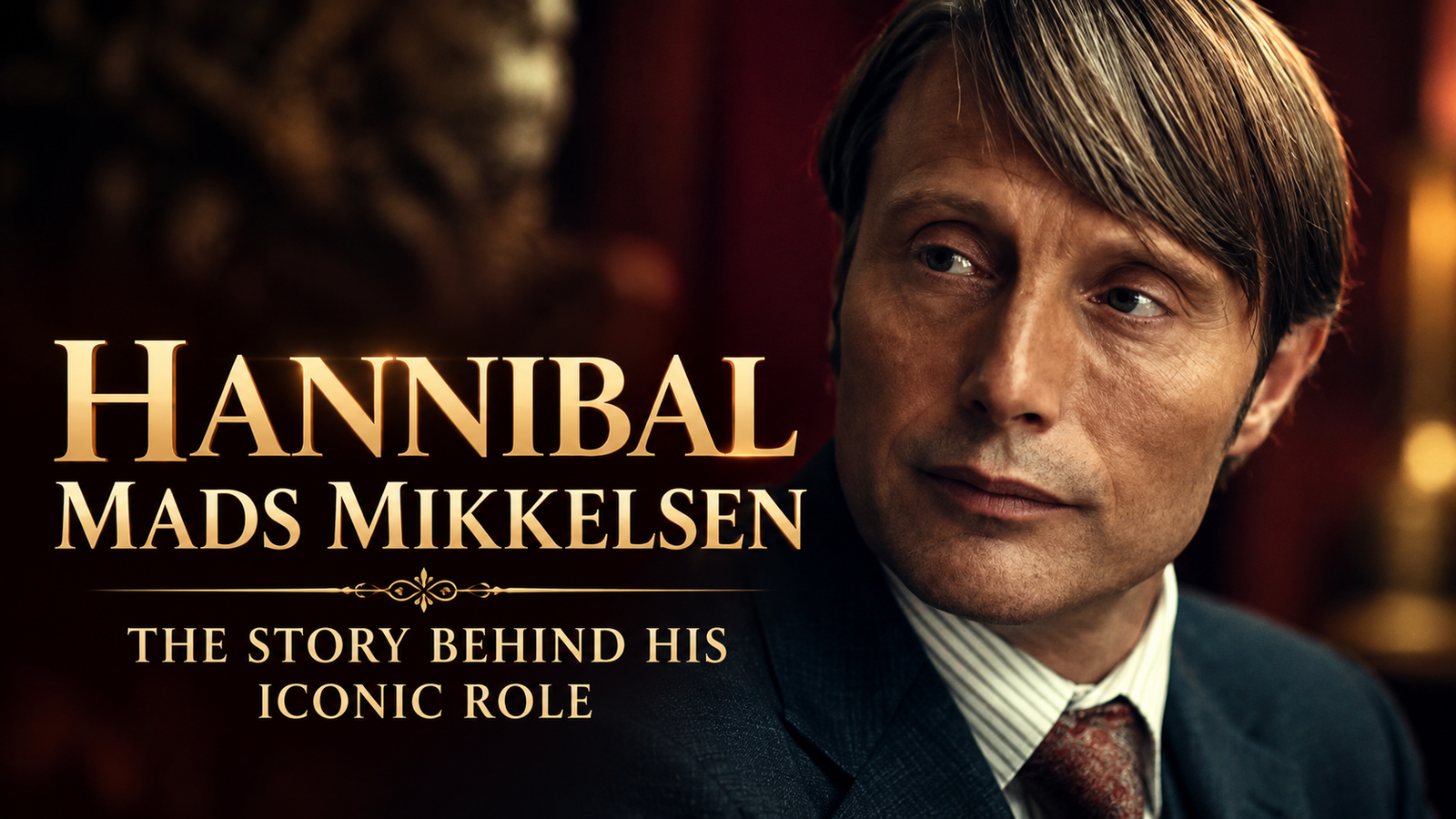
Hannibal Mads Mikkelsen is one of the most memorable portrayals of Hannibal Lecter in modern television. With his calm voice, elegant appearance, sharp intelligence, and carefully controlled expressions, Mads Mikkelsen brought a distinctive personality to a character already famous in books and films. Rather than copying earlier interpretations, he created a version of Hannibal that felt sophisticated, mysterious, and quietly unsettling.
The television series Hannibal, created by Bryan Fuller, premiered in 2013 and ran for three seasons until 2015. Based partly on characters and stories from Thomas Harris’s novels, the series explored the complicated relationship between psychiatrist Hannibal Lecter and FBI criminal profiler Will Graham, played by Hugh Dancy.
What made Mikkelsen’s performance special was not simply the character’s intelligence or frightening secrets. It was the contrast between Hannibal’s polished public image and the dangerous personality hidden beneath it. His performance encouraged viewers to pay attention to every pause, glance, and carefully chosen word.
BIO
| Label | Information |
|---|---|
| Full Name | Mads Dittmann Mikkelsen |
| Known For | Playing Hannibal Lecter |
| Date of Birth | November 22, 1965 |
| Age | 60 years (as of October 2026) |
| Birthplace | Copenhagen, Denmark |
| Nationality | Danish |
| Profession | Actor |
| Famous Role | Dr. Hannibal Lecter |
| TV Series | Hannibal |
| Series Creator | Bryan Fuller |
| Co-Star | Hugh Dancy |
| Number of Seasons | 3 seasons |
| Original Run | 2013–2015 |
Who Is Mads Mikkelsen?
Mads Mikkelsen is a Danish actor known for his work in European cinema and major international productions. Born in Copenhagen, Denmark, on November 22, 1965, he initially pursued dance before moving into acting.
His early professional experience as a dancer helped him develop an awareness of physical movement, posture, and expression. These skills later became valuable tools in his acting career, particularly when portraying characters who communicate as much through body language as through dialogue.
Mikkelsen began attracting attention in Danish films, including Pusher (1996), which helped establish him as a serious screen performer. He continued building his reputation through a variety of dramatic roles, demonstrating an ability to portray complicated characters without relying on exaggerated expressions.
International audiences became more familiar with him through films such as King Arthur (2004) and Casino Royale (2006), in which he played the memorable villain Le Chiffre. His performances showed that he could portray intelligent, composed characters whose intentions were not always easy to understand.
Other acclaimed projects, including The Hunt (2012) and Another Round (2020), further demonstrated his range. However, his role as Hannibal Lecter introduced a different side of his talent to television audiences.
How Mads Mikkelsen Became Hannibal Lecter
Taking on Hannibal Lecter was a significant challenge. Before the television series arrived, the character had already been portrayed by actors including Brian Cox and Anthony Hopkins. Hopkins, in particular, had made a lasting impression through The Silence of the Lambs (1991).
A new interpretation therefore needed to offer something different while respecting the character’s established identity.
Series creator Bryan Fuller wanted to explore Hannibal during a period when he was practising psychiatry and secretly living as a dangerous criminal. Instead of beginning with a familiar story about Hannibal behind bars, the series placed him within a world where he could influence people, maintain his professional reputation, and operate without immediately revealing his true nature.
Fuller strongly supported Mikkelsen for the role. In interviews, the creator explained that casting the Danish actor involved discussions with the network before the choice was finalised. Fuller believed Mikkelsen had the qualities needed to make the character compelling.
Mikkelsen also wanted to create his own version rather than imitate previous actors. That decision became central to the success of his interpretation.
His European background, distinctive voice, and controlled acting style gave Hannibal a different screen presence. The result was a character who could appear welcoming and cultured while remaining difficult to trust.
What Makes Hannibal Mads Mikkelsen So Unique?
One of the defining features of Hannibal Mads Mikkelsen is the contrast between his outward behaviour and his hidden intentions. Many television villains rely on anger, threats, or dramatic outbursts to create tension. Mikkelsen often takes the opposite approach.
His Hannibal can remain polite even when a conversation becomes threatening. He rarely needs to raise his voice to establish authority. Instead, he creates tension through small changes in expression, deliberate movements, and an unusual ability to remain composed.
This approach makes the character interesting because viewers are constantly encouraged to question what he is thinking.
A Calm and Controlled Personality
Hannibal’s calmness is one of his most recognisable characteristics. Whether he is speaking with a patient, preparing a meal, or discussing a criminal investigation, he usually maintains a measured manner.
Mikkelsen uses this restraint to suggest that Hannibal is always observing the people around him. His character often seems to understand more than he chooses to reveal.
The performance also creates an unsettling contrast. Hannibal’s manners suggest a person who respects social rules, yet his behaviour demonstrates that his moral boundaries are profoundly different from those of the people around him.
This contradiction gives the character much of his dramatic power.
Intelligence Hidden Behind Charm
Hannibal is presented as an intelligent psychiatrist who understands human behaviour and knows how to communicate with different personalities. He can be an attentive listener, a thoughtful conversationalist, and a gracious host.
However, the series gradually reveals that these qualities can also serve as tools for manipulation.
Mikkelsen does not portray Hannibal as someone who constantly announces his intelligence. Instead, the character demonstrates it through his observations, carefully selected questions, and ability to recognise emotional weaknesses.
His charm is therefore never entirely reassuring. Even during friendly conversations, viewers may wonder whether Hannibal is being sincere or quietly pursuing another purpose.
The Power of Silence and Body Language
Mikkelsen’s physical performance is another important part of the character. He uses posture, eye contact, facial expressions, and pauses to communicate information that the dialogue does not directly explain.
A brief look can suggest curiosity, disappointment, or concealed amusement. A moment of silence can make an otherwise ordinary conversation feel tense.
These details require careful attention from the audience, but they also reward repeated viewing. Small expressions sometimes take on a different meaning after viewers learn more about Hannibal’s intentions.
Rather than making every moment dramatic, Mikkelsen allows tension to develop naturally. This restraint helps distinguish his performance from more theatrical interpretations of fictional villains.
How Mads Mikkelsen Prepared for the Role
Creating a believable Hannibal required more than learning dialogue. The character needed a consistent personality, distinctive manners, and a clear sense of how he behaved in different situations.
Mikkelsen’s performance combines physical control with emotional restraint. His movements are measured, his speech is deliberate, and his reactions often remain subtle even when the surrounding events become disturbing.
His background in dance may help explain his awareness of movement and posture, although the character’s overall presentation also reflects the work of the writers, directors, costume designers, and other members of the production team.
Mikkelsen also benefited from the show’s creative approach. Bryan Fuller wanted a version of Hannibal that could exist within an artistic and psychologically complex television drama rather than simply repeating familiar scenes from earlier adaptations.
The result was a character whose elegance felt like an essential part of his personality. Hannibal’s wardrobe, dining habits, professional environment, and conversational style all supported the same carefully constructed public image.
The performance works because these elements feel connected. Hannibal does not suddenly become a different person when he enters a new room. His composure remains consistent, making the moments when his behaviour changes especially significant.
The Story Behind the Hannibal TV Series
Hannibal was created by Bryan Fuller and originally broadcast on NBC. The series ran for three seasons, from 2013 to 2015, and featured Mads Mikkelsen as Hannibal Lecter and Hugh Dancy as Will Graham.
The story follows Will, an FBI criminal profiler with an unusual ability to understand the thinking of violent offenders. His work places him under considerable psychological pressure, so he receives professional guidance from psychiatrist Hannibal Lecter.
Unbeknownst to Will, Hannibal has a hidden identity that makes their professional relationship far more dangerous than it first appears.
This setup allows the series to explore trust, manipulation, identity, and the limits of psychological understanding. Hannibal is not simply a criminal whom the authorities must identify. He is someone who becomes personally involved in the life of a person whose work depends on understanding criminals.
The series also draws on elements from Thomas Harris’s fictional world, particularly Red Dragon. However, it develops its own narrative structure and places considerable emphasis on the changing relationship between Hannibal and Will.
Its storytelling combines crime investigations with psychological drama and stylised horror. Rather than treating every episode as an entirely separate mystery, the series allows relationships and consequences to develop over time.
This approach gives Mikkelsen room to show different sides of Hannibal while maintaining the character’s essential mystery.
Hannibal and Will Graham: A Complicated Relationship
The relationship between Hannibal Lecter and Will Graham is at the centre of the series. Their connection begins through professional circumstances but gradually develops into a much more complicated dynamic.
Will’s ability to understand criminal behaviour makes him valuable to the FBI. It also leaves him emotionally vulnerable, as he must repeatedly imagine the perspectives of people responsible for terrible acts.
Hannibal recognises Will’s unusual abilities and becomes interested in the way his mind works. Their conversations often appear intellectual and professional, but they gradually acquire deeper personal significance.
For Hannibal, Will is not simply another patient or colleague. Will challenges his understanding of other people and becomes someone whose reactions matter to him.
At the same time, Hannibal’s influence creates serious problems for Will. The psychiatrist’s apparent support cannot be separated from his hidden intentions, leaving Will uncertain about whom he can trust.
Hugh Dancy and Mikkelsen give the relationship much of its emotional complexity. Dancy portrays Will as sensitive, troubled, and perceptive, while Mikkelsen presents Hannibal as composed, observant, and difficult to understand.
Their contrasting performances create a strong dramatic balance. Will’s emotional openness stands against Hannibal’s careful self-control, and their conversations often reveal more through what remains unsaid than through direct statements.
This relationship is one of the principal reasons the series continues to attract discussion among viewers.
Mads Mikkelsen’s Most Memorable Hannibal Moments
Some of the series’ strongest scenes do not depend on dramatic action. Instead, they focus on conversations, social encounters, and moments when Hannibal’s carefully maintained image becomes harder to interpret.
His interactions with Will are especially memorable because they combine intellectual competition with personal tension. Even an apparently ordinary exchange can suggest that both characters are trying to understand the other’s intentions.
Hannibal’s professional conversations also demonstrate Mikkelsen’s ability to make the character appear convincing. He listens attentively, asks precise questions, and responds with a calmness that fits his public identity as a psychiatrist.
The character’s dining scenes are another defining feature. Meals often function as social occasions where Hannibal displays his taste, hospitality, and appreciation for presentation. Their significance extends beyond food, reflecting his desire to control his surroundings and shape how other people experience him.
The series also uses quiet moments to reveal changes in Hannibal’s relationships. A subtle expression or an unusually direct response can carry considerable meaning when set against his usual composure.
These scenes illustrate an important quality of Mikkelsen’s performance: he makes restraint an active part of the storytelling. Instead of explaining every feeling, he allows viewers to interpret the character through behaviour and context.
The Style, Food, and Visual World of Hannibal
The visual identity of Hannibal is an important part of its appeal. The series uses carefully composed images, detailed interiors, striking costumes, and elaborate food presentation to create a world that feels elegant but unsettling.
Hannibal’s clothing reflects his public identity. Tailored suits, formal shirts, and coordinated accessories reinforce the impression of a man who pays close attention to appearances.
His home and professional spaces also contribute to the character’s personality. The environments are organised and sophisticated, suggesting control, taste, and a desire to maintain a carefully constructed world.
Food plays a particularly important role. Hannibal’s cooking is presented as a form of craftsmanship, with attention given to presentation, ingredients, and the rituals surrounding a meal. This refinement becomes unsettling because the audience understands the character’s secret identity.
The contrast between beauty and danger is central to the show’s visual language. An attractive dining room or beautifully presented dish can create tension when viewers know more about the person responsible for it than the other guests do.
The cinematography and production design support this effect through colour, lighting, composition, and atmosphere. Rather than treating visual style as decoration, the series uses it to communicate character and mood.
Mikkelsen’s performance fits naturally within this world. His deliberate movements and formal manner complement the show’s carefully arranged imagery, helping Hannibal feel like a central part of its distinctive artistic identity.
How Mads Mikkelsen’s Hannibal Compares to Other Versions
Hannibal Lecter has been portrayed by several actors, and each interpretation reflects a different approach to the character.
Brian Cox played Hannibal in Manhunter (1986), a film adaptation of Thomas Harris’s novel Red Dragon. His version was restrained and grounded, serving the film’s particular approach to criminal investigation.
Anthony Hopkins later portrayed Hannibal in The Silence of the Lambs (1991), creating one of the character’s most widely recognised screen interpretations. Hopkins’s performance is notable for its intense eye contact, precise delivery, and striking changes in tone.
Mikkelsen’s version takes a different route. Because the television series explores Hannibal before his familiar imprisonment, viewers see more of his professional life, social relationships, and carefully maintained public image.
His portrayal places considerable emphasis on elegance, subtle manipulation, and psychological ambiguity. The series also has more time to explore how Hannibal interacts with people beyond the immediate circumstances of a single film.
These differences do not make one interpretation automatically better than another. Each actor works within a different story, format, and creative vision.
What distinguishes Mikkelsen is the way he combines a controlled physical presence with a character whose relationships become increasingly complicated over three seasons. He creates a Hannibal who can seem welcoming and thoughtful while leaving viewers uncertain about his motives.
Why Fans Still Love Hannibal Mads Mikkelsen
The continuing interest in Hannibal Mads Mikkelsen comes from several elements working together. His performance is distinctive, the writing gives the character psychological complexity, and the series presents its story through an unusual combination of crime drama and visual artistry.
One reason the portrayal remains memorable is that Hannibal is not written as a simple villain who exists only to frighten others. He has professional responsibilities, social habits, intellectual interests, and relationships that make him feel like a complete fictional character.
These qualities do not excuse his actions. Instead, they help explain why the character is so difficult to understand and why other characters may struggle to recognise the danger he represents.
Mikkelsen’s restraint also gives viewers reasons to revisit scenes. Details that appear insignificant at first can become more meaningful once the audience understands the character’s intentions.
The series’ visual style adds another layer. Its costumes, music, sets, and food presentation create a recognisable atmosphere that distinguishes it from conventional crime dramas.
The relationship between Hannibal and Will also remains a major part of the show’s appeal. Their changing dynamic combines intellectual conflict, personal fascination, and questions about identity and influence.
Together, these elements have helped the series maintain a dedicated audience beyond its original broadcast run.
How Hannibal Influenced Mads Mikkelsen’s Career
Mads Mikkelsen had already established himself as a respected actor before Hannibal. His work in Danish cinema and international productions demonstrated his ability to play very different characters.
Nevertheless, Hannibal became one of his most recognisable roles. The series gave international audiences an extended opportunity to see his acting style develop across a long-form story.
Unlike a film role that may last only a few hours, a television series allows an actor to explore gradual changes in a character’s relationships and behaviour. Mikkelsen used that opportunity to develop a consistent interpretation of Hannibal while responding to the story’s changing circumstances.
The role also reinforced his reputation for portraying complicated and sometimes morally troubling characters. His work in Casino Royale, The Hunt, and Another Round shows that he is not limited to playing villains, but Hannibal remains a particularly distinctive example of his ability to combine physical control with emotional ambiguity.
His broader career demonstrates versatility across genres, languages, and production styles. He has worked in intimate dramas, international action films, historical stories, and large-scale fantasy productions.
Hannibal stands out within that career because it brings together his expressive physicality, understated delivery, and ability to suggest several layers of meaning within a single scene.
Will Mads Mikkelsen Return as Hannibal?
The possibility of seeing Mads Mikkelsen return as Hannibal Lecter has remained a subject of interest among fans. The original television series concluded in 2015 after three seasons, leaving viewers interested in what might happen next.
Bryan Fuller has discussed the show’s future in interviews, and Mikkelsen has also spoken about the role and the interest surrounding a possible continuation. However, interest from actors, creators, or fans is not the same as an officially confirmed new season.
Any revival would also need to account for the schedules of the cast and creative team, as well as the practical arrangements required to bring the production back.
The series’ existing story provides material for continued discussion, and its dedicated audience helps explain why questions about a return persist. Nevertheless, readers should distinguish between public speculation and verified production announcements.
For an entertainment blog, the most responsible approach is to update this section whenever reliable information becomes available rather than presenting rumours as confirmed news.
Whatever happens in the future, Mikkelsen’s original performance remains an important part of the series’ identity.
Frequently Asked Questions
How many seasons of Hannibal feature Mads Mikkelsen?
Mads Mikkelsen appears as Hannibal Lecter throughout all three seasons of Hannibal. The series originally aired from 2013 to 2015 and explores the character’s relationship with FBI profiler Will Graham.
Why was Mads Mikkelsen chosen to play Hannibal Lecter?
Creator Bryan Fuller strongly supported Mikkelsen for the role because he believed the actor could bring a distinctive presence to the character. His controlled acting style and ability to communicate through subtle expressions helped create a version different from earlier portrayals.
Is Mads Mikkelsen’s Hannibal different from Anthony Hopkins’s?
Yes. Hopkins’s portrayal in The Silence of the Lambs is widely recognised for its intense delivery and unsettling presence. Mikkelsen’s television version places greater emphasis on Hannibal’s professional life, refined public image, and developing relationships over three seasons.
Did Mads Mikkelsen enjoy playing Hannibal?
Mikkelsen has discussed the role in interviews and expressed interest in the character’s unusual creative possibilities. His approach focused on developing an interpretation of Hannibal rather than simply repeating what earlier actors had done.
Is Hannibal coming back for another season?
The original series ended after its third season in 2015. A continuation has been discussed publicly, but discussions and expressions of interest should not be treated as confirmation of a new season. Any claim about a revival should be checked against an official announcement.
Conclusion
Hannibal Mads Mikkelsen remains a memorable example of how a familiar fictional character can be reinterpreted through a different acting style and creative vision. Mikkelsen brought elegance, restraint, intelligence, and uncertainty to Hannibal Lecter, creating a character whose public charm often conceals troubling intentions.
The series gave him room to explore Hannibal’s professional identity, personal relationships, and psychological complexity over three seasons. His work with Hugh Dancy, the writing of Bryan Fuller, and the show’s distinctive visual design helped turn the role into something more than a conventional television villain.
Mikkelsen’s performance also stands apart from earlier versions of Hannibal Lecter because it develops within a broader story about trust, influence, and the complicated relationship between two very different minds.
Years after the show’s original run, the character remains an important part of discussions about Mikkelsen’s career. His portrayal demonstrates that a performance does not always need loud speeches or dramatic gestures to leave a lasting impression. Sometimes, a calm voice, a measured expression, and a carefully timed pause can say much more.