








Donald Sutherland built one of the most varied acting careers in modern cinema. Over more than six decades, he moved comfortably between war films, psychological dramas, comedies, thrillers, historical movies, television productions, and major franchises. His unusual screen presence, distinctive voice, and willingness to take on complicated characters helped make him recognizable across several generations.
From his breakthrough in The Dirty Dozen to memorable performances in MASH*, Klute, Ordinary People, JFK, and The Hunger Games, Sutherland rarely stayed in one type of role for long. The Academy recognized the breadth of his work with an Honorary Oscar in 2017, describing the award as recognition of his lifetime of memorable characters.
BIO
| Label | Information |
|---|---|
| Full Name | Donald McNichol Sutherland |
| Born | July 17, 1934 |
| Birthplace | Saint John, New Brunswick, Canada |
| Died | June 20, 2024 |
| Age at Death | 88 years |
| Profession | Actor |
| Career Span | 1960s–2024 |
| Nationality | Canadian |
| Best Known For | MASH*, Ordinary People, The Hunger Games |
| Famous Role | President Coriolanus Snow |
| Major Honor | Honorary Academy Award, 2017 |
| Children | Five, including Kiefer Sutherland |
Early Life
Donald McNichol Sutherland was born on July 17, 1934, in Saint John, New Brunswick, Canada, and grew up in Bridgewater, Nova Scotia. His early years were not especially easy. As a child, he experienced several serious illnesses, experiences that later became part of the story of his unusual path toward acting.
Before becoming a professional performer, Sutherland studied at the University of Toronto. He initially pursued engineering as well as drama, graduating in 1956 with a double major. During university, he became involved with the UC Follies comedy group and discovered that performing could become more than a hobby.
His interest in acting eventually took him to Britain, where he studied at the London Academy of Music and Dramatic Art. He worked in repertory theatre and began appearing in British television productions before moving steadily toward film.
The early years were filled with small parts rather than instant stardom. That period was important because Sutherland learned how to adapt to different characters and production styles. His height, unusual appearance, and deep voice gave him a distinctive presence, but they also meant that he was not always an obvious choice for conventional leading-man roles.
First Film Roles
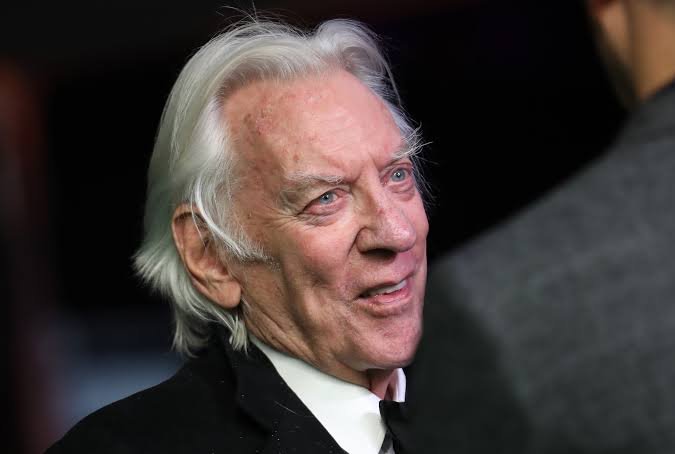
Sutherland made his feature-film debut in the Italian horror movie The Castle of the Living Dead in 1964. He also appeared in British films and television programs during this period, gradually building experience.
His early work included productions such as Dr. Terror’s House of Horrors, The Bedford Incident, and appearances in television series including The Saint and The Avengers. These were not necessarily the roles that made him famous, but they gave him valuable opportunities to demonstrate his range.
Sutherland was particularly effective when a character needed something unusual. He could appear humorous, threatening, awkward, intelligent, or mysterious without losing the qualities that made him recognizable.
That versatility became one of the defining features of his career.
The Dirty Dozen
Sutherland’s major breakthrough came with The Dirty Dozen in 1967. The film, directed by Robert Aldrich, featured a large ensemble cast and became a major success.
Sutherland played Vernon L. Pinkley, a member of the unconventional military unit at the center of the story. Although the role was not initially designed to make him a major star, his performance helped draw attention to him.
The Academy identifies The Dirty Dozen as the breakthrough point in his career, noting that he had previously spent years working in smaller British and Italian productions.
After the film, opportunities became more substantial. Sutherland was no longer simply a character actor appearing briefly in a production. He was becoming someone directors could build important parts around.
MAS*H
One of the biggest turning points in Donald Sutherland’s career came in 1970 with Robert Altman’s MASH*.
Sutherland played Captain Benjamin Franklin “Hawkeye” Pierce, a talented surgeon serving during the Korean War. The movie used comedy and satire to explore the absurdity of military life and the emotional strain of war.
Hawkeye was witty, rebellious, and irreverent, and Sutherland gave the character an energetic quality that helped make the film memorable.
MASH* became one of Sutherland’s defining performances and gave him his first major starring role in a successful ensemble film. The Academy specifically highlights the movie as an important milestone in his career.
The success of MASH* also established an important pattern in Sutherland’s career. He could play a recognizable leading role without fitting the traditional image of a Hollywood hero.
Klute
In 1971, Sutherland appeared opposite Jane Fonda in Alan J. Pakula’s Klute.
The film combined elements of mystery, psychological drama, and crime. Sutherland played John Klute, a private detective investigating the disappearance of a businessman.
Compared with the energetic Hawkeye Pierce, Klute was a much more restrained character. The role demonstrated that Sutherland could create tension through quiet observation rather than constant action.
His work in Klute also showed his growing connection with some of the most important filmmakers of the period. Throughout the 1970s, he became associated with ambitious movies that were willing to take creative risks.
Don’t Look Now
Nicolas Roeg’s Don’t Look Now, released in 1973, became another important part of Sutherland’s filmography.
He played John Baxter, an architect living in Venice with his wife after a devastating family tragedy. The movie blended psychological drama with mystery and unsettling supernatural elements.
Sutherland’s performance was central to the film’s atmosphere. Rather than relying on obvious emotional displays, he allowed the character’s grief and uncertainty to develop gradually.
The film has remained an important part of discussions about 1970s cinema, and Sutherland’s performance is one of the reasons it continues to attract attention.
Animal House
Sutherland also demonstrated that he could be extremely effective in comedy.
In National Lampoon’s Animal House in 1978, he played Professor Dave Jennings, a laid-back college professor. The performance was very different from his dramatic roles and demonstrated his willingness to embrace eccentric comedy.
His appearance in the film became one of his memorable supporting performances. It also showed that Sutherland did not need to be the central character to leave a strong impression.
His filmography from this period included a striking mixture of genres, from serious dramas to broad comedies and psychological thrillers.
Ordinary People
One of Sutherland’s most respected dramatic performances came in Robert Redford’s Ordinary People in 1980.
He played Calvin Jarrett, a father attempting to hold his family together after the death of one son and the suicide attempt of another. The film focuses heavily on grief, family relationships, guilt, and communication.
Sutherland’s performance is quiet and emotionally controlled. Calvin is not presented as someone who has all the answers. Instead, he is a father trying to understand what has happened to his family while dealing with his own emotions.
Ordinary People won the Academy Award for Best Picture, and Sutherland’s portrayal of Calvin became one of the most acclaimed performances of his career. The Academy lists the role among the major highlights of his filmography.
The film also demonstrated something that became increasingly clear throughout Sutherland’s career: he was especially effective at portraying people whose emotions were complicated rather than straightforward.
A Versatile Career
The 1980s were an uneven period commercially for Sutherland, but he continued working steadily.
He appeared in films such as Threshold, Eye of the Needle, The Winter of Our Discontent, Ordeal by Innocence, and A Dry White Season. He also continued taking television roles.
Rather than trying to maintain a single public image, Sutherland continued moving between different types of productions.
That approach allowed him to work with filmmakers from different generations and backgrounds. His filmography became unusually broad, and his willingness to accept unconventional roles remained one of his most recognizable professional characteristics.
JFK
Sutherland entered the 1990s with several significant performances.
One of the most memorable was Oliver Stone’s JFK, released in 1991. Sutherland played the mysterious character known as “X,” who provides Jim Garrison with information connected to the investigation surrounding the assassination of President John F. Kennedy.
The role was relatively limited in screen time, but Sutherland made a strong impression.
It was another example of his ability to give a supporting character considerable weight. His voice, physical presence, and controlled delivery made the character stand out within a large ensemble cast.
Backdraft
Sutherland reunited with director Ron Howard for Backdraft, also released in 1991.
The film focused on firefighters and the investigation of a series of dangerous fires. Sutherland played Ronald Bartel, a convicted arsonist whose knowledge becomes relevant to the investigation.
Again, the role was very different from his earlier performances. Sutherland had a natural ability to make characters feel distinctive even when they appeared for relatively limited portions of a story.
Six Degrees of Separation
In 1993, Sutherland appeared in Six Degrees of Separation, a drama built around identity, deception, social class, and perception.
He played Flan Kittredge, an art dealer whose wealthy lifestyle becomes connected to a young man claiming to be the son of actor Sidney Poitier.
The movie gave Sutherland another opportunity to play a sophisticated character while working alongside a talented ensemble.
His career during the 1990s continued to demonstrate his range. He could appear in major studio productions while also taking roles in smaller dramas and television projects.
Television Success
Although Sutherland became internationally known through movies, television was also an important part of his career.
One of his notable television performances came in Citizen X, a 1995 television film. His work earned him an Emmy Award and a Golden Globe, adding major television recognition to an already extensive film career.
He later appeared in a wide variety of television productions, demonstrating that his career was not limited to theatrical films.
His television work also allowed him to explore characters in longer formats, where subtle changes could develop over several hours rather than within a two-hour movie.
The Hunger Games
A new generation of viewers became familiar with Donald Sutherland through The Hunger Games.
Beginning with the 2012 film, Sutherland portrayed President Coriolanus Snow, the authoritarian leader of Panem. The character was very different from many of the sympathetic or eccentric roles Sutherland had played earlier in his career.
Snow is controlled, calculating, and politically powerful. Sutherland did not need exaggerated physical movements to communicate the character’s authority. His calm delivery and measured presence helped establish Snow as a central threat within the story.
He returned as Snow in subsequent installments of the original film series.
The Academy notes that Sutherland appeared as President Snow in the first Hunger Games film and reprised the role in three later entries.
The franchise introduced his work to millions of younger viewers who may not have previously seen his films from the 1960s, 1970s, and 1980s.
Other Notable Roles
Donald Sutherland’s career contains far more than a handful of famous performances.
In Invasion of the Body Snatchers in 1978, he played a health inspector confronting an extraordinary threat. The film became an important science-fiction thriller and showed Sutherland working effectively within a tense ensemble.
He appeared in Space Cowboys in 2000 alongside Clint Eastwood, Tommy Lee Jones, and James Garner. The movie allowed him to combine drama, humor, and adventure in a story about older astronauts returning to space.
He also appeared in Cold Mountain and The Italian Job in 2003, followed by numerous other film and television projects.
Later in his career, he appeared in films including The Mechanic, The Eagle, The Hunger Games films, Ad Astra, and Mr. Harrigan’s Phone. His continued activity demonstrated the remarkable length of his professional career.
The Academy credited him with more than 140 film credits spanning six decades when it honored him in 2017.
Acting Style
One of the most interesting aspects of Donald Sutherland’s work was that he never depended on a single acting style.
His voice was instantly recognizable, but he used it differently depending on the character. He could be relaxed and humorous in one film and intimidating or emotionally restrained in another.
His physical appearance also became part of his screen identity. Early in his career, his unconventional features did not necessarily fit traditional Hollywood expectations. Over time, however, those qualities became strengths.
Sutherland often seemed comfortable playing characters who were imperfect, mysterious, eccentric, or morally complicated.
That quality made his performances difficult to reduce to a single type.
Awards and Recognition
Donald Sutherland received major recognition throughout his career.
He won an Emmy and a Golden Globe for Citizen X, and his work in film earned recognition from critics and industry organizations.
One of the most significant honors came in 2017, when the Academy of Motion Picture Arts and Sciences presented him with an Honorary Academy Award.
The Academy’s official citation recognized him for a lifetime of memorable characters. The Honorary Award is intended to recognize extraordinary lifetime achievement and contributions to the art of filmmaking.
Importantly, Sutherland received this Honorary Oscar despite never receiving a competitive Academy Award nomination. The award represented recognition of his overall body of work rather than a single performance.
Family and Personal Life
Donald Sutherland’s family was also connected to the entertainment world.
His son Kiefer Sutherland became a successful actor, best known for projects including 24. Donald and Kiefer eventually appeared together in the 2016 western Forsaken, giving audiences an opportunity to see the father and son share the screen.
Sutherland was married three times. His marriages included actress Shirley Douglas and, later, Francine Racette, whom he married in 1972. He had five children.
Despite his international career, Sutherland maintained strong connections with Canada and continued to be regarded as an important Canadian figure in cinema.
Final Years
Sutherland continued acting well into his later years.
His later credits demonstrated that he had no need to rely only on the movies that made him famous decades earlier. He continued accepting new roles and working with contemporary filmmakers.
His final years also brought renewed attention to his earlier performances as audiences revisited his work.
Donald Sutherland died on June 20, 2024, at the age of 88. His death was confirmed by his son Kiefer Sutherland, and tributes followed from actors, directors, filmmakers, and audiences around the world.
The Academy subsequently included him among the artists remembered in its 2024 In Memoriam presentation.
Lasting Legacy
Donald Sutherland’s legacy is closely connected to the remarkable variety of his career.
He was not an actor who became famous for playing one character repeatedly. Instead, he built a body of work around change.
He could play a rebellious surgeon in MASH*, a detective in Klute, a grieving father in Ordinary People, a mysterious figure in JFK, a professor in Animal House, and President Snow in The Hunger Games.
Each role had a different personality and emotional purpose.
His career also illustrates how an actor can remain relevant across generations. Viewers who discovered Sutherland through The Hunger Games could later explore his earlier work and encounter a completely different performer.
The Academy’s recognition of his career reflects that breadth. At the time of his Honorary Oscar, the Academy described a career spanning more than 140 film credits and six decades.
Why Donald Sutherland Remains Memorable
Donald Sutherland remains memorable because his career was built on range, curiosity, and a willingness to take different kinds of roles.
He worked with directors such as Robert Altman, Alan J. Pakula, Nicolas Roeg, Federico Fellini, Robert Redford, Oliver Stone, and many others. His filmography crossed generations of filmmaking and included both major studio productions and more unconventional projects.
His performances also reached audiences at very different stages of his life. In the 1970s, he became closely associated with a new generation of American cinema. Decades later, The Hunger Games introduced him to a much younger worldwide audience.
That ability to remain relevant without abandoning his individuality was one of the most notable parts of his career.
Conclusion
Donald Sutherland’s life and career tell the story of an actor who refused to be confined to one category.
From his early work in British television and European films to his breakthrough in The Dirty Dozen, he gradually developed into one of cinema’s most recognizable character actors. MASH* established him as a major star, while films such as Klute, Don’t Look Now, and Ordinary People demonstrated his dramatic range.
His later work in JFK, Backdraft, Space Cowboys, Cold Mountain, and The Hunger Games showed that his career could continue evolving long after his early successes.
By the time he received an Honorary Academy Award in 2017, Donald Sutherland had already created a filmography spanning more than six decades. His death in 2024 marked the end of an extraordinary acting career, but his performances remain available to audiences who want to discover the many sides of his work.
For many viewers, Donald Sutherland will always be remembered for President Snow. For others, he will be Hawkeye Pierce, Calvin Jarrett, John Klute, or one of the many unusual characters he brought to life.
That variety is perhaps the clearest measure of his contribution to film: he did not simply play roles; he made each new character feel like a different chapter in an exceptionally long career.