







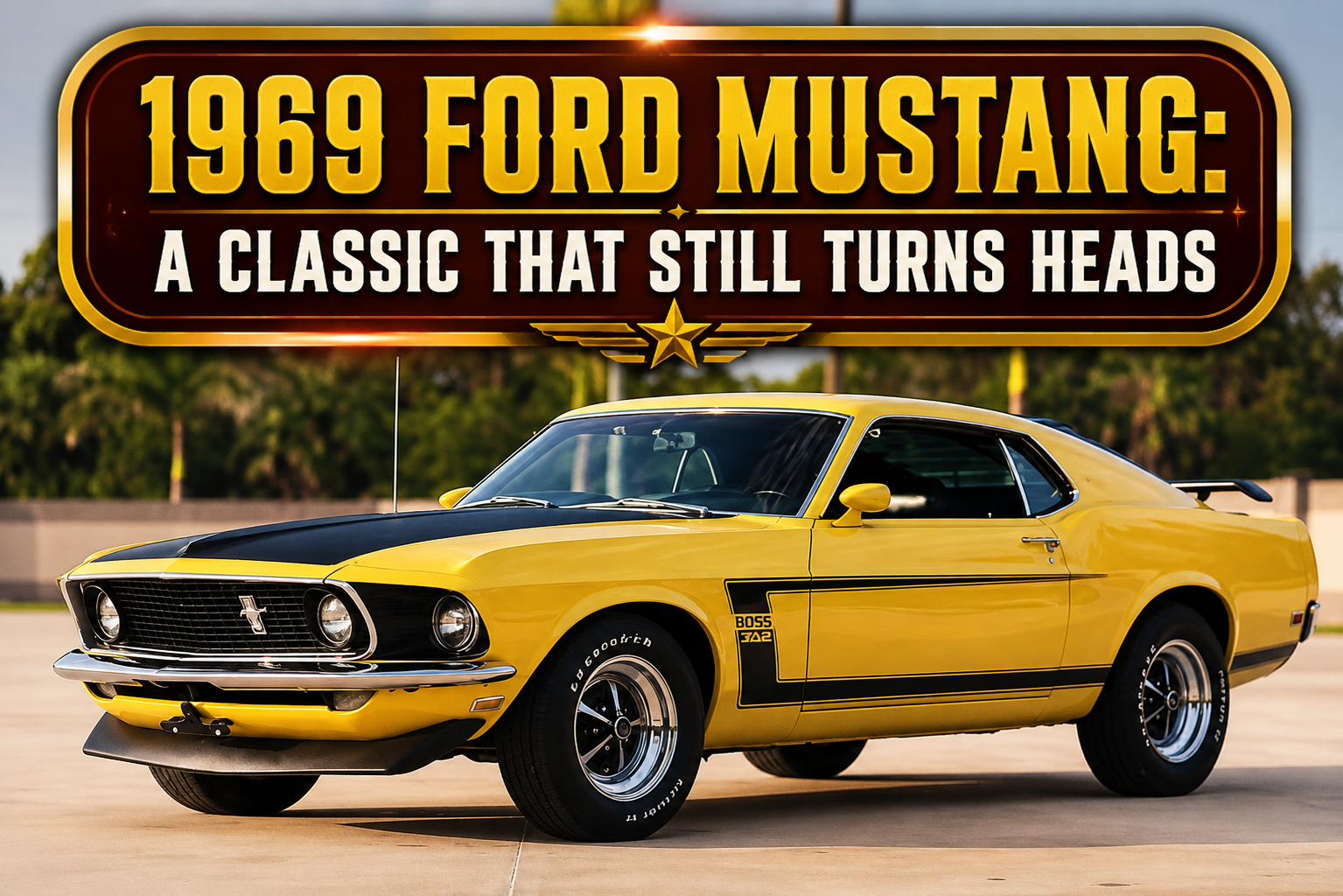
The 1969 Ford Mustang arrived at an important point in the history of Ford’s pony car. By then, the Mustang had already established itself as one of America’s best-known performance-oriented cars, but Ford continued to expand the lineup with more body styles, engine choices, and specialized models.
The 1969 model year stands out because it offered an unusually broad range of Mustangs. Buyers could choose a practical six-cylinder model, a V8-powered coupe, a convertible, a SportsRoof fastback, or a high-performance version such as the Mach 1, Boss 302, or Boss 429. Ford also continued its Shelby relationship for the 1969 Shelby GT350 and GT500.
That combination of styling, choice, and performance is a major reason the 1969 Mustang remains so recognizable today. Nearly six decades later, it still has the proportions and personality that made classic Mustangs so memorable.
BIO
| Label | Information |
|---|---|
| Model | 1969 Ford Mustang |
| Type | Classic American pony car |
| Model Year | 1969 |
| Body Styles | Coupe, SportsRoof, Convertible |
| Total Production | 299,824 units |
| Base Engine | 200 cu. in. 6-cylinder |
| V8 Options | 302, 351, 390, 428, 429 |
| Top Performance Model | Boss 429 |
| Special Models | Mach 1, Boss 302, Boss 429 |
| Mach 1 Production | 72,458 units |
| Wheelbase | 108 inches |
| Key Appeal | Styling, performance, and collector value |
The 1969 Mustang Story
The 1969 Mustang was part of the first-generation Mustang family, but it brought noticeable changes in appearance and model strategy. Ford gave the car a more substantial visual presence while continuing to build on the basic Mustang formula of sporty styling, relatively compact dimensions, and a wide selection of equipment.
Production records show that Ford built roughly 299,824 Mustangs for the 1969 model year, although historical sources sometimes differ slightly in their totals because of how individual versions are counted. The lineup included hardtops, convertibles, SportsRoof models, the Grande, and the increasingly important Mach 1.
The year was also significant because Ford used the Mustang nameplate to cover very different types of cars. A basic six-cylinder Mustang and a Boss 429 shared the same family name, yet their intended personalities were worlds apart.
That variety helped make the Mustang appealing to a much wider audience than a traditional performance car.
Bold Styling
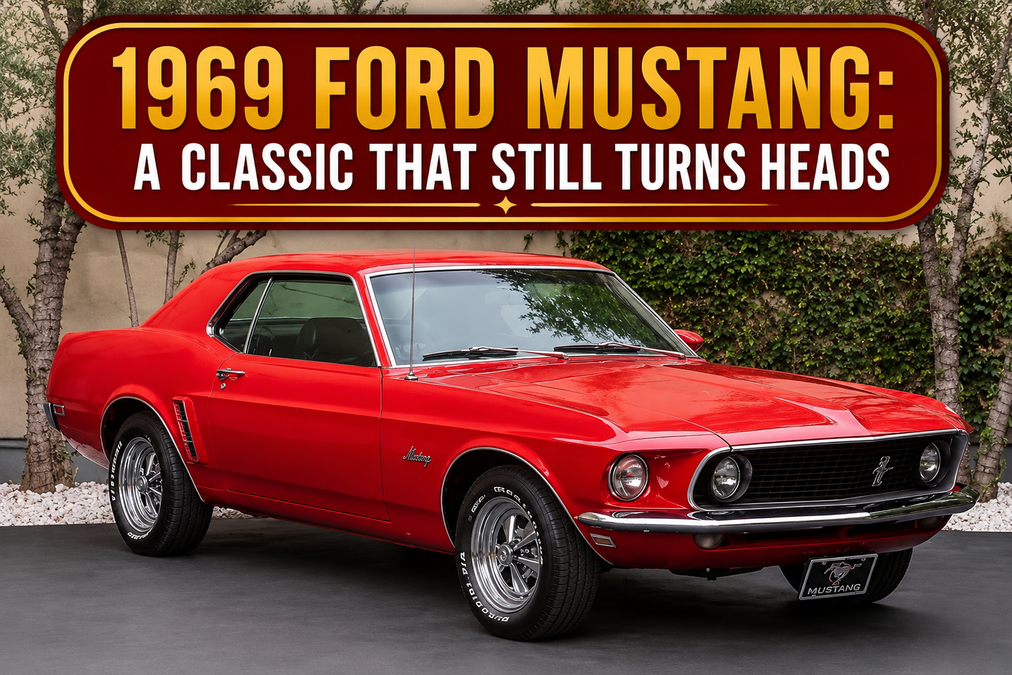
The 1969 Ford Mustang received styling that looked more aggressive than the earlier cars. The front end featured a wider grille treatment and four headlights, while the body had a longer, more muscular appearance.
The SportsRoof body style was especially important to the Mustang’s image. Its fastback-like roofline gave the car a sporty profile and provided the foundation for several of the most desirable performance versions.
The hardtop remained a major part of the lineup, while the convertible offered a more relaxed interpretation of the Mustang. Ford also introduced the Grande as an upscale hardtop with additional trim and interior equipment.
Color choices added even more personality. Period production references list colors including Raven Black, Candyapple Red, Acapulco Blue, Meadowlark Yellow, Wimbledon White, Winter Blue, and Lime Gold.
The result was a car that could look elegant, sporty, or intimidating depending on its body style, color, wheels, and options.
Engine Choices
One of the biggest strengths of the 1969 Mustang was its engine selection. Ford offered everything from economical six-cylinder engines to large-displacement V8s.
Available engines included a 200-cubic-inch six-cylinder, a 250-cubic-inch six-cylinder, the 302 V8, several versions of the 351 V8, the 390 V8, and the powerful 428 Cobra Jet. The Boss models added their own specialized V8 engines.
The basic 200-cubic-inch six-cylinder was rated at about 115 horsepower in commonly cited 1969 specifications, while the 250 six-cylinder produced about 155 horsepower. V8 choices moved the Mustang into a different level of performance, with the 302 and 351 engines providing a range of power suitable for everyday driving as well as enthusiast use.
At the top of the regular Mustang engine range was the 428 Cobra Jet, a famous Ford big-block that was officially rated at 335 horsepower. Contemporary specifications also identify the Cobra Jet’s torque output at 440 lb-ft in relevant applications.
These choices made the 1969 Mustang unusually flexible. Buyers did not have to choose between a basic car and a dedicated muscle machine; there were many steps in between.
The Mach 1
The Mustang Mach 1 became one of the defining models of 1969.
It was offered only with a V8 and used the SportsRoof body style. Its appearance emphasized the performance character of the Mustang with distinctive trim and equipment, helping separate it from the ordinary versions.
The Mach 1 was not simply a cosmetic package. Depending on the engine and options selected, it could become a genuinely serious performance car.
Production figures show that Ford built approximately 72,458 Mach 1s for 1969, making it considerably more common than the Boss models but still highly significant to Mustang history.
The Mach 1 also helped establish a formula that would remain important for future Mustang generations: combine aggressive styling with a range of performance equipment and offer buyers the ability to configure the car to their preferences.
The Boss 302
The Boss 302 was developed with competition in mind. Ford created it as a road-going performance car closely connected to the requirements of Trans-Am racing.
The engine displaced 302 cubic inches and was rated at approximately 290 horsepower in period specifications. The car also received suspension and chassis changes designed to make it more capable in corners than an ordinary Mustang.
This distinction is important. The Boss 302 was not simply about having a larger engine. Ford’s engineers paid attention to handling, suspension, and the overall balance of the car.
Production was limited. Depending on the historical source and counting method, figures for 1969 Boss 302 production are commonly listed around 1,600 to 1,900 cars.
That limited production is one reason original Boss 302s are so closely watched by collectors today.
The Boss 429
If the Boss 302 represented the Mustang’s road-racing side, the Boss 429 represented Ford’s pursuit of enormous engine capacity and racing credentials.
The 429-cubic-inch V8 was developed in connection with Ford’s NASCAR program. Installing the large engine into a Mustang required substantial engineering work, and the resulting car became one of the rarest and most famous Mustangs of the period.
The Boss 429 is particularly interesting because its reputation is not based simply on straight-line performance. Its importance also comes from the engineering effort required to fit the engine into the Mustang and from its connection to Ford’s broader racing program.
Historical production figures vary depending on whether certain cars are included, but commonly cited figures put total 1969 Boss 429 production at fewer than 900 Mustangs, making it dramatically rarer than the Mach 1.
That rarity has made the Boss 429 one of the most recognizable collector Mustangs from the classic era.
Shelby Mustangs
The 1969 model year also included the Shelby GT350 and GT500, which occupied a special position above the regular Mustang range.
Shelby versions featured extensive visual changes and specialized body components. According to Hemmings’ production research, 1969 Shelby production included hundreds of GT350 SportsRoofs and more than a thousand GT500 SportsRoofs, along with convertible versions and special Hertz-related production.
The Shelby cars are worth mentioning because they demonstrate how far Ford and Shelby were willing to take the Mustang concept. These were not merely standard Mustangs with a badge added; they were distinctive performance-oriented versions with their own styling and equipment.
For collectors, authentic Shelby documentation and originality can be especially important.
Inside the Cabin
The interior of the 1969 Mustang reflected the period in which it was built. It was not designed to provide the technology or refinement expected from a modern car. Instead, the focus was on straightforward controls, practical seating, and a sporty atmosphere.
Higher-level versions could receive more attractive upholstery, additional instrumentation, decorative trim, and convenience equipment.
The Grande, for example, was aimed at buyers who wanted a more upscale Mustang. Period references describe features such as special interior trim, an electric clock, upgraded upholstery, and additional sound insulation.
This variety once again shows how Ford positioned the Mustang as more than a single type of vehicle.
Performance on the Road
Driving a 1969 Ford Mustang today is a very different experience from driving a modern performance car.
The car’s suspension, steering, brakes, tires, and engine response reflect late-1960s engineering. A well-maintained example can feel lively and mechanical, with the driver much more connected to the sounds and movements of the vehicle.
Performance varies enormously depending on the engine and equipment. A six-cylinder Mustang has a very different character from a 428 Cobra Jet or Boss model.
The Boss 302 is particularly interesting because its design emphasized handling as well as power. Contemporary technical information describes front disc brakes, a live rear axle, leaf springs, and performance-oriented suspension equipment on the Boss versions.
That mechanical simplicity is part of the appeal for many classic-car enthusiasts. There are fewer electronic systems separating the driver from the machine.
Specifications at a Glance
| Feature | 1969 Ford Mustang |
|---|---|
| Model year | 1969 |
| Body styles | Hardtop, SportsRoof, convertible |
| Special models | Grande, Mach 1, Boss 302, Boss 429 |
| Six-cylinder engines | 200 and 250 cu. in. |
| V8 options | 302, 351, 390, 428 and specialized Boss engines |
| Transmission choices | Manual and automatic options |
| Wheelbase | Approximately 108 inches |
| Total production | About 299,824 |
| Mach 1 production | About 72,458 |
| Boss 302 production | About 1,600+ |
| Boss 429 production | Fewer than 900 in commonly cited 1969 figures |
Production and engine figures can vary slightly between historical references because different sources use different counting methods and specifications.
What to Check When Buying One
Buying a classic Mustang requires more attention than buying a modern used car. The condition of the individual vehicle matters considerably more than the badge on the grille.
Rust is one of the first things worth examining. A prospective buyer should pay close attention to the floors, frame-related areas, wheel arches, lower body panels, and other places where corrosion may have developed.
The engine should also be inspected carefully. A car advertised with a particular engine is not necessarily still equipped with the engine it left the factory with. Matching components and documentation can make a major difference to a collector-focused purchase.
The same applies to transmissions, rear axles, interior equipment, trim, wheels, and paint.
A careful inspection can also reveal whether a restoration was carried out properly or whether cosmetic work is hiding structural problems.
Originality Matters
Not every classic Mustang needs to remain completely original. Some owners prefer tasteful modifications, improved braking systems, modern tires, upgraded suspension, or other changes that make the car easier to enjoy.
For a collector, however, originality can be extremely important.
Factory documentation, VIN information, body codes, engine codes, build details, and historical records can help establish what a particular car was when it was produced.
The 1969 Mustang VIN contains useful information about the model year, assembly plant, body style, engine, and production sequence. Historical Mustang references identify 9 as the model-year digit for 1969 and distinguish assembly plants such as Dearborn, San Jose, and Metuchen.
That information is particularly useful when evaluating a rare performance model.
Collector Appeal
The collector market for the 1969 Ford Mustang is broad because there is no single version that represents the entire model year.
An ordinary hardtop can appeal to someone who simply loves classic Mustang styling. A convertible offers a different experience. A Mach 1 combines recognizable styling with performance history, while a Boss 302 or Boss 429 appeals to collectors interested in rarity and competition heritage.
This range of choices also means that condition, authenticity, specifications, and documentation can have a major effect on a particular car’s desirability.
A restored example with questionable history is not necessarily equivalent to an original, well-documented car with the same model designation.
Why It Still Turns Heads
There is a straightforward reason the 1969 Ford Mustang remains so memorable: it brought together several qualities that still work today.
Its styling is unmistakably from the late 1960s, but it has enough presence to stand out on a modern road. The long hood, compact cabin, aggressive front end, and SportsRoof profile give it a character that modern cars rarely replicate.
Then there is the variety. The Mustang could be a comfortable cruiser, a stylish convertible, a powerful Mach 1, or a limited-production Boss.
Few cars from the same era offered such a broad spectrum under one name.
The 1969 Mustang also represents an important moment in American automotive history. It came during an era when manufacturers were using performance, motorsports, styling, and personalization to compete for buyers. Ford’s approach produced some of the most memorable versions of the Mustang name.
1969 Mustang vs. Other Muscle Cars
The late 1960s offered buyers plenty of alternatives, including the Chevrolet Camaro, Pontiac Firebird, Dodge Charger, and other performance-oriented cars.
The Mustang’s advantage was its combination of variety and accessibility.
It was possible to buy a relatively straightforward Mustang without committing to a high-performance setup, while buyers who wanted more power had numerous V8 choices and specialized models.
The Mach 1, Boss 302, and Boss 429 each served different purposes. That breadth helped the Mustang remain relevant even as competition became increasingly intense.
A Classic With Many Personalities
Perhaps the most interesting thing about the 1969 Ford Mustang is that there is no single correct way to describe it.
It was a family of cars rather than one specific machine.
A six-cylinder coupe represented affordable transportation with sporty styling. A convertible emphasized open-air cruising. A Grande added a more refined character. The Mach 1 pushed the Mustang toward the muscle-car market, while the Boss models brought racing influence and limited-production exclusivity.
That flexibility explains why the model continues to attract different kinds of enthusiasts.
Final Thoughts
The 1969 Ford Mustang remains one of the most recognizable classic American cars for good reason. Its styling is distinctive, its engine lineup was remarkably broad, and its special models gave the Mustang an important place in the performance-car history of the late 1960s.
With nearly 300,000 examples produced for the model year, the Mustang itself was not an especially rare car. What makes individual examples valuable and interesting today is the combination of model, engine, originality, condition, documentation, and history.
From the stylish convertible to the famous Mach 1 and the exceptionally rare Boss 429, the 1969 lineup offered something for almost every kind of Mustang enthusiast.
More than half a century later, that combination still works. The 1969 Mustang does not need modern technology or extreme styling to attract attention. Its proportions, mechanical character, and place in American automotive history are enough to make it a classic that still turns heads.
Frequently Asked Questions
1. What makes the 1969 Ford Mustang special?
The 1969 Ford Mustang stands out for its redesigned styling, broad engine lineup, and range of performance models. Ford offered versions such as the Mach 1 and Boss 302, making this model year particularly important in Mustang history.
2. How many 1969 Ford Mustangs were produced?
Ford produced approximately 299,824 Mustangs for the 1969 model year. The total included several body styles and versions, including hardtops, convertibles, SportsRoof models, and the Mach 1.
3. What engines were available in the 1969 Ford Mustang?
The 1969 Mustang offered several engines, ranging from 200- and 250-cubic-inch six-cylinder engines to V8 options including the 302, 351, 390, and 428 Cobra Jet. The Boss models had specialized 302 and 429 V8 engines.
4. What is the 1969 Mustang Mach 1?
The Mach 1 was a new performance-oriented Mustang introduced for 1969. It was offered exclusively with the SportsRoof body style and combined distinctive styling with performance equipment. Ford produced 72,458 Mach 1s during the model year.
5. Why is the 1969 Mustang Boss 429 so collectible?
The Boss 429 is highly regarded because of its limited production and connection to Ford’s NASCAR racing program. Common historical production figures put 1969 Boss 429 production at fewer than 900 cars, making authentic examples especially rare.