







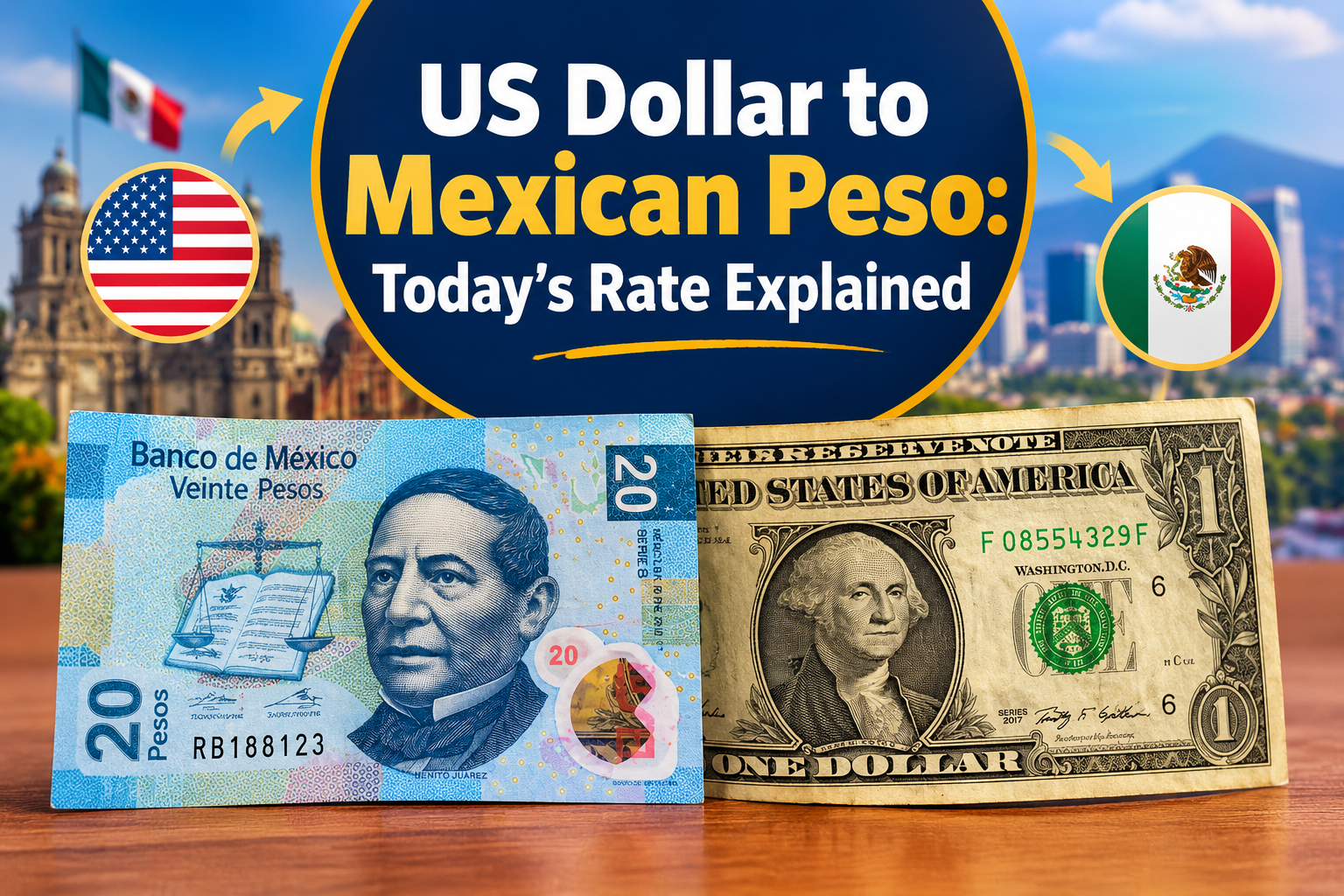
The US dollar to Mexican peso exchange rate is one of the most closely watched currency pairs in North America. It matters to travelers, businesses, investors, online shoppers, families sending money across borders, and anyone who needs to convert dollars into pesos.
The value of the Mexican peso compared with the U.S. dollar does not stay fixed. It moves throughout the foreign-exchange market as traders respond to interest rates, inflation, economic reports, trade conditions, political developments, and changes in investor confidence.
For anyone planning a trip to Mexico or simply trying to understand how much their dollars are worth, knowing how the USD/MXN rate works can make currency conversion much easier.
BIO
| Label | Information |
|---|---|
| Topic | US Dollar to Mexican Peso |
| Currency Pair | USD/MXN |
| U.S. Currency | U.S. Dollar (USD) |
| Mexican Currency | Mexican Peso (MXN) |
| Exchange Rate | Pesos received for 1 U.S. dollar |
| Main Purpose | Currency conversion |
| Rate Type | Market and reference rates |
| Rate Movement | Changes throughout the market |
| Key Influences | Rates, inflation, trade, and economic data |
| Conversion Formula | USD × exchange rate = MXN |
| Common Use | Travel, trade, payments, and remittances |
| Important Note | Bank rates may include fees or spreads |
What Does US Dollar to Mexican Peso Mean?
The US dollar to Mexican peso rate tells you how many Mexican pesos are needed to equal one U.S. dollar.
The currency pair is commonly written as USD/MXN. USD represents the U.S. dollar, while MXN represents the Mexican peso.
For example, if the exchange rate is 17 pesos for $1, then:
$1 USD = 17 MXN
Using the same rate, $100 would equal 1,700 Mexican pesos before considering any fees or exchange-rate markups.
The important point is that the quoted market rate is not necessarily the exact rate a person receives from a bank, ATM, money-transfer service, or currency exchange counter. Those providers may add a spread or fee.
What Is the US Dollar to Mexican Peso Rate Today?
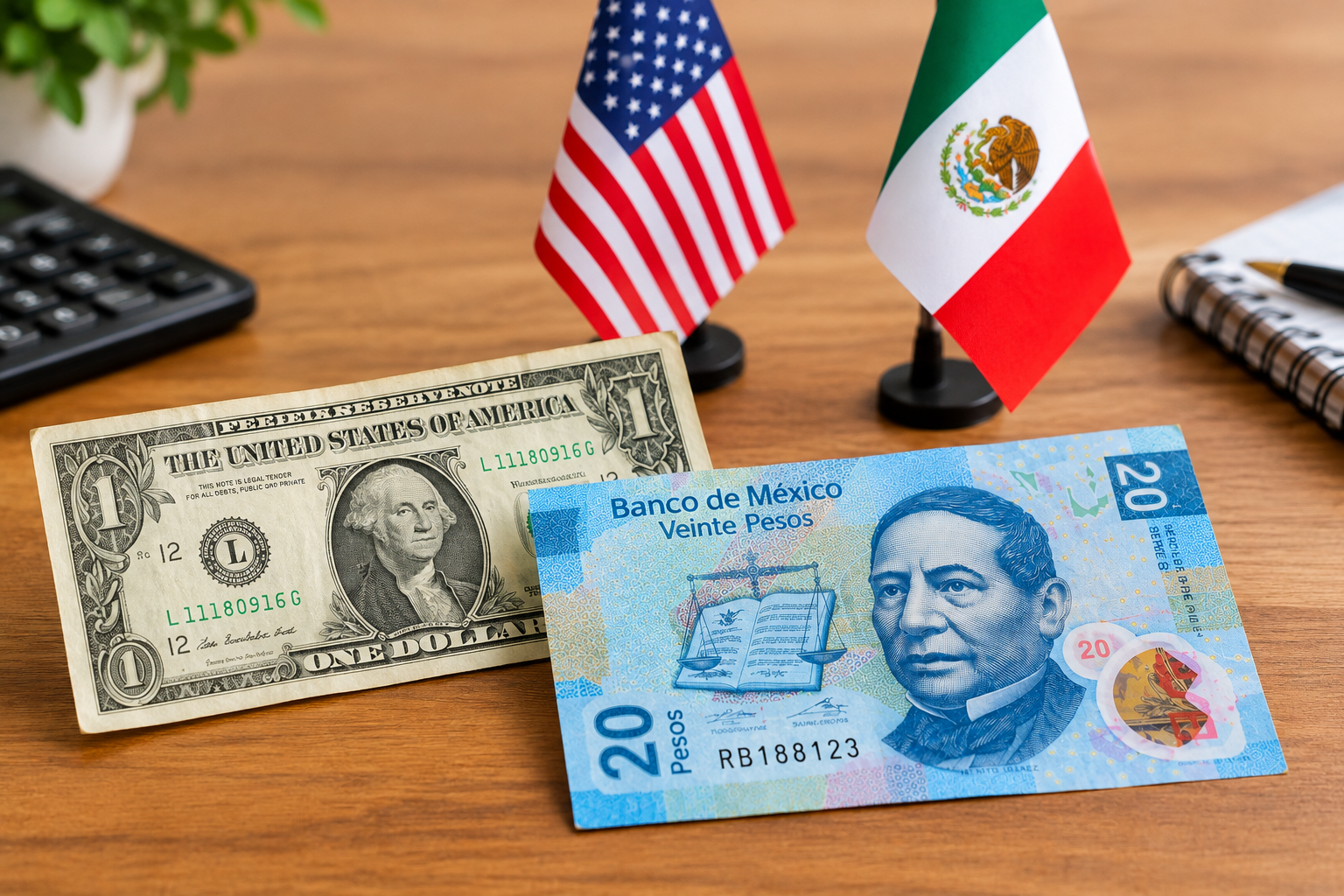
The exchange rate changes regularly, so a “today” rate should always be associated with a specific date and time.
Banco de México’s official data shows that the peso traded around the 17-peso-per-dollar area during August 2026. Its August monthly average FIX exchange rate was 17.0664 pesos per U.S. dollar, while the end-of-month FIX rate was 17.0147. These official figures are useful reference points, although the live market rate can move during the day.
As of early September 2026, the USD/MXN market remains sensitive to expectations surrounding U.S. interest rates, Mexican monetary policy, inflation, economic activity, and international market conditions.
That means readers should avoid treating one quoted number as permanent. The rate can be different a few hours later, particularly when important economic news is released.
How to Convert US Dollars to Mexican Pesos
The basic conversion is simple.
U.S. dollars × exchange rate = Mexican pesos
Suppose the rate is 17.00 MXN for every $1 USD.
A $10 conversion would be:
$10 × 17.00 = 170 MXN
A $100 conversion would be:
$100 × 17.00 = 1,700 MXN
A $500 conversion would be:
$500 × 17.00 = 8,500 MXN
And $1,000 would equal:
$1,000 × 17.00 = 17,000 MXN
These examples are for understanding the calculation. The amount actually received can be lower because banks and currency services may use their own customer exchange rates and fees.
Why Does the Exchange Rate Change?
There is no single reason behind every movement in USD/MXN.
Currencies respond to a combination of economic conditions and market expectations. Sometimes a relatively small piece of economic news can move a currency because traders were already positioned for a different outcome.
Interest Rates
Interest rates are among the most important influences on currencies.
When investors believe U.S. interest rates will remain relatively high, dollar-denominated assets can become more attractive. This can increase demand for dollars.
Mexico’s interest-rate decisions matter as well. The relationship between Mexican and U.S. rates can influence how international investors view peso-denominated assets.
The Federal Reserve maintained its federal funds target range at 3.50% to 3.75% at its July 2026 meeting. The central bank’s September 15–16, 2026 meeting is another important event for financial markets.
Expectations can matter just as much as the actual decision. If traders expect a major change before policymakers announce it, the exchange rate may move before the meeting takes place.
Inflation
Inflation can also affect currencies.
When inflation rises, central banks may consider tighter monetary policy to slow price growth. On the other hand, expectations that inflation is falling can create room for lower interest rates.
For the USD/MXN exchange rate, investors watch inflation developments in both the United States and Mexico.
The difference between the two countries can influence expectations about future interest rates and investment flows.
Economic Growth
Strong economic growth can support a currency because it may attract investment and improve confidence in an economy.
Important economic indicators include employment, consumer spending, industrial production, business investment, manufacturing activity, and economic-growth figures.
The United States and Mexico are closely connected economically, so changes in either country’s economic outlook can affect the peso-dollar relationship.
The Role of US-Mexico Trade
The United States and Mexico have an unusually close trading relationship.
Large amounts of goods and services move between the two countries every year. Manufacturing, automobiles, electronics, agriculture, energy, and other industries all contribute to cross-border economic activity.
Because of this relationship, changes in trade policy can influence expectations for the Mexican economy and the peso.
Businesses that earn revenue in dollars but have costs in pesos may also pay close attention to USD/MXN movements. The same is true for Mexican companies that purchase products or services priced in U.S. dollars.
Trade uncertainty can sometimes increase market volatility because investors attempt to estimate how new policies could affect economic growth, investment, and cross-border commerce.
What Happens When the Peso Gets Stronger?
A stronger peso means fewer pesos are required to purchase one U.S. dollar.
For example, imagine USD/MXN moves from 17.50 to 17.00.
In that situation, the dollar has become less valuable relative to the peso, while the peso has strengthened against the dollar.
For someone traveling from the United States to Mexico, a stronger peso can mean that their dollars purchase fewer pesos than before.
For Mexican consumers and businesses purchasing certain products priced in dollars, however, a stronger peso can make those purchases relatively less expensive.
The effect depends on the person’s income, expenses, and exposure to foreign currencies.
What Happens When the Dollar Gets Stronger?
When the U.S. dollar strengthens against the Mexican peso, the USD/MXN rate rises.
For example:
1 USD = 18 MXN
would represent a stronger dollar against the peso than:
1 USD = 17 MXN
For U.S. travelers in Mexico, a stronger dollar generally means their dollars can be exchanged for more pesos.
For Mexican consumers or businesses buying goods priced in U.S. dollars, the situation can be different. They may need more pesos to pay the same dollar-denominated price.
This is why the direction of the exchange rate matters differently depending on where someone earns and spends money.
Why Your Bank Rate May Be Different
One of the most common sources of confusion is the difference between a market exchange rate and the rate offered to a customer.
A financial website may show a rate close to the wholesale or mid-market level. A bank, ATM operator, exchange counter, or payment provider may use a different rate.
The difference is often called the spread.
For example, if the market rate is 17.00 pesos per dollar, a provider might give a customer a slightly less favorable rate. The provider may also charge a separate transaction fee.
This means the final amount matters more than simply looking at the headline exchange rate.
Before exchanging a large amount of money, it can be useful to compare the total cost rather than comparing the quoted rate alone.
How Much Is $100 in Mexican Pesos?
The answer depends on the exchange rate at the time of conversion.
If the rate were:
1 USD = 17 MXN
then:
$100 = 1,700 MXN
If the rate changed to:
1 USD = 17.50 MXN
then:
$100 = 1,750 MXN
That difference may seem small for a $100 transaction, but it becomes more noticeable when converting larger amounts.
For example, a 0.50-peso difference on every dollar would represent a 500-peso difference on a $1,000 conversion before fees.
Common US Dollar to Mexican Peso Conversions
Using a hypothetical rate of 17 MXN for $1 USD, the calculation would look like this:
| U.S. Dollars | Mexican Pesos |
|---|---|
| $1 | 17 MXN |
| $5 | 85 MXN |
| $10 | 170 MXN |
| $20 | 340 MXN |
| $50 | 850 MXN |
| $100 | 1,700 MXN |
| $250 | 4,250 MXN |
| $500 | 8,500 MXN |
| $1,000 | 17,000 MXN |
These numbers are examples rather than guaranteed transaction amounts. A live exchange rate and provider fees should always be used for an actual conversion.
What Can Move USD/MXN Next?
Predicting a currency precisely is difficult because several forces can move the market at the same time.
One major factor to watch is the Federal Reserve. Its September 2026 policy meeting is scheduled for September 15–16, making U.S. monetary policy an important near-term focus for currency markets.
Recent U.S. employment data have also influenced interest-rate expectations. August 2026 payroll growth came in stronger than economists had expected, while the unemployment rate remained at 4.1%. Such data can affect expectations about the Federal Reserve’s next decisions.
Mexican monetary policy is another important factor. Investors also watch Mexican inflation, economic growth, domestic interest rates, government finances, and capital flows.
Global risk sentiment matters too. When investors become nervous about international markets, emerging-market currencies can experience larger moves.
Is the Mexican Peso Strong or Weak?
Calling a currency “strong” or “weak” depends on the comparison and the period being considered.
The Mexican peso can strengthen against the dollar while weakening against another currency. It can also move in one direction for several weeks and then reverse quickly.
One useful way to understand the USD/MXN pair is to remember this simple rule:
A lower USD/MXN number generally means a stronger peso relative to the dollar.
A higher USD/MXN number generally means a stronger dollar relative to the peso.
This makes it easier to interpret daily price movements.
Why the Rate Matters to Travelers
Travelers often notice exchange rates immediately because they need pesos for hotels, food, transportation, shopping, and other expenses.
A small change in the exchange rate may not have much effect on a short trip, but larger differences can matter when converting substantial amounts.
Travelers should also remember that cash exchange rates, card transactions, and ATM withdrawals may involve different costs.
A card purchase might use a different conversion process from a cash exchange, while an ATM withdrawal may involve additional charges.
The exchange rate is therefore only one part of the total cost.
Why Businesses Watch USD/MXN
Companies with operations in both countries have an even stronger reason to monitor the exchange rate.
A Mexican manufacturer that buys equipment priced in dollars may see its costs change when the peso moves.
Likewise, a U.S. company receiving revenue in pesos may find that its earnings are worth more or less when converted back into dollars.
For businesses, currency changes can influence budgets, pricing, profits, import costs, and financial planning.
Large companies sometimes use financial strategies to manage currency exposure, but smaller businesses may simply monitor exchange rates and adjust budgets when necessary.
How to Read USD/MXN Correctly
The easiest mistake is to look at the number without remembering what it represents.
If USD/MXN is 17, it means approximately 17 Mexican pesos for one U.S. dollar.
If it moves to 18, the dollar has strengthened relative to the peso.
If it falls to 16, the peso has strengthened relative to the dollar.
This simple framework makes daily movements much easier to understand.
It is also important to distinguish between an official reference rate and a rate available for an actual consumer transaction. Official reference rates are useful for reporting and comparison, but the amount you receive from a financial provider may be different.
The Bigger Picture
The US dollar to Mexican peso exchange rate is more than a number displayed on a currency-converter screen.
It reflects the interaction between two major economies and is influenced by interest rates, inflation, trade, investment, economic growth, political developments, and global financial sentiment.
The peso has attracted considerable attention in recent years because of its movements against the dollar and Mexico’s important role in North American trade.
At the same time, exchange rates can change quickly. A rate that looks favorable in the morning may not be available later in the day.
That is why anyone making an actual currency conversion should check the latest available rate and consider the provider’s fees and spread.
Final Thoughts
Understanding the US dollar to Mexican peso exchange rate does not require a background in economics.
The basic idea is straightforward: the USD/MXN rate tells you how many Mexican pesos are equal to one U.S. dollar.
What makes the rate move is more complicated. Interest-rate expectations, inflation, economic data, U.S.-Mexico trade, investor confidence, and global events can all influence the relationship between the two currencies.
For everyday users, the most important lesson is to look beyond the headline number. Check the date, understand whether the quoted figure is a market or customer rate, and account for fees before deciding how much a conversion will actually cost.
For businesses and investors, the exchange rate can provide a broader view of economic conditions in the United States and Mexico.
And for travelers, even a basic understanding of USD/MXN can make it easier to plan a realistic budget.
Ultimately, the best way to understand the dollar-to-peso market is to treat the exchange rate as a moving figure rather than a permanent value. The rate changes because the economic relationship between the two currencies is constantly changing.
Frequently Asked Questions
What is the US dollar to Mexican peso exchange rate?
The USD/MXN rate shows how many Mexican pesos are equal to one U.S. dollar. It changes regularly as currency-market conditions change.
How much is $100 in Mexican pesos?
The exact amount depends on the current exchange rate. Multiply 100 by the current USD/MXN rate to estimate the peso value before fees or exchange-rate markups.
Why does the US dollar to Mexican peso rate change?
The rate can move because of interest rates, inflation, economic data, trade conditions, investor confidence, and changes in the U.S. or Mexican economic outlook.
Is a bank’s exchange rate the same as the market rate?
Not necessarily. Banks and other providers may add a spread or transaction fee, so the amount received can differ from the published market or reference rate.
Where can I check the latest USD/MXN rate?
Banco de México publishes official exchange-rate information, including its FIX reference rate. The rate should be checked with its publication date because exchange values change over time.