







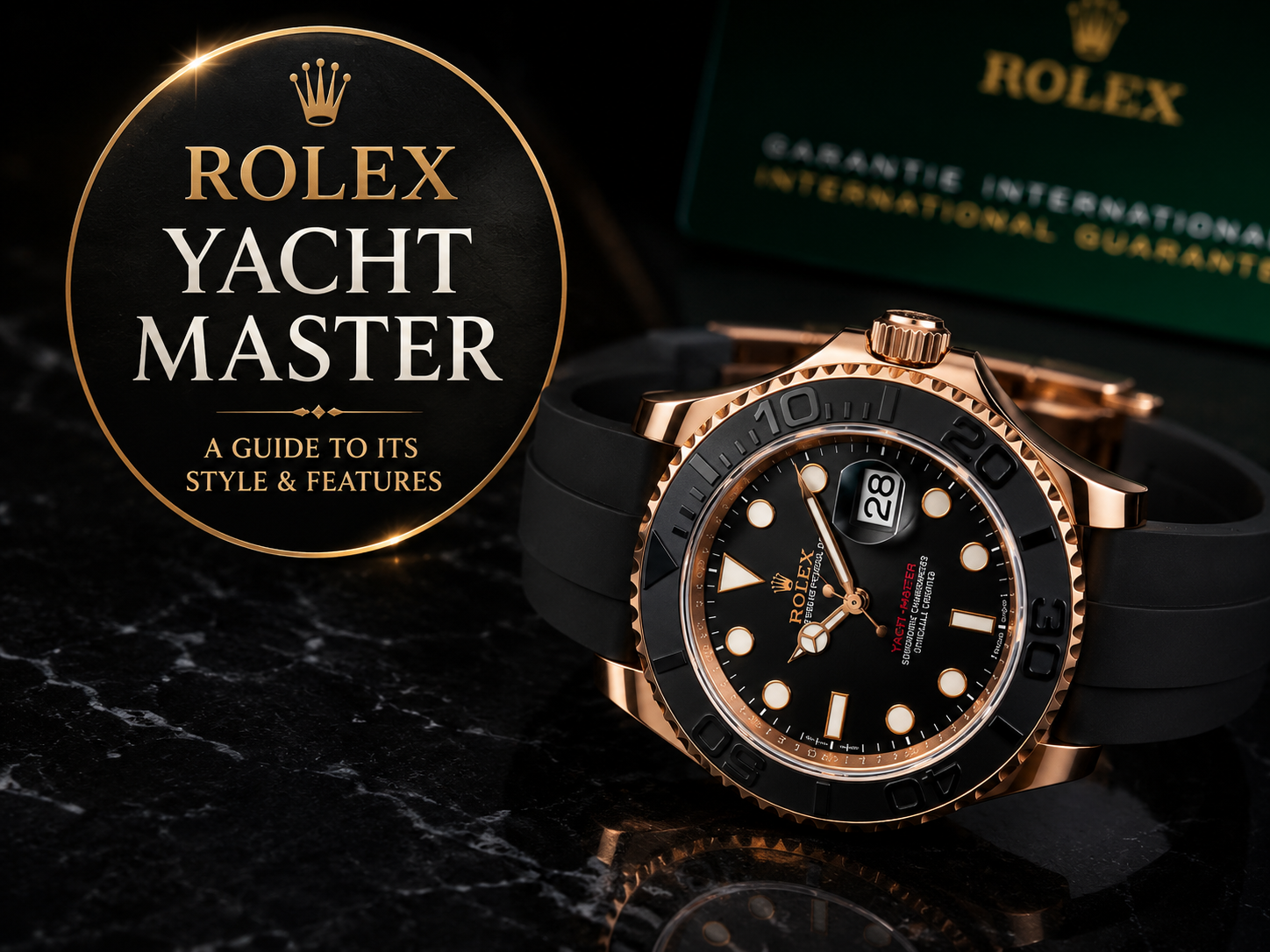
The Rolex Yacht Master occupies an interesting place in the world of luxury watches. It has the recognizable quality associated with Rolex, but its personality is different from the brand’s better-known diving, racing, or travel watches. The Yacht-Master combines a sporty character with polished materials, nautical inspiration, and a design that can work just as comfortably away from the water.
Since its introduction in 1992, the Yacht-Master has developed into a collection with several sizes, materials, dial choices, and bracelet options. Rolex currently offers the watch in 37 mm, 40 mm, and 42 mm sizes, with versions using Oystersteel, platinum, gold alloys, and RLX titanium.
For someone discovering the collection for the first time, there is quite a lot to understand. The bezel, materials, movement, bracelet, and proportions all contribute to the personality of each model. This guide takes a closer look at what makes the Rolex Yacht Master distinctive and why it continues to attract attention among luxury-watch enthusiasts.
BIO
| Label | Information |
|---|---|
| Name | Rolex Yacht-Master |
| Type | Luxury sports watch |
| Brand | Rolex |
| Introduced | 1992 |
| Main Inspiration | Sailing and yachting |
| Case Sizes | 37 mm, 40 mm, and 42 mm |
| Bezel | Bidirectional 60-minute bezel |
| Movement | Self-winding mechanical |
| Water Resistance | Up to 100 metres |
| Bracelet Options | Oyster and Oysterflex |
| Key Materials | Oystersteel, platinum, gold, and titanium |
| Standout Feature | Nautical style with luxury finishing |
What Is the Rolex Yacht Master?
The Rolex Yacht-Master is a luxury sports watch created around the relationship between Rolex and the world of sailing. Rolex describes the model as combining functionality with nautical style, while also emphasizing its usefulness as a timing instrument on the water.
Unlike a traditional dive watch, the Yacht-Master was not designed primarily around underwater exploration. Its identity is more closely connected with boating, sailing, and life around the sea. That difference is reflected in its appearance.
The watch has a strong sports-watch foundation, but its finishing is often more refined than what people might expect from a purely utilitarian timepiece. Precious metals, polished surfaces, distinctive bezels, and comfortable bracelet options give it a more luxurious personality.
That balance is probably one of the most appealing things about the collection. It can look at home on a boat, but it does not feel out of place with everyday clothing or a more formal outfit.
The History of the Yacht Master
The Yacht-Master was officially launched in 1992. Rolex says the watch was designed specifically for sailors and represented the brand’s long relationship with the sailing world.
That relationship stretches much further back. Rolex formed an alliance with the New York Yacht Club in 1958 and subsequently developed relationships with yacht clubs and sailing events around the world. The company’s history also includes connections with prominent sailors and major competitive sailing events.
A significant development came in 1999, when Rolex introduced the Yacht-Master in Rolesium. The term refers to a combination of Oystersteel and platinum, bringing a particularly distinctive appearance to the collection.
Another important step arrived in 2015 with the introduction of the Oysterflex bracelet on the Yacht-Master 37. Rolex describes the bracelet as using metal blades covered with a high-performance elastomer, combining flexibility with a robust construction.
The collection has continued to evolve, including the introduction of the Yacht-Master 42 in RLX titanium, a lightweight material selected for its strength and corrosion resistance.
Yacht Master Design and Style
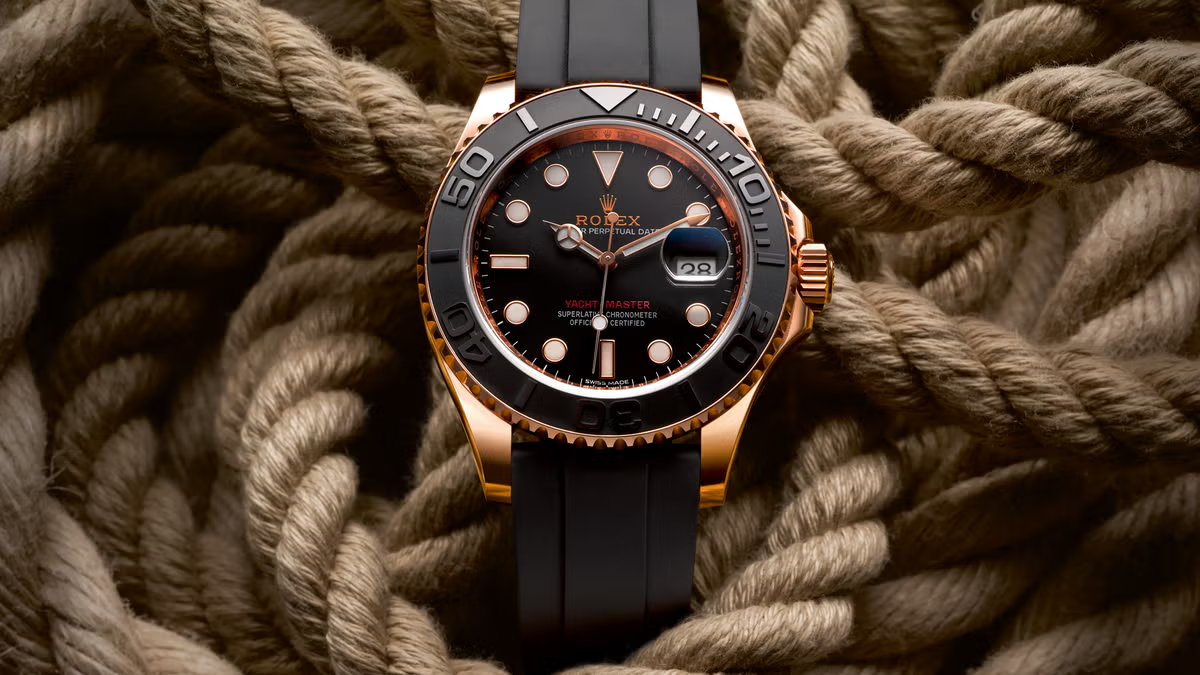
The design of the Rolex Yacht Master is immediately recognizable, but it does not rely on an overly complicated appearance. Its appeal comes from the way individual elements work together.
The Oyster case provides the familiar Rolex foundation, while the bezel creates much of the watch’s visual identity. Depending on the model, the case can be made from Oystersteel, gold, or RLX titanium, with certain versions incorporating platinum.
The result is a watch that can look sporty without being aggressive. It has enough polished detailing to feel luxurious while retaining the practical character expected from a Rolex professional watch.
The Bezel
One of the most important details is the bidirectional rotatable bezel with raised 60-minute graduations. Rolex identifies this as a central feature of the Yacht-Master.
The bezel has a practical purpose. It can be used to read time intervals, including timing the sailing distance between two points. Its design also gives the watch much of its distinctive visual character.
Depending on the model, the bezel can be made from precious metal or use a Cerachrom ceramic insert. The raised numerals and graduations are designed to stand out clearly against the surrounding surface.
This is an excellent example of how the Yacht-Master combines function and appearance. The bezel is useful, but it is also one of the reasons the watch looks different from other Rolex sports models.
Dial and Legibility
The dial is another area where the Yacht-Master maintains a relatively clean approach.
Rolex uses highly legible hands and hour markers, with Chromalight providing visibility in low-light conditions. The blue luminescence is designed to remain visible for an extended period.
Many Yacht-Master models also feature the familiar Rolex date display with a Cyclops lens over the date window. Rolex identifies both the Chromalight display and Cyclops lens as features that contribute to legibility.
Dial colors vary between models, giving buyers an opportunity to choose between understated and more expressive combinations. Some configurations have a particularly elegant appearance, while others lean more strongly toward the sporty side of the collection.
Materials Used in the Yacht Master
Materials have always been an important part of the Yacht-Master’s identity.
Oystersteel
Oystersteel is used on several Yacht-Master models. It is part of Rolex’s family of corrosion-resistant steels and suits a watch intended to have a strong relationship with the marine environment.
The material also gives the watch a relatively versatile appearance. It can look sporty on the wrist while still benefiting from Rolex’s polished finishing.
Rolesium
Rolesium is one of the Yacht-Master’s signature combinations. Rolex uses the term for a configuration combining Oystersteel with platinum elements. The combination creates a subtle contrast between the materials while maintaining the robust character of the Oyster case and bracelet.
For many enthusiasts, Rolesium is closely associated with the personality of the Yacht-Master.
Gold
The collection also includes models made with Rolex gold alloys, including yellow gold and Everose gold. These versions naturally create a more luxurious and visually prominent appearance.
Gold models can feel more formal than the Oystersteel versions, although the nautical design and sports-watch construction prevent them from becoming purely dress watches.
RLX Titanium
The Yacht-Master 42 has also been offered in RLX titanium. Rolex describes its RLX titanium as a grade 5 titanium alloy selected for its strength and lightness.
This material changes the wearing experience considerably. A large 42 mm watch can feel surprisingly light when made from titanium, making the material particularly interesting for people who prefer larger watches without the weight normally associated with precious metals or steel.
Bracelet and Strap Options
The bracelet can have a major influence on the overall personality of a Yacht-Master.
The classic Oyster bracelet consists of three-piece links and has long been associated with Rolex’s combination of comfort, security, and durability.
The Oysterflex bracelet offers a different experience. Introduced to the Yacht-Master 37 in 2015, it uses metal blades covered with a high-performance elastomer. Rolex designed it to provide flexibility while maintaining a secure structure.
This means the same basic watch can feel very different depending on the bracelet. An Oyster bracelet tends to give the watch a more traditional luxury-sports appearance, while Oysterflex can create a cleaner and more contemporary look.
Rolex Yacht Master Sizes
One of the strengths of the current collection is the range of case sizes.
Yacht Master 37
The 37 mm Yacht-Master offers more compact proportions. It can appeal to people who prefer a smaller watch or want a Yacht-Master with a less imposing presence on the wrist.
The size also works particularly well with the collection’s more refined material combinations.
Yacht Master 40
The 40 mm model sits in a versatile middle ground. It offers enough wrist presence to maintain the character of a sports watch without becoming overly large.
Rolex currently equips the Yacht-Master 40 with calibre 3235.
For many wearers, 40 mm is an easy size to adapt to because it can transition naturally between casual and more polished settings.
Yacht Master 42
The 42 mm Yacht-Master provides a larger presence. It is particularly interesting in RLX titanium because the lightweight material offsets some of the physical presence of the larger case.
The current Yacht-Master 42 RLX titanium model uses an intense black dial, Oyster bracelet, calibre 3235, and a 100-metre water-resistance rating.
The Movement
Inside the Yacht-Master 40 and 42 is Rolex calibre 3235, a self-winding mechanical movement developed and manufactured by Rolex.
The movement is designed around precision, reliability, and efficiency. The Yacht-Master 42 RLX titanium, for example, has an officially stated accuracy of -2/+2 seconds per day after casing and an approximate 70-hour power reserve.
Calibre 3235 also includes Rolex technologies intended to improve resistance to shocks and magnetic fields. The movement uses the brand’s Chronergy escapement and Parachrom hairspring, while Paraflex shock absorbers provide additional protection.
For everyday ownership, these technical details matter because a luxury watch is not simply about its exterior. The movement is the mechanical foundation that determines how reliably the watch performs over time.
Water Resistance and Durability
Although the Yacht-Master is strongly associated with sailing, its water resistance should not be confused with the specialized depth capabilities of a professional dive watch.
The Yacht-Master 42 RLX titanium is rated to 100 metres / 330 feet of water resistance and uses a screw-down crown with Rolex’s Triplock triple waterproofness system.
The Oyster case architecture provides an important part of the watch’s protection. Rolex has built its Oyster concept around resistance to water and dust for many decades.
This makes the Yacht-Master well suited to an active lifestyle around water, while its refined styling also makes it appropriate for everyday use away from the coast.
What Makes the Yacht Master Different?
The easiest way to understand the Yacht-Master is to look at what it does differently from Rolex’s other sports watches.
The Submariner is strongly associated with diving. The GMT-Master II is closely connected with travel and multiple time zones. The Daytona is built around chronograph functionality and racing heritage.
The Yacht-Master takes a different route.
Its identity is based on nautical styling, time-interval measurement, comfort, and luxury materials. The bidirectional bezel is practical, but the watch is not presented as a heavy-duty instrument in the same way as some other professional models.
That gives the Yacht-Master a distinctive middle ground. It has the technical foundation of a sports watch but the visual sophistication of a luxury piece.
Is the Yacht Master Suitable for Everyday Wear?
For many owners, one of the strongest qualities of the Yacht-Master is versatility.
The 37 mm, 40 mm, and 42 mm sizes give different wrist profiles an opportunity to find a suitable proportion. Material choices also make a difference. An Oystersteel model can feel relatively understated, while a full-gold configuration has a much stronger presence.
The Oysterflex bracelet can further change the character of the watch by giving it a more relaxed appearance.
The watch’s 100-metre water-resistance rating on the Yacht-Master 42 RLX titanium also provides practical protection for normal water-related activities, provided the watch is properly maintained and used according to Rolex’s guidance.
How to Choose a Yacht Master
Choosing a Yacht-Master is less about finding one universally “best” model and more about deciding which combination suits your preferences.
Start with the size. A 37 mm model provides a compact presence, 40 mm offers a balanced option, and 42 mm creates a larger wrist profile.
Then consider the material. Oystersteel and platinum combinations offer a classic Yacht-Master identity, while gold provides a more luxurious appearance and RLX titanium emphasizes lightness.
Next, look at the bracelet. The Oyster bracelet has a traditional Rolex sports-watch feel, while Oysterflex provides a more contemporary alternative.
Finally, consider the dial and bezel combination. These details can change the appearance of the watch dramatically even when the basic case design remains familiar.
Yacht Master Care and Maintenance
A mechanical luxury watch benefits from sensible care.
Keeping the case and bracelet clean helps preserve their appearance. It is also important to avoid unnecessary impacts and to ensure the crown is properly secured when the watch is being used around water.
Professional servicing is another important part of long-term ownership. Rolex recommends servicing its watches through its authorized network, where trained technicians use specialized equipment and genuine components.
A well-maintained mechanical watch can remain a meaningful possession for many years, so maintenance should be viewed as part of ownership rather than an afterthought.
Yacht Master Price and Value
The price of a Yacht-Master varies significantly depending on its size, material, configuration, and market.
Rolex’s current listings show substantial differences between Oystersteel-and-platinum models, gold versions, and RLX titanium configurations. For example, official U.S. listings currently show the Yacht-Master 40 in Oystersteel and platinum at $13,200, while selected 42 mm gold and white-gold versions are priced considerably higher.
Prices can also differ in other countries because of taxes, duties, currency conversion, and local pricing structures.
For that reason, it is better to think about the Yacht-Master as a collection rather than a single watch with one fixed price.
Pros and Cons
Advantages
Distinctive design: The Yacht-Master has a recognizable nautical character without looking like a conventional dive watch.
Strong material choices: Buyers can choose among Oystersteel, platinum combinations, gold, and RLX titanium depending on the model.
Useful bezel: The bidirectional 60-minute bezel provides a practical timing function while also defining the watch’s appearance.
Multiple sizes: The 37 mm, 40 mm, and 42 mm options make the collection more flexible.
Versatility: Its combination of sports-watch construction and refined finishing allows it to work in a wide range of settings.
Considerations
Premium pricing: The Yacht-Master occupies the luxury end of the mechanical-watch market.
Material differences: Precious-metal models can have a noticeably different feel and visual presence from Oystersteel versions.
Not a dedicated dive watch: While water resistant, its purpose and bezel design are different from a purpose-built diving watch.
Frequently Asked Questions
What is the Rolex Yacht Master known for?
The Rolex Yacht-Master is known for combining nautical styling, a bidirectional 60-minute graduated bezel, Rolex mechanical performance, and luxury materials. It was introduced in 1992 and remains closely connected with the brand’s sailing heritage.
What sizes does the Yacht Master come in?
The current collection is available in 37 mm, 40 mm, and 42 mm sizes.
What is the difference between Yacht Master 40 and 42?
The primary difference is case size, although material and configuration choices can also vary. The Yacht-Master 40 and 42 use calibre 3235 according to Rolex’s current specifications.
Is the Yacht Master waterproof?
Rolex describes the Yacht-Master 42 RLX titanium as water resistant to 100 metres / 330 feet. Its Oyster case and screw-down Triplock crown contribute to its water resistance.
What is Rolesium?
Rolesium is Rolex’s name for a Yacht-Master combination using Oystersteel and platinum elements. Rolex introduced the combination to the Yacht-Master in 1999.
Final Thoughts
The Rolex Yacht Master stands apart because it does not try to be everything at once. Its identity is rooted in sailing, but its appeal extends well beyond the water.
From the distinctive bidirectional bezel and nautical design to the choice of 37 mm, 40 mm, and 42 mm cases, the collection offers plenty of variation. Materials such as platinum, gold, Oystersteel, and RLX titanium further allow different versions to have their own personality.
What makes the Yacht-Master especially interesting is the balance it achieves. It has the practical foundation of a Rolex sports watch, yet it carries a more polished and luxurious character than many people initially expect.
For someone looking for a watch that combines technical ability, refined design, nautical heritage, and everyday versatility, the Yacht-Master remains one of the most distinctive options in the Rolex collection.