







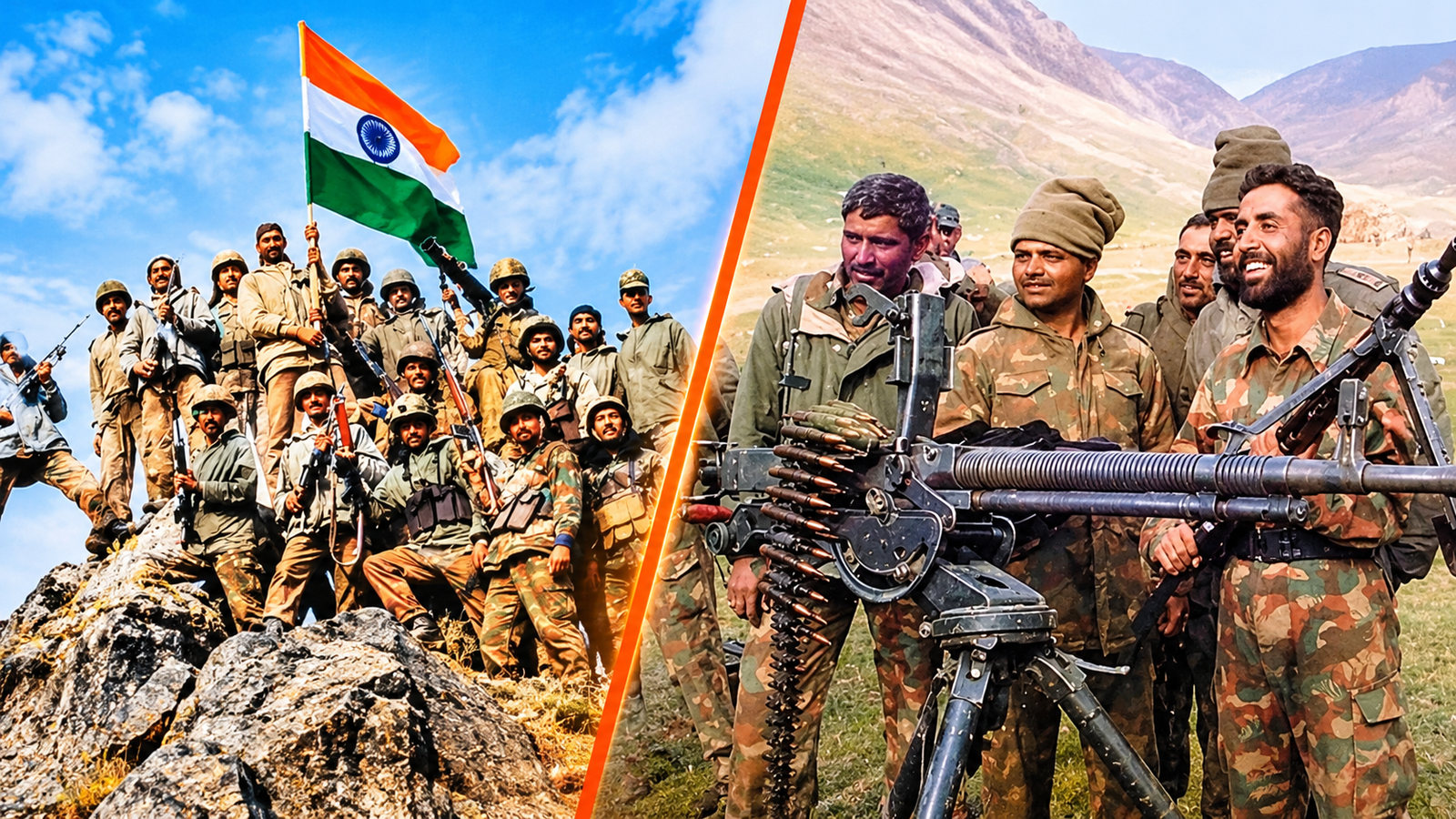
The India Pak War 1999, widely known as the Kargil War, was a major military conflict between India and Pakistan in the Himalayan region of Kashmir. The fighting began in May 1999 after Pakistani soldiers and armed personnel occupied strategic mountain positions on the Indian side of the Line of Control (LoC). India launched Operation Vijay to recapture the occupied positions, while the Indian Air Force supported the campaign through Operation Safed Sagar. The conflict lasted nearly three months and officially ended on July 26, 1999. Its consequences shaped military planning, diplomatic relations, and security discussions between the two nuclear-armed countries.
Quick Facts About the Kargil War
| Field | Details |
|---|---|
| Conflict | Kargil War |
| Year | 1999 |
| Countries involved | India and Pakistan |
| Location | Kargil, Dras, Batalik and nearby areas |
| Beginning | May 1999 |
| Official end date | July 26, 1999 |
| Indian military operation | Operation Vijay |
| Indian Air Force operation | Operation Safed Sagar |
| Indian Prime Minister | Atal Bihari Vajpayee |
| Pakistani Prime Minister | Nawaz Sharif |
| Pakistani Army Chief | General Pervez Musharraf |
| Main disputed area | Line of Control in Kashmir |
| Outcome | Indian forces regained the occupied positions |
What Was the India Pak War 1999?
The India Pak War 1999 was a limited but intense military confrontation fought in the Kargil district of the then Indian-administered Jammu and Kashmir. It developed after Pakistani forces and armed personnel crossed the Line of Control and occupied strategic mountain positions during the winter and early months of 1999.
These positions overlooked important military routes, including the Srinagar–Leh highway. Their occupation created a serious security concern for India because the highway connected important military locations in Ladakh.
India responded by deploying troops to the region and launching a military campaign to recover the occupied heights. Unlike conventional wars fought across plains, the Kargil fighting took place at extremely high altitudes, where freezing temperatures, steep mountain slopes, and limited oxygen made military operations especially difficult.
Why Did the India Pak War 1999 Begin?
The conflict was closely connected to the longstanding Kashmir dispute between India and Pakistan. Both countries had fought previous wars over the region, and tensions remained high despite diplomatic efforts.
In February 1999, Indian Prime Minister Atal Bihari Vajpayee traveled to Lahore, where he met Pakistani Prime Minister Nawaz Sharif. The two leaders signed the Lahore Declaration, expressing their commitment to peace and improved relations.
However, military preparations in the Kargil region were already underway. Pakistani forces occupied positions across the Line of Control, creating a confrontation that undermined the recent diplomatic initiative.
The strategic objective of the operation is commonly understood to have included threatening the Srinagar–Leh highway, gaining military leverage, and influencing the Kashmir dispute.
The discovery of these positions in May 1999 turned an already tense political situation into a major military confrontation.
How the Kargil Conflict Developed
The India Pak War 1999 unfolded through several important stages. The following events explain how the situation developed from the initial discovery to the end of military operations.
1. Discovery of the Infiltration
On May 3, 1999, local residents reported suspicious movements in the Kargil area. Indian military patrols were sent to investigate the reports.
Further reconnaissance revealed that armed personnel had occupied several strategic mountain positions. These locations provided a military advantage because they overlooked important routes and surrounding valleys.
The discovery forced Indian military officials to reassess the security situation and prepare a large-scale response.
2. Launch of Operation Vijay
India launched Operation Vijay on May 26, 1999, to remove the occupying forces and restore control over the affected positions.
Indian troops faced difficult conditions while advancing through steep mountain terrain. Many positions were located thousands of meters above sea level, making movement, communication, and the transportation of supplies extremely challenging.
The operation required coordinated military planning, artillery support, infantry assaults, and logistical assistance.
3. Operation Safed Sagar
The Indian Air Force joined the campaign through Operation Safed Sagar, beginning on May 26, 1999.
Aircraft were used to support ground operations and target military positions. Operating at high altitudes presented additional challenges for pilots because of the difficult terrain and changing weather conditions.
The involvement of air power became an important part of India’s military response.
4. Recapture of Important Mountain Positions
Indian troops gradually regained control of several strategic locations. The battles around Tololing, Tiger Hill, and Point 4875 became particularly important.
These operations involved dangerous uphill assaults against well-positioned defenders. The fighting also demonstrated how difficult it was to remove troops from fortified mountain positions.
Major Battles of the India Pak War 1999
Several battles played a decisive role in the military campaign. Each involved difficult terrain and intense fighting between opposing forces.
Battle of Tololing
Tololing was one of the first major positions recaptured by Indian forces. Its strategic location made it important for controlling surrounding areas and improving access to other military objectives.
Indian troops faced strong resistance during the assault. The recapture of Tololing on June 13, 1999, became an important turning point in the campaign.
Battle of Tiger Hill
Tiger Hill became one of the most recognized locations of the conflict. Its height and strategic position made it a major objective for Indian military planners.
Indian soldiers launched a difficult assault to regain control of the peak. The Indian Army recaptured Tiger Hill on July 4, 1999, marking a significant development in the campaign.
Battle of Point 4875
Point 4875 was another important battlefield in the Kargil region. Indian soldiers encountered intense resistance while attempting to capture the position.
The fighting around this peak became associated with the bravery and sacrifice of Indian soldiers, including Captain Vikram Batra, who was posthumously awarded the Param Vir Chakra.
Battles in Batalik and Mushkoh Valley
The Batalik sector and Mushkoh Valley also witnessed intense fighting. Indian forces conducted operations to regain control of important mountain positions and prevent further military threats.
These battles demonstrated the importance of coordination, artillery support, and specialized high-altitude military training.
Important Events Timeline of the 1999 Kargil War
The following timeline highlights the major developments during the India Pak War 1999.
| Date | Important Event |
|---|---|
| February 1999 | Lahore Declaration signed by India and Pakistan |
| May 3, 1999 | Local residents report suspicious activity in Kargil |
| May 1999 | Indian patrols identify occupied mountain positions |
| May 26, 1999 | Operation Vijay and Operation Safed Sagar begin |
| June 13, 1999 | Indian forces recapture Tololing |
| July 4, 1999 | Tiger Hill is recaptured |
| July 4, 1999 | Nawaz Sharif meets US President Bill Clinton |
| July 11, 1999 | Withdrawal arrangements are announced |
| July 26, 1999 | Military operations officially conclude |
The timeline shows how the conflict developed from the initial discovery of the occupation into a major military campaign. July 26 is now observed in India as Kargil Vijay Diwas.
How Did International Diplomacy Influence the Conflict?
International diplomacy played an important role in bringing the conflict toward an end. Because India and Pakistan were both nuclear-armed countries, the possibility of a wider war attracted international attention.
The United States became particularly involved in diplomatic efforts. On July 4, 1999, Pakistani Prime Minister Nawaz Sharif met US President Bill Clinton in Washington.
During the meeting, Clinton pressed for the restoration of the Line of Control and the withdrawal of Pakistani forces from the Kargil positions. The discussions contributed to the diplomatic process that followed.
The international community generally supported restoring the existing Line of Control rather than allowing the military confrontation to change the territorial situation.
These developments demonstrated that the conflict was not only a regional military issue but also an important international diplomatic concern.
How Did the India Pak War 1999 End?
The conflict gradually moved toward an end during July 1999. After suffering military pressure and facing growing international diplomatic demands, Pakistan agreed to withdraw its forces from the occupied positions.
Indian troops continued their operations to regain control of the remaining strategic heights. By July 26, the Indian military declared that the campaign had achieved its objective.
The India Pak War 1999 therefore ended with India regaining the positions occupied during the conflict. The date became significant in Indian military history and is commemorated annually as Kargil Vijay Diwas.
However, the end of fighting did not resolve the broader Kashmir dispute. Political disagreements, military tensions, and security concerns continued between the two neighboring countries.
What Was the Impact of the Kargil War?
The Kargil conflict had important consequences for both countries and their future military planning.
1. Increased military preparedness: The conflict highlighted the importance of intelligence gathering, border surveillance, and preparedness in high-altitude regions.
2. Changes in military coordination: The campaign exposed areas where communication and cooperation between military branches could be improved.
3. Greater international attention: The confrontation increased international concern about the possibility of military escalation between nuclear-armed countries.
4. Lasting diplomatic tensions: The conflict damaged the atmosphere created by the Lahore Declaration and made future peace efforts more difficult.
5. National remembrance: The war became an important part of India’s military history, with July 26 established as a day to remember the soldiers who died during the campaign.
The Kargil Review Committee, established in July 1999, examined the events leading to the conflict and recommended measures to improve national security. Its report was presented to Parliament in February 2000.
Why Is the India Pak War 1999 Still Remembered?
The India Pak War 1999 remains an important subject because it demonstrated how quickly a regional dispute could develop into a serious military confrontation.
The conflict also highlighted the challenges of modern mountain warfare. Soldiers had to operate in freezing conditions, navigate dangerous slopes, and fight for positions that were difficult to reach.
For India, Kargil Vijay Diwas represents remembrance of the soldiers who lost their lives during the campaign. For historians and military researchers, the conflict remains an important case study in intelligence, diplomacy, military strategy, and the risks of escalation between nuclear-armed neighbors.
What Is Confirmed About the Kargil Conflict?
The main military events, dates of major battles, diplomatic meetings, and conclusion of the conflict are documented in official records and historical reporting.
The precise details of every operational decision and the motivations behind individual military actions have been debated by researchers. The Kargil Review Committee examined intelligence and security failures, providing an important basis for understanding the events.
A balanced account should distinguish documented military developments from political interpretations and competing claims about the conflict.
Conclusion
The India Pak War 1999 was a defining chapter in the history of relations between India and Pakistan. The Kargil conflict involved difficult mountain battles, major military operations, and international diplomatic intervention. Although the fighting ended on July 26, 1999, its impact continued through changes in military planning and regional security discussions. Understanding the conflict provides valuable historical context for the continuing tensions surrounding Kashmir.
Frequently Asked Questions
1. What was the India Pak War 1999?
The India Pak War 1999 was a military conflict fought in the Kargil region of Kashmir between Indian forces and Pakistani military personnel. It began in May and ended on July 26, 1999, after India regained the occupied mountain positions.
2. Why did the Kargil War start?
The conflict began after Pakistani forces occupied strategic mountain positions across the Line of Control. The occupation threatened important Indian military routes and triggered India’s decision to launch Operation Vijay.
3. Who was the Prime Minister of India during the Kargil War?
Atal Bihari Vajpayee was India’s Prime Minister during the conflict. He played an important political role in directing India’s response and managing the diplomatic situation.
4. Who was Pakistan’s Prime Minister during the 1999 conflict?
Nawaz Sharif was Pakistan’s Prime Minister during the Kargil conflict. He met US President Bill Clinton on July 4, 1999, as international diplomatic efforts focused on ending the confrontation.
5. What was Operation Vijay?
Operation Vijay was the Indian Army’s military campaign to remove Pakistani forces and armed personnel from occupied positions in the Kargil region. It began on May 26, 1999, and continued until the objectives were achieved.
6. When did the Kargil War officially end?
The Kargil War officially ended on July 26, 1999. India observes this date as Kargil Vijay Diwas to remember the soldiers who sacrificed their lives during the conflict.
READ MORE: Kansas City Chiefs vs Dallas: A Complete Game Preview