





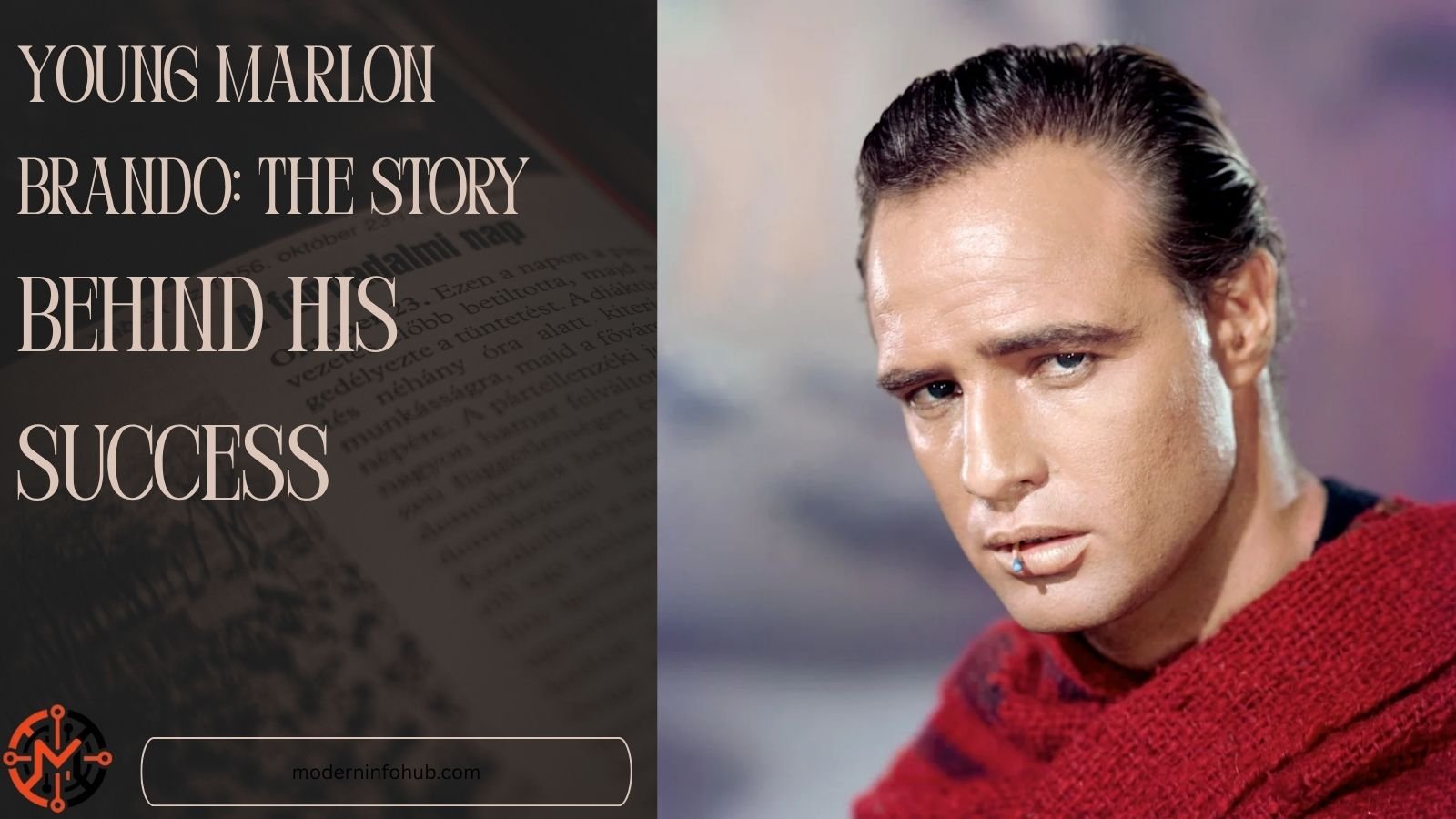
When people look back at the golden age of Hollywood, Marlon Brando young is a name that continues to attract attention. Known for his striking screen presence, expressive performances, and rebellious personality, Brando changed the way audiences understood film acting. He was more than a handsome young star; he was a performer who brought unusual emotional depth and realism to his characters.
During the 1940s and 1950s, Brando rose from a relatively unknown theater actor to one of the most influential performers in American cinema. His work in A Streetcar Named Desire, Viva Zapata!, Julius Caesar, and On the Waterfront established a reputation that would shape Hollywood for generations.
His success did not happen overnight. It developed through childhood experiences, professional training, years of theater work, and a willingness to approach characters differently from many actors of his time.
Understanding young Marlon Brando means looking beyond his famous photographs and classic movies. His early life reveals the experiences, choices, and performances that helped him become a Hollywood legend.
BIO
| Label | Information |
|---|---|
| Full Name | Marlon Brando Jr. |
| Date of Birth | April 3, 1924 |
| Birthplace | Omaha, Nebraska, USA |
| Nationality | American |
| Profession | Actor and filmmaker |
| Known For | Natural and realistic acting style |
| Acting Debut | The Men (1950) |
| Broadway Breakthrough | A Streetcar Named Desire (1947) |
| Famous Early Movie | On the Waterfront (1954) |
| Acting Teacher | Stella Adler |
| First Oscar Win | Best Actor for On the Waterfront |
| Iconic Role | Stanley Kowalski |
| Date of Death | July 1, 2004 |
Who Was c?
Marlon Brando was an American actor born on April 3, 1924, in Omaha, Nebraska. He became internationally recognized for his intense performances and his ability to make fictional characters appear remarkably believable.
Brando worked in theater before moving into films. His breakthrough came through the Broadway production of A Streetcar Named Desire, in which he played Stanley Kowalski. When the story was adapted for the screen in 1951, Brando reprised the role and gained even wider recognition.
During his younger years, he became known for a distinctive acting style that emphasized realistic speech, natural movement, and emotional complexity. Instead of presenting characters as polished theatrical figures, he often portrayed them as complicated people with conflicting feelings and personal weaknesses.
His early performances helped establish a new standard for screen acting. Although his career later included many different types of roles, the work he completed during the 1950s remains central to his reputation.
Brando died on July 1, 2004, in Los Angeles, California, at the age of 80. His influence on modern acting continues to be discussed by film historians, directors, and performers.
Marlon Brando’s Early Life and Childhood
Marlon Brando was born into a family that had its own challenges and creative influences. His father, Marlon Brando Sr., worked as a salesman, while his mother, Dorothy Julia Pennebaker Brando, had a strong interest in theater and amateur acting.
He grew up with two older sisters, Jocelyn and Frances. His family eventually settled in Illinois, where he spent much of his childhood.
Brando’s relationship with his parents was complicated. Accounts of his early life describe an emotionally difficult home environment, and his experiences growing up became an important part of his personal story. However, it would be too simple to attribute his later acting talent to childhood difficulties alone.
His mother played a particularly important role in introducing him to the performing arts. Her interest in theater exposed him to a creative world that would eventually become his profession.
Brando was not an especially enthusiastic student. He struggled with discipline and frequently resisted authority. His school experiences were uneven, and he eventually left formal education without graduating from high school.
These early years did not suggest a conventional path toward Hollywood success. Yet Brando’s interest in performance gradually developed, giving him a direction that was different from the future his family might have expected.
How Young Marlon Brando Discovered Acting
Brando’s interest in acting grew during his teenage years. At Shattuck Military Academy in Minnesota, he encountered opportunities to perform and became interested in dramatic work. He also received encouragement from a teacher who introduced him to Shakespeare.
His time at the academy ended after disciplinary problems, and he did not complete his education there. Rather than following a traditional academic route, Brando began considering what he wanted to do with his life.
In 1943, at approximately 19 years old, he moved to New York City. His older sister Jocelyn was pursuing an acting career there, and the city offered opportunities to study theater and audition for professional productions.
New York became a turning point. Brando enrolled in dramatic training and studied with Stella Adler, an influential acting teacher who emphasized imagination, character motivation, and the importance of understanding a character’s circumstances.
Adler encouraged actors to build believable performances through detailed study and creative interpretation. Her teaching helped Brando move beyond simply memorizing lines or copying gestures.
He also became associated with the Actors Studio, where he encountered the developing culture of psychologically realistic American acting. Although different teachers had different approaches, these theatrical environments helped him explore the emotional and physical details that would become hallmarks of his performances.
His training gave him a foundation, but his greatest lessons came from applying those ideas to actual stage roles.
Marlon Brando’s First Steps Toward Fame
Brando made his Broadway debut in 1944 in I Remember Mama, a play by John Van Druten. He played Nels, a young member of a Norwegian-American family.
The production introduced him to professional theater audiences and allowed him to demonstrate a style that felt natural rather than overly formal. Even at this early stage, his ability to communicate personality through small movements and expressions attracted attention.
In 1946, Brando appeared in Truckline Cafe, playing a returning World War II veteran. Although the production itself was not a major success, his performance impressed theater critics, who recognized him as a promising young actor.
He also appeared in other stage productions during this period, gaining experience and learning how to work with different scripts, directors, and fellow performers.
His most important early stage opportunity arrived in 1947 when director Elia Kazan cast him as Stanley Kowalski in Tennessee Williams’s A Streetcar Named Desire.
The role became a breakthrough. Stanley was forceful, physically imposing, emotionally unpredictable, and far from the refined leading men commonly associated with Hollywood. Brando approached him as a recognizable human being rather than a simple dramatic stereotype.
The production was a major success, and Brando quickly became one of Broadway’s most talked-about young performers. His stage work opened the door to a film career that would transform his life.
Young Marlon Brando’s First Movies
Brando entered the film industry in 1950, beginning a remarkable run of performances that established him as a major talent.
The Men (1950)
Brando made his feature-film debut in The Men, directed by Fred Zinnemann. He played Ken Wilcheck, a former soldier who becomes paralyzed after being wounded during World War II.
To prepare for the role, Brando spent time observing patients undergoing rehabilitation. This research helped him understand the everyday frustrations and challenges faced by people adjusting to life with physical disabilities.
His performance was restrained and emotionally grounded. Rather than relying on exaggerated gestures, he portrayed a man struggling with changes to his independence, relationships, and sense of identity.
The film demonstrated that Brando was interested in understanding the people he played. It also introduced movie audiences to an actor whose performances could feel unusually intimate.
A Streetcar Named Desire (1951)
The film adaptation of A Streetcar Named Desire brought Brando to a much larger audience. He returned to the role of Stanley Kowalski, opposite Vivien Leigh as Blanche DuBois.
The film explored the tension between Stanley’s forceful personality and Blanche’s fragile, carefully maintained world. Brando’s performance combined physical confidence with flashes of humor, anger, and vulnerability.
His speech was often casual and uneven, while his body language communicated emotions that were not always expressed directly in dialogue. This approach made Stanley feel immediate and unpredictable.
The performance earned Brando his first Academy Award nomination for Best Actor. More importantly, it established him as one of the defining screen performers of the 1950s.
Viva Zapata! (1952)
In Viva Zapata!, Brando portrayed Emiliano Zapata, the Mexican revolutionary who became an important figure during the Mexican Revolution.
The film required Brando to play a historical figure whose ambitions were tied to the struggles of ordinary people. His performance explored the tensions between personal responsibility, political power, and revolutionary ideals.
The role also demonstrated his willingness to move beyond contemporary American characters. Brando continued to develop his range, taking on roles that demanded different accents, physical behavior, and emotional approaches.
He received another Academy Award nomination for the performance, strengthening his position among Hollywood’s leading actors.
Julius Caesar (1953)
Brando surprised some viewers by taking on Shakespeare in Julius Caesar. He played Mark Antony in the film adaptation of the famous tragedy.
Shakespearean dialogue presented a different challenge from the naturalistic conversations of A Streetcar Named Desire. Brando had to communicate complex political ideas and powerful emotions through carefully structured language.
His performance showed that his abilities extended beyond modern dramatic roles. He demonstrated that a relatively young film star could handle classical material without losing the individuality that made him popular.
The film received significant critical recognition, and Brando earned another Academy Award nomination for Best Actor.
On the Waterfront (1954)
For many film fans, On the Waterfront represents the high point of Brando’s early career. Directed by Elia Kazan, the film follows Terry Malloy, a former boxer and dockworker caught in a world of corruption and intimidation.
Brando gave Terry a mixture of toughness, uncertainty, regret, and moral courage. The character was not presented as a flawless hero. Instead, he was a man trying to decide whether he could stand against people who had considerable power over his life.
The performance was widely admired for its emotional realism. In 1955, Brando won the Academy Award for Best Actor for the film.
The award confirmed what many critics already believed: he was not simply a promising young performer but one of the most important actors of his generation.
What Made Young Marlon Brando Different?
One of the most important reasons for Brando’s success was his approach to character development.
Many traditional screen performances of the period favored polished delivery, carefully controlled expressions, and clearly defined emotional gestures. Brando brought a different quality to his work.
His characters often paused, mumbled, shifted their weight, or reacted in ways that appeared spontaneous. These details created the impression that audiences were watching a person think and feel in real time.
His performances also contained contradictions. A character could appear confident in one moment and uncertain in the next. Anger might hide embarrassment, while humor could reveal insecurity.
This complexity made his characters more convincing. Rather than telling audiences exactly what a character felt, Brando often allowed the meaning to emerge through expression, movement, and silence.
His work was associated with Method acting, a broad term connected with approaches that emphasize a character’s inner life and psychological motivation. However, Method acting includes different techniques, and Brando’s style should not be reduced to a single formula.
His collaboration with Stella Adler and Elia Kazan was particularly important. Both encouraged a serious engagement with character and dramatic circumstances, helping him develop a distinctive performance style.
Brando’s influence can be seen in the work of later generations of actors who placed greater emphasis on emotional authenticity and psychologically detailed characters.
Young Marlon Brando’s Appearance and Iconic Style
Interest in young Marlon Brando is not limited to his films. Photographs from the 1940s and 1950s continue to attract attention because of his distinctive appearance and understated style.
Brando had a strong screen presence, expressive features, and a relaxed physical manner. He could appear confident without relying on the formal elegance associated with many traditional movie stars.
His appearance became especially influential through The Wild One (1953), in which he played Johnny Strabler, the leader of a motorcycle gang. Wearing a leather jacket and casual clothing, Brando helped popularize an image of youthful rebellion.
The character represented independence and resistance to conventional expectations. His clothing and posture became closely associated with the rebellious youth culture emerging in the postwar years.
Brando’s influence extended beyond the screen. His casual approach to style helped establish the idea that a leading man did not always need a perfectly tailored suit or carefully controlled manner to appear compelling.
Still, his fashion influence was only one part of his appeal. His strongest performances combined appearance with a convincing understanding of the people he portrayed.
For readers searching for Marlon Brando young photos, images from A Streetcar Named Desire, The Wild One, and On the Waterfront offer a useful visual record of how his screen image developed during this period.
Awards and Achievements in His Early Career
Brando’s achievements during the 1950s reflected both his versatility and his growing reputation.
His first Academy Award nomination came for A Streetcar Named Desire. He subsequently received nominations for Viva Zapata! and Julius Caesar, demonstrating his ability to move between contemporary drama, historical storytelling, and classical theater adaptations.
His victory for On the Waterfront was a major milestone. The Academy Award recognized a performance that combined subtle emotional detail with a compelling character journey.
Brando continued to take on different kinds of roles after this success. In Guys and Dolls (1955), he appeared in a musical comedy, playing Sky Masterson. The role was a departure from the troubled and physically intense characters that had established his early reputation.
He later starred in Sayonara (1957) and The Young Lions (1958), among other productions. These films showed that he was willing to explore stories beyond the gritty urban dramas for which he had become famous.
His early success was not based on a single film or character. It developed through a series of memorable performances that repeatedly challenged expectations.
How Young Marlon Brando Became a Hollywood Legend
Brando’s rise to fame reflected a broader change in American cinema. Audiences were increasingly receptive to stories about complicated individuals, social conflict, and characters whose motivations were not always easy to understand.
His performances suited this shift. He brought a level of physical and psychological detail that made familiar dramatic situations feel fresh.
Directors also benefited from his ability to communicate meaning without relying entirely on dialogue. A glance, a pause, or a small change in posture could reveal a character’s uncertainty or anger.
His influence was not limited to actors working in similar roles. Performers across different genres learned from his willingness to make characters imperfect and emotionally unpredictable.
Brando also resisted many expectations associated with celebrity. He could be private, unpredictable, and openly critical of the film industry. His complicated relationship with fame became a significant part of his public image.
His career later included another landmark performance as Vito Corleone in The Godfather (1972), for which he won his second Academy Award for Best Actor. That achievement came years after his early breakthrough and demonstrated his ability to reinvent himself.
Nevertheless, the foundations of his legacy were established during his younger years, when theater training and a series of daring performances helped him change the possibilities of screen acting.
The Lasting Legacy of Young Marlon Brando
Looking at young Marlon Brando provides more than a glimpse of a famous actor before he became a legend. It reveals the development of a performer who challenged established conventions and encouraged audiences to expect greater realism from cinema.
His journey from Omaha to Broadway and then Hollywood was shaped by determination, professional training, memorable collaborations, and a willingness to take creative risks.
Films such as A Streetcar Named Desire and On the Waterfront remain important because their emotional power has not depended on changing fashion or celebrity trends. Their characters continue to feel complicated, recognizable, and human.
Brando’s appearance also left a lasting mark on popular culture, particularly through the rebellious image he created in The Wild One. Yet his greatest contribution was his acting, which helped influence how performers approached character, emotion, and dialogue.
Young Marlon Brando became successful because he brought something distinctive to the screen. He combined physical presence with psychological depth, allowing audiences to see characters as complicated people rather than simple heroes or villains.
His early career remains an important chapter in film history and a reminder that memorable performances can change not only an actor’s future but also the art form itself.