






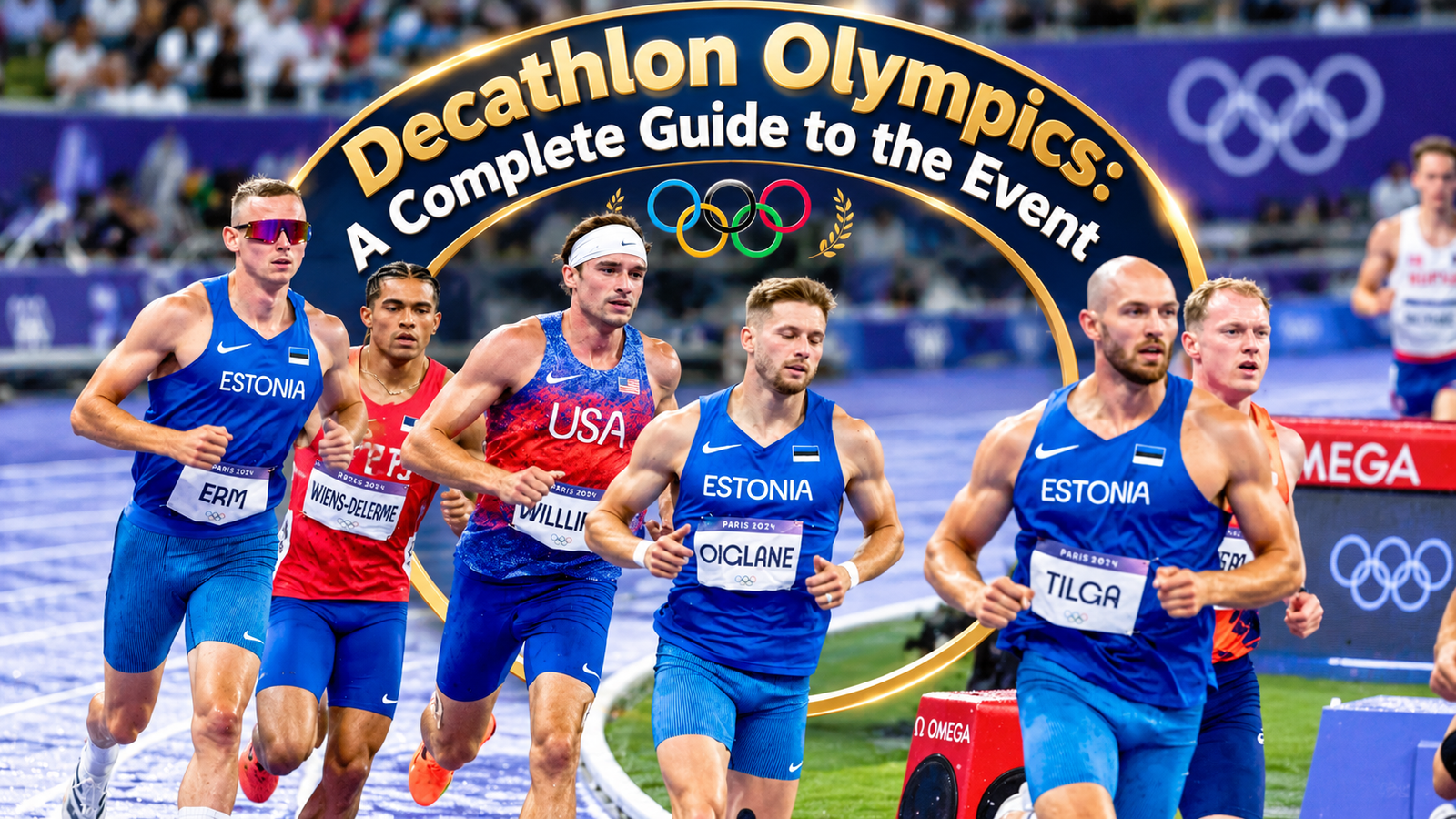
The Decathlon Olympics is one of the most demanding competitions in athletics. Unlike events that focus on a single skill, the decathlon asks athletes to perform across 10 different track and field disciplines. They must sprint, jump, throw, hurdle and run middle distance, all while managing fatigue over two intense days.
The competition is not simply about winning individual events. Every performance contributes points to an overall score, and the athlete with the highest total at the end becomes the Olympic champion. This scoring system makes the decathlon especially interesting because an athlete can recover from a weaker performance with a strong result in another discipline.
The modern decathlon has been part of the Olympic program since 1912, and it has developed into a major test of athletic versatility. World Athletics describes it as an all-around athletics competition requiring athletes to master a wide range of skills and techniques.
BIO
| Label | Information |
|---|---|
| Event Name | Olympic Decathlon |
| Event Type | Combined athletics event |
| Number of Events | 10 disciplines |
| Competition Length | Two days |
| Day One | Five track and field events |
| Day Two | Five track and field events |
| First Event | 100 metres |
| Final Event | 1500 metres |
| Scoring | Points awarded for each performance |
| Winner | Athlete with the highest total score |
| Olympic Debut | 1912 Stockholm Games |
| First Champion | Jim Thorpe |
| Key Skills | Speed, strength, jumping, throwing, endurance |
What Is the Olympic Decathlon?
The Olympic decathlon is a 10-event combined athletics competition traditionally contested by men at the Olympic Games. The events are spread across two days, with five events taking place each day.
The first day combines speed, jumping, strength and sprint endurance. The second day begins with hurdles and continues through throwing and jumping events before finishing with the 1500 metres.
The 10 events are:
- 100 metres
- Long jump
- Shot put
- High jump
- 400 metres
- 110 metres hurdles
- Discus throw
- Pole vault
- Javelin throw
- 1500 metres
Each discipline tests a different part of an athlete’s ability. A successful decathlete therefore cannot rely entirely on speed, strength or endurance. They need a balanced combination of all three, along with technical skill and mental control.
A Brief History of the Decathlon
The idea of combining several athletic disciplines has roots in ancient athletics. World Athletics notes that the modern decathlon evolved from the pentathlon, which was part of the Ancient Olympic Games.
Different forms of combined events appeared again during the 19th century. At the 1904 Olympic Games, a combined event was contested, helping establish the idea that athletes could be tested across multiple disciplines.
The format that became the modern decathlon was first contested in 1911, and the event made its Olympic debut at the 1912 Stockholm Games.
The first Olympic decathlon champion was Jim Thorpe, an American athlete who became one of the most famous figures in Olympic history. His performance helped give the event an important place in the development of modern athletics.
Since then, the decathlon has produced generations of remarkable all-around athletes. Champions such as Bob Mathias, Rafer Johnson, Daley Thompson, Dan O’Brien, Bryan Clay and Ashton Eaton have helped build the event’s international reputation.
How the Decathlon Works
The competition takes place over two days, with five events scheduled on each day.
Athletes receive points for their performance in every event. Those points are then added together to create their overall decathlon score.
This means that an athlete does not necessarily need to win individual events to become Olympic champion. A competitor who consistently produces strong performances can defeat someone who wins several events but struggles badly in others.
The two-day structure also makes strategy important. Athletes have to think about energy management, recovery and maintaining concentration while moving from one discipline to another.
Day One Events
100 Metres
The decathlon begins with one of the most recognizable events in athletics: the 100 metres.
Athletes start from blocks and race over the straight 100-metre distance. A fast start and strong acceleration are particularly valuable because even a small difference in time can affect the points earned.
For many competitors, the opening sprint provides an early indication of their overall speed and helps establish momentum for the rest of the competition.
Long Jump
The second event is the long jump.
Athletes sprint along a runway before taking off from a designated board and attempting to travel as far as possible through the air. The distance of the jump determines the athlete’s score.
The event requires more than jumping ability. Speed on the runway, accurate takeoff technique, body control and landing technique all play important roles.
Shot Put
The third event changes the emphasis from speed to strength.
In the shot put, athletes push a heavy metal ball from inside a throwing circle. In the men’s decathlon, the shot weighs 7.26 kilograms.
Power is essential, but technique matters just as much. Athletes must generate force while maintaining balance and staying within the competition rules.
A strong shot-put performance can help a decathlete make up points against competitors who are stronger in running events.
High Jump
The fourth event is the high jump.
Athletes attempt to clear a horizontal bar without knocking it down. The bar is progressively raised, and competitors continue attempting higher heights according to the competition rules.
High jump requires speed, explosive power, coordination and precise technique. It is another event where athletes must carefully balance risk and reward.
400 Metres
The first day concludes with the 400 metres.
Unlike the opening 100m, the 400m requires athletes to maintain a very high speed for an entire lap of the track. By this point, competitors have already completed four events, making fatigue a major factor.
The 400m can therefore be particularly demanding. Athletes need to control their pace while still producing enough speed to earn a strong point total.
Day Two Events
110 Metres Hurdles
The second day begins with the 110 metres hurdles.
Athletes sprint while clearing a series of hurdles placed along the track. The event demands speed, rhythm, flexibility and coordination.
A small mistake can cost valuable time, so maintaining a consistent rhythm between hurdles is important.
Discus Throw
The discus throw follows the hurdles.
Athletes throw a heavy discus from a circular throwing area, attempting to achieve the greatest legal distance. The event requires rotational technique, balance and explosive strength.
Because decathletes are competing across many disciplines, their discus technique must be developed alongside skills required for sprinting, jumping and other throwing events.
Pole Vault
The pole vault is one of the most technically demanding events in the decathlon.
Athletes run along a runway, plant a flexible pole and use it to help propel themselves over a horizontal bar. Speed, timing, coordination and confidence all contribute to a successful vault.
A strong performance can make a substantial difference to an athlete’s overall points, while mistakes can quickly become costly.
Javelin Throw
The ninth event is the javelin throw.
Athletes run along a runway before releasing a spear-like implement, aiming for the longest legal throw. The javelin must land correctly for the attempt to count.
The event combines running speed with throwing technique and upper-body power. Decathletes need to produce force without sacrificing control.
1500 Metres
The 1500 metres is the final event of the Olympic decathlon.
By this stage, athletes have already completed nine disciplines and are carrying considerable physical fatigue. The 1500m therefore provides a dramatic conclusion to the competition.
Every second matters because the final performance is converted into points and added to the athlete’s total. Once the race is finished, the points from all 10 events are combined and the highest overall score determines the champion.
How Decathlon Scoring Works
One of the most important things to understand about the Decathlon Olympics is that the competition is based on a points system rather than simply counting event victories.
An athlete receives a score for their performance in each discipline. Those individual scores are then added together.
The scoring tables convert performances such as running times, jumping distances, throwing distances and pole-vault heights into points. Generally, better performances produce more points.
World Athletics provides specific combined-events scoring tables. The combined-events scoring system is separate from the general World Athletics scoring tables used for other purposes.
For example, World Athletics lists performances corresponding to 1,000 points in each decathlon event. These include 10.39 seconds for the 100m, 7.76m for the long jump, 18.40m for the shot put and 2.21m for the high jump. Similar benchmarks exist for the remaining events.
These figures demonstrate how different the scoring standards are between disciplines. A time in a running event cannot simply be compared directly with a distance in a throwing event. The scoring system creates a common points-based scale.
Why Consistency Matters
The decathlon rewards overall performance rather than specialization.
An athlete might be one of the fastest competitors in the 100m but lose points in the throwing events. Another athlete might be an excellent thrower but give away points in the sprints.
The strongest competitors usually avoid major weaknesses while maximizing their best disciplines.
This is one reason the decathlon is so difficult. Athletes spend years developing skills that could each require an entire career to master individually.
What Makes the Decathlon So Difficult?
The physical challenge is obvious, but the difficulty goes beyond physical fitness.
A decathlete needs to switch between completely different movements throughout the competition. The athlete may sprint at maximum speed, perform a technical jump, throw a heavy implement and later run a demanding 1500m.
There is also very little time to completely reset mentally. After finishing one event, the athlete must prepare for another discipline with different technical requirements.
Recovery is another major challenge. The first day’s final event is the 400m, while the second day ends with the 1500m. Athletes must manage their energy carefully because an overly aggressive approach early in the competition can affect later performances.
The Skills of a Successful Decathlete
A top-level decathlete needs a broad athletic skill set.
Speed is important for the 100m, 400m and 110m hurdles.
Explosive power helps in the long jump, high jump and pole vault.
Strength and throwing technique are essential for the shot put, discus and javelin.
Endurance becomes particularly important in the 1500m and also helps athletes cope with the overall workload of two demanding days.
Beyond these physical qualities, successful competitors need coordination, concentration, discipline and resilience.
World Athletics specifically highlights the wide range of skills and techniques required to compete successfully in the decathlon.
Famous Olympic Decathletes
The history of the event includes many athletes who have become closely associated with Olympic athletics.
Jim Thorpe remains one of the most historic names because he won the first Olympic decathlon in 1912.
Bob Mathias became another legendary figure after winning Olympic decathlon gold in 1948 and 1952.
Daley Thompson of Great Britain dominated the event during the 1980s and won Olympic gold in both 1980 and 1984.
Dan O’Brien became a major figure in American athletics during the 1990s.
Ashton Eaton later established himself as one of the greatest decathletes of the modern era. His exceptional consistency across the 10 disciplines helped raise the standard of the event.
More recently, athletes such as Damian Warner have continued the tradition of elite Olympic decathlon competition.
Decathlon vs. Heptathlon
The decathlon and heptathlon are both combined athletics competitions, but they are not the same event.
The decathlon contains 10 events, while the heptathlon contains seven.
The men’s Olympic combined event is traditionally the decathlon, while the women’s Olympic combined event is the heptathlon.
Both competitions require athletes to perform across running, jumping and throwing disciplines. The difference is mainly in the number and selection of events.
This structure allows both competitions to test all-around athletic ability while maintaining their own distinct formats.
How Athletes Prepare for the Decathlon
Preparing for a decathlon requires a highly specialized training approach.
Athletes cannot simply train like sprinters, distance runners or throwers. They need to develop several athletic qualities at the same time.
Training programs commonly include sprint work, jumping drills, throwing practice, strength training, mobility work and endurance sessions.
Technical practice is especially important. Events such as pole vault, hurdles and the throwing disciplines require precise movement patterns that must become reliable under competition pressure.
Athletes also need to practice performing while tired. During an actual decathlon, the final events are not completed with the same freshness an athlete would have at the beginning of a single-event competition.
The Importance of Strategy
Strategy can make a significant difference in the decathlon.
Athletes and coaches study the competitors, identify strengths and weaknesses, and determine where points can realistically be gained or protected.
A competitor who knows that they are particularly strong in the 1500m may approach earlier events with the goal of staying close to the leaders rather than taking unnecessary risks.
Likewise, an athlete with exceptional sprinting ability may try to build an early advantage.
However, the central principle remains the same: the decathlon is won through the combined total, not through one spectacular performance.
Rules and Competition Standards
Olympic decathlon competitions follow international athletics rules and technical regulations.
These rules cover matters such as starting procedures, legal attempts, measurements, fouls, equipment and event procedures. World Athletics maintains the official competition rules and technical regulations used for international athletics.
Because the decathlon combines 10 separate disciplines, competitors must meet the requirements of each event. A legal performance is essential because an invalid attempt or other rule violation can have a direct effect on the athlete’s score.
The details can be technical, which is why official competition rules are important when examining specific situations.
Why the Decathlon Is Called an All-Around Test
The decathlon has earned its reputation because it brings together almost every major athletic quality.
The opening 100m tests acceleration and speed. The long jump combines speed with explosive jumping ability. The shot put demands strength. The high jump requires coordination and power. The 400m tests speed endurance.
The second day adds hurdles, rotational throwing, pole vaulting, javelin technique and middle-distance endurance.
Few Olympic competitions require an athlete to change physical and technical demands so dramatically within such a short period.
That variety is what makes the event special.
What Makes an Olympic Decathlon Champion?
Winning the Olympic decathlon requires more than being exceptional in one discipline.
A champion needs balance, consistency and adaptability. They must score well enough across all 10 events while taking advantage of their strongest areas.
They also need the mental ability to recover from disappointing performances. One poor result does not automatically end an athlete’s chances because nine events remain.
At the same time, a strong performance can create momentum and put pressure on the competition.
The final result is ultimately determined by the total number of points accumulated across the complete competition.
Frequently Asked Questions
How many events are in the Olympic decathlon?
The Olympic decathlon consists of 10 events spread across two days, with five events on each day.
What are the 10 decathlon events?
The events are the 100m, long jump, shot put, high jump, 400m, 110m hurdles, discus throw, pole vault, javelin throw and 1500m.
How is Olympic decathlon scoring calculated?
Each performance is converted into points using the combined-events scoring system. The points from all 10 events are added together, and the athlete with the highest total wins.
How long does the decathlon take?
The Olympic decathlon is conducted over two days. Athletes compete in five events on the first day and five on the second.
Who won the first Olympic decathlon?
Jim Thorpe won the decathlon at the 1912 Olympic Games, the first Olympic Games to feature the modern decathlon format.
Is the decathlon only about running?
No. Running is only part of the competition. The decathlon also includes jumping and throwing events, making it a broad test of athletic ability.
Conclusion
The Decathlon Olympics stands apart from most athletics competitions because it demands excellence across an unusually wide range of disciplines. Over two days, athletes compete in 10 events that test speed, strength, jumping ability, throwing technique, coordination and endurance.
The event’s scoring system makes every performance important. A strong result in one discipline can compensate for a weaker result in another, while consistency across the entire competition is often the key to success.
From Jim Thorpe’s historic Olympic victory in 1912 to the achievements of modern champions, the decathlon has maintained its reputation as one of athletics’ greatest tests of versatility.
Ultimately, the appeal of the Olympic decathlon comes from its variety. It does not ask athletes to be the world’s best sprinter, jumper or thrower. Instead, it asks them to become complete athletes capable of competing at a high level in all 10 disciplines. That combination of skill, endurance, strategy and determination is what makes the decathlon one of the most fascinating events on the Olympic program.