






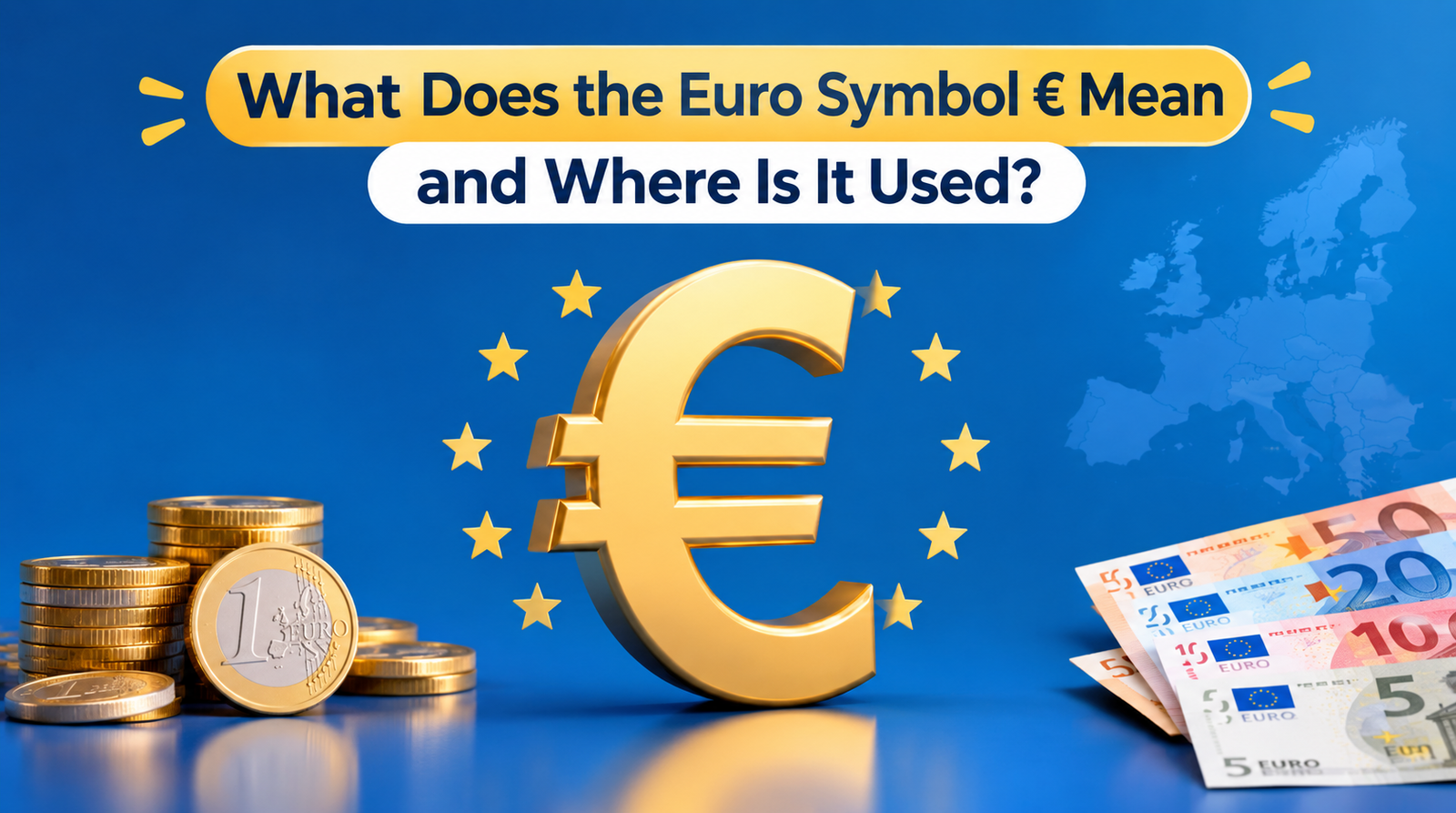
The euro symbol € is one of the most recognizable currency symbols in the world. It appears on price tags, websites, invoices, menus, bank statements, travel documents, and countless everyday purchases across Europe. For many people, seeing the symbol immediately communicates that a price or amount is expressed in euros.
But the symbol has a story behind its simple design. It was created for a new common currency intended to make economic activity easier across participating European countries. The euro itself was introduced in stages: it became an official currency for accounting and electronic transactions on 1 January 1999, while euro banknotes and coins entered circulation on 1 January 2002.
Today, the euro symbol € is used alongside the three-letter currency code EUR. Although they refer to the same currency, they serve different purposes. Understanding that distinction, as well as where and how the symbol is used, makes it easier to read prices and financial information correctly.
BIO
| Label | Information |
|---|---|
| Topic | Euro symbol € |
| Currency | Euro |
| Currency Code | EUR |
| Symbol | € |
| Symbol Meaning | Represents amounts in euros |
| Origin | European Union |
| Symbol Design | Inspired by Greek epsilon |
| Key Feature | Two parallel lines suggest stability |
| Introduced | 1997 as the official symbol |
| Euro Launched | 1 January 1999 |
| Cash Introduced | 1 January 2002 |
| Main Use | Prices, invoices, banking, and trade |
| Euro Area | 21 EU countries (european-union.europa.eu) |
What Is the Euro Symbol €?
The euro symbol € is the official visual symbol used to represent the euro currency. It works in much the same way that $ represents the dollar or £ represents the pound sterling.
For example:
- €5 means five euros.
- €20 means twenty euros.
- €99 means ninety-nine euros.
- €1,000 means one thousand euros.
The symbol is particularly common in everyday situations where people need to identify a price quickly. Shops, restaurants, hotels, online stores, advertisements, transport services, and other businesses can use it to show that a listed amount is denominated in euros.
The euro symbol should not be confused with the currency code EUR. The symbol is designed for visual use, while EUR is the internationally standardized three-letter code used in many banking, financial, accounting, and technical systems.
The European Union identifies EUR as the ISO code for the euro.
What Does the Euro Symbol € Mean?
At its simplest, the euro symbol € means that an amount is expressed in euros.
The euro is the common currency used by the countries that belong to the euro area. According to the European Central Bank, euro banknotes and coins are currently legal tender in 21 of the 27 EU Member States. Several European microstates also use the euro under formal arrangements, while Montenegro and Kosovo use it without a formal monetary agreement with the EU.
When you see a price such as €25, the symbol tells you that the amount is 25 euros rather than dollars, pounds, or another currency.
This simple identification is especially useful in international commerce. A website serving customers from different countries might list products in several currencies, so the currency symbol helps readers understand which monetary unit applies to a particular price.
Where Did the Euro Symbol € Come From?
The design of the euro symbol was created as part of the preparations for the new European currency.
The name “euro” was selected by European leaders at a European Council meeting in Madrid in 1995. The currency also needed a recognizable symbol that could be used on price lists and other documents.
The final design was inspired by several ideas connected with Europe. The European Union explains that the symbol is based partly on the Greek letter epsilon (ε) and the first letter of the word Europe. The two parallel horizontal lines are intended to represent stability.
That combination gives the symbol its familiar appearance:
€
It is simple enough to recognize quickly while also carrying a connection to European identity and the idea of a stable common currency.
When Was the Euro Symbol € Introduced?
The euro symbol was developed during the preparation of the single European currency in the 1990s.
The European Monetary Institute publicly supported the proposed currency symbol in July 1997, describing it as a distinctive sign suitable for price lists and documents containing monetary values, including invoices, cheques, and tickets.
The currency itself followed a carefully planned transition.
On 1 January 1999, the euro officially became the currency of participating countries, initially functioning largely as an accounting and electronic currency. National banknotes and coins remained in circulation during the transition.
Then, on 1 January 2002, euro banknotes and coins entered everyday circulation. This changeover replaced national cash currencies in the participating countries and marked one of the largest currency transitions in modern history.
The euro symbol therefore became much more visible in everyday life after the introduction of physical euro cash.
Which Countries Use the Euro Symbol €?
The euro symbol is primarily associated with the countries in the euro area, where the euro is the official currency.
As of 2026, the euro area consists of 21 EU Member States. The euro is also used in several European microstates under formal arrangements with the EU, including Andorra, Monaco, San Marino, and Vatican City. Montenegro and Kosovo also use the euro, although under different circumstances.
This means that seeing the € symbol does not necessarily tell you that the location is an EU member. Currency use and EU membership are related but are not exactly the same thing.
The euro’s reach also extends beyond physical cash. Businesses, financial institutions, travelers, and international organizations may work with euros even when their own domestic currency is different.
How Is the Euro Symbol € Used in Prices?
The most familiar use of the euro symbol € is in displaying prices.
For example:
€10
€24.50
€199.99
However, the exact placement and formatting of the symbol can vary depending on the country, language, and local convention.
In English-language contexts, it is common to see the symbol placed before the number, such as €50. In some European countries and formal styles, the symbol may appear after the number, sometimes with a space.
European pricing conventions can also differ when it comes to decimal and thousands separators. For this reason, readers should consider the local formatting convention rather than assuming that every European country writes monetary amounts in exactly the same way.
The important point is that € identifies the currency as euros. The surrounding number formatting provides additional information about how the amount should be read.
Is € the Same as EUR?
Yes, both € and EUR identify the euro, but they are used differently.
The symbol is intended to be easy for people to recognize visually:
€50
The currency code is useful when a standardized written identifier is needed:
EUR 50
The code EUR was assigned under the ISO 4217 currency-code system before the euro was launched. The European Monetary Institute noted in 1997 that the code was intended for applications involving trade, commerce, and banking.
In everyday shopping, the symbol is usually more natural. A store is more likely to display €30 than EUR 30.
In financial systems, international transfers, databases, currency exchange information, and technical applications, EUR can be more useful because it clearly identifies the currency in a standardized format.
So the difference is mainly one of purpose and context, not meaning.
How to Write the Euro Symbol € Correctly
Using the euro symbol € is generally straightforward, but formatting can depend on the language or country.
For an English-language article or website, examples such as these are easy to understand:
- €5
- €25
- €125.50
- €2,000
When writing about currency in a formal financial context, however, it can be useful to include the currency name or code when there could be confusion.
For example, an international report might use EUR because readers could be working with several currencies at the same time.
The main mistake to avoid is using the euro symbol for an amount that is actually denominated in another currency. A symbol should always match the currency being discussed.
How to Type the Euro Symbol € on a Keyboard
People often search for the euro symbol € because they cannot immediately find it on their keyboard.
The exact shortcut depends on the operating system, keyboard layout, and device. European keyboard layouts may have a dedicated key combination, while other layouts may require an alternate keyboard shortcut or character input method.
On smartphones and tablets, the symbol can usually be found by switching to the numbers or symbols keyboard and looking through the available currency characters.
Another simple option is to copy the character directly:
€
The important thing is to remember that keyboard shortcuts are not universal. A shortcut that works on one keyboard layout may produce a different character on another.
Common Uses of the Euro Symbol €
The euro symbol € appears in many areas of daily life.
Shopping
Retailers use it to display the prices of clothing, electronics, food, household products, and other goods.
A product listing might show:
€49.99
This immediately tells the customer which currency is being used.
Online Stores
E-commerce websites often display euro prices for customers located in European markets. Some websites allow visitors to change their preferred currency, meaning the same product may appear with different symbols depending on the selected setting.
Travel
Hotels, airlines, transportation providers, restaurants, museums, and tourist attractions may use the euro symbol when displaying prices in euro-area destinations.
Business
Companies use euro amounts on invoices, quotations, receipts, contracts, financial statements, and other business documents.
The symbol’s original purpose was partly connected with making monetary values easy to identify on documents such as invoices and price lists.
Banking and Finance
Banks and financial platforms may display balances, transactions, exchange rates, and investment information using either the € symbol or EUR, depending on the application.
The Euro Symbol € and Euro Coins
The symbol represents the same currency used on euro coins and banknotes.
Euro coins come in eight denominations:
1, 2, 5, 10, 20 and 50 cents, €1 and €2.
One euro is equal to 100 cents.
Euro coins have an interesting design system. One side has a common design shared across the euro area, while the other side carries a country-specific design. This allows the coins to reflect national identity while remaining part of the same currency system.
Despite their different national designs, euro coins have legal-tender status throughout the euro area when they are intended for circulation.
The Euro Symbol € and Banknotes
Euro banknotes are different from the coins because their designs are shared across the euro area.
The original series included seven denominations: €5, €10, €20, €50, €100, €200, and €500. The later Europa series contains six denominations, from €5 through €200. The €500 note is no longer issued, although it remains valid and retains its value.
The banknotes were designed around European architectural themes. Windows, gateways, and bridges represent ideas such as openness, cooperation, and communication between European people and the wider world.
This gives the euro more than a financial identity. Its physical currency was designed to communicate a broader idea of European cooperation.
Euro Symbol € vs Other Currency Symbols
Currency symbols can sometimes be confused because many use familiar letters or shapes.
For example:
- € — euro
- $ — dollar
- £ — pound sterling
- ¥ — yen or yuan, depending on context
- ₹ — Indian rupee
The euro symbol € is distinctive because of its combination of the curved “E”-like shape and two horizontal lines.
When reading an international price, identifying the currency symbol is important. The number alone does not tell you the value in your own currency.
For example, €100 is 100 euros, not automatically 100 dollars or 100 pounds. Its value in another currency depends on the applicable exchange rate.
Why Is the Euro Symbol Important?
The euro symbol € may look like a small typographical character, but it plays an important practical role.
A common currency needs a recognizable way of identifying monetary amounts. The symbol provides that visual shorthand.
Instead of writing:
25 euros
a store can simply write:
€25
That saves space and makes prices easier to scan.
The symbol also contributes to consistency across a large currency area. Millions of consumers and businesses can recognize the same character even when they speak different languages.
The euro itself has become a visible part of European economic integration. The European Commission describes the currency as an important symbol of European unity, while the European Central Bank notes that euro cash has become a tangible representation of European integration.
Common Mistakes When Using the Euro Symbol
There are a few simple mistakes worth avoiding.
Using € for another currency: The euro symbol should only identify euro-denominated amounts.
Confusing € with EUR: They refer to the same currency, but the symbol and standardized code have different purposes.
Assuming every European country uses euros: Europe is larger than the euro area. Not every European country has adopted the euro.
Ignoring local formatting: Price-writing conventions differ between countries and languages.
Assuming the symbol tells you the exchange value: €100 simply means 100 euros. Its value in dollars, pounds, rupees, or another currency changes with exchange rates.
These distinctions become especially useful when shopping internationally or reading financial information from different countries.
Frequently Asked Questions About the Euro Symbol €
What does the € symbol stand for?
The € symbol represents the euro, the common currency used by the countries in the euro area and several other European states or territories under different arrangements.
Why does the euro have the € symbol?
The design combines ideas associated with Europe and stability. The European Union says it is based on the Greek letter epsilon, relates to the first letter of Europe, and includes two parallel lines representing stability.
Is € the official symbol for the euro?
Yes. € is the euro’s currency symbol, while EUR is its standardized three-letter currency code.
Is € the same as EUR?
They identify the same currency, but they are used differently. The symbol is convenient for everyday prices, while EUR is commonly used in international financial and technical contexts.
Where is the euro symbol used?
It is used primarily wherever prices or monetary amounts are expressed in euros, including shops, websites, invoices, banking systems, travel services, and financial documents.
When did the euro become a real currency?
The euro was launched on 1 January 1999 as a currency for accounting and electronic transactions. Euro banknotes and coins entered circulation on 1 January 2002.
Final Thoughts
The euro symbol € is much more than a character placed beside a price. It represents a currency that was created through years of European economic and political cooperation.
Its design was deliberately made recognizable, with elements connected to Europe and stability. The symbol became especially important when euro banknotes and coins entered circulation in 2002, giving millions of people a common visual sign for their new currency.
Today, € can be found almost everywhere euros are used: from supermarket shelves and restaurant menus to online stores, invoices, travel services, and financial documents. Knowing the difference between € and EUR, understanding where the euro is used, and recognizing common formatting conventions makes international prices much easier to read.
In everyday life, the meaning is simple: when you see €, the amount is expressed in euros. Behind that small symbol, however, is the history of one of the world’s most important modern currencies and a visible representation of European economic integration.