







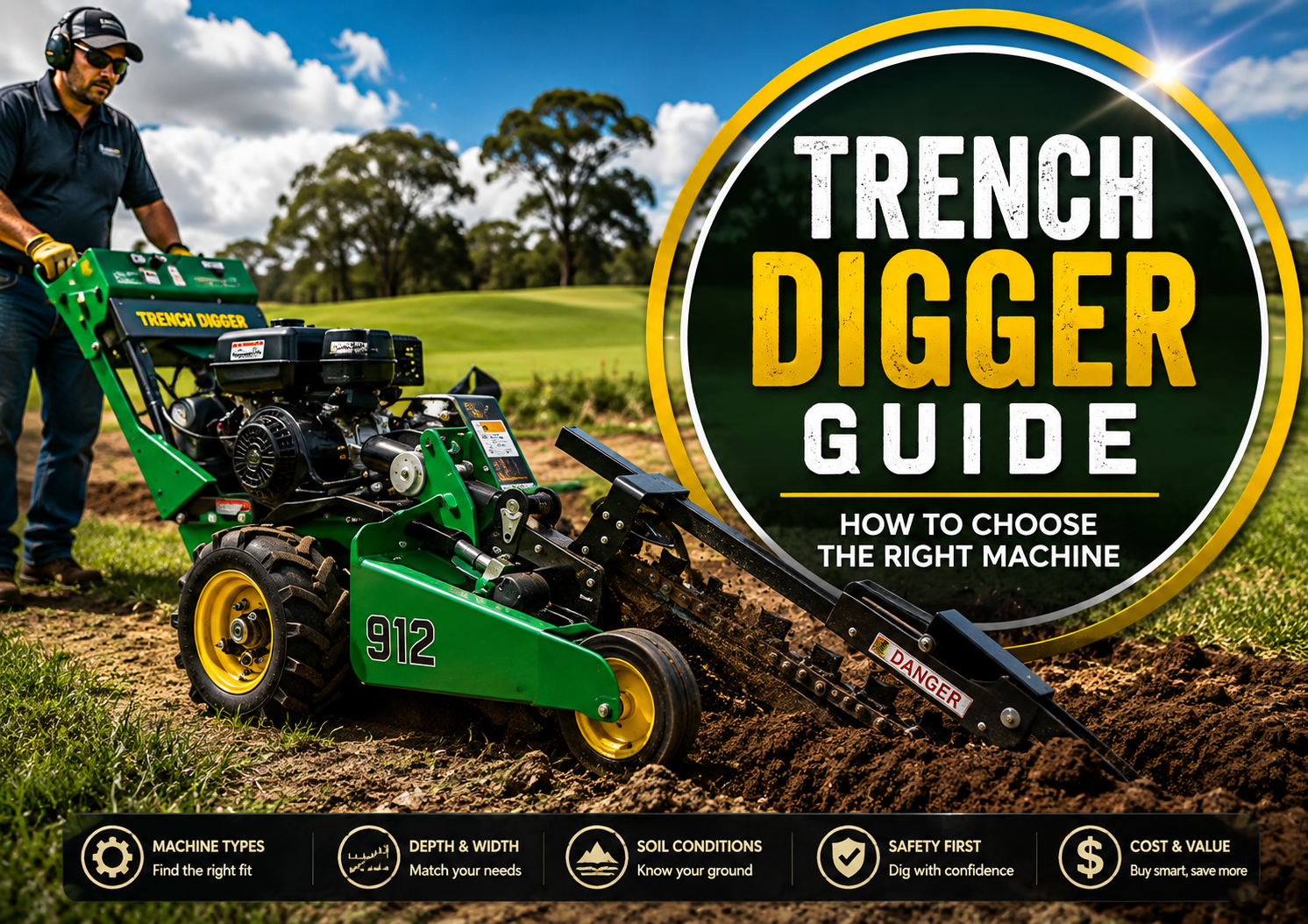
Choosing the right trench digger can make a major difference in how efficiently a digging project gets completed. A machine that suits the job can save time, reduce unnecessary labor, and produce a more consistent trench. On the other hand, choosing equipment without considering the ground conditions, trench dimensions, or available working space can create problems before the work even begins.
Trench digging is used for many different purposes, from installing drainage and irrigation systems to placing utility lines and preparing sites for construction. The equipment needed for a small landscaping project can be very different from what is appropriate for a large commercial job.
This guide explains the important factors to consider when selecting a trench digger, including machine type, digging depth, trench width, soil conditions, job size, maintenance, cost, and safety.
What Is a Trench Digger?
A trench digger is a machine designed to create relatively narrow, continuous trenches in the ground. The equipment is commonly known in the industry as a trencher, although people may use different terms depending on the region or type of machine.
Unlike a conventional excavator, which uses a bucket to remove larger quantities of soil, a trencher is generally designed around a digging attachment that follows a narrow path. This makes it particularly useful when the goal is to create a trench for something such as a pipe, cable, drainage line, or irrigation system.
Trenchers come in several sizes and configurations. Some are compact machines operated from behind the equipment, while others are larger ride-on machines or attachments mounted to tractors, skid-steer loaders, and similar equipment.
The best choice depends less on the name of the machine and more on what the project actually requires.
How Does a Trench Digger Work?
A typical trenching machine uses a powered digging system to cut into the soil and remove material as the machine progresses along the planned trench.
Different machines use different digging arrangements. Some employ a chain fitted with cutting teeth, while other designs use rotating wheels or specialized attachments. The cutting system is selected according to the type of ground and the dimensions required for the trench.
The machine’s power source, hydraulic system, cutting attachment, and overall design all affect performance.
Soil is also a major factor. Loose ground may be considerably easier to work than heavily compacted material, clay, or ground containing rocks. A machine that performs well in one location may not be the best choice somewhere else.
Types of Trench Diggers
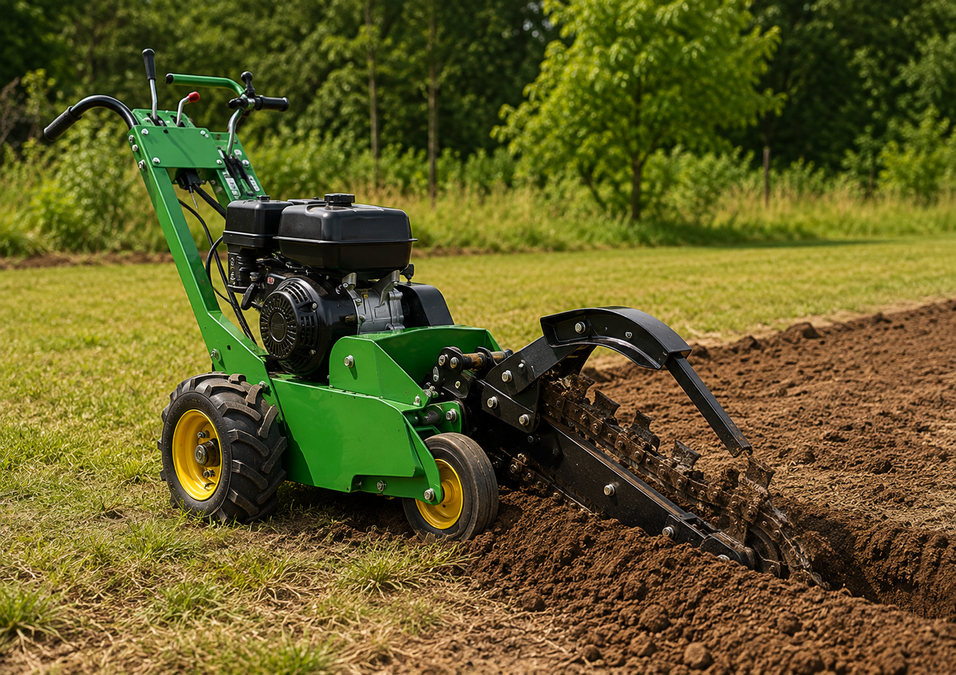
There is no single trench digger that is ideal for every project. The main categories differ in size, mobility, power, and intended application.
Walk-Behind Trench Diggers
Walk-behind trenchers are compact machines designed for smaller projects and areas where maneuverability is important.
They can be useful around landscaping projects, residential properties, gardens, and other locations where larger construction equipment may have difficulty accessing the work area.
Their smaller size can make transportation and positioning easier. However, compact equipment generally has limitations compared with larger machines, particularly when a project requires extensive production or challenging ground conditions.
Ride-On Trench Diggers
Ride-on trenchers are larger machines that allow the operator to control the equipment from the machine itself.
They are generally better suited to projects where greater productivity and longer working periods are expected. Their larger size can provide additional power and stability, although it can also make access more difficult in confined areas.
For contractors regularly completing trenching work, a ride-on machine may offer advantages that a compact walk-behind unit cannot provide.
Tractor and Skid-Steer Attachments
Another option is a trenching attachment fitted to equipment that is already available on the job site.
This approach can be practical for contractors who already own a tractor, skid-steer loader, or another compatible machine. Instead of maintaining a separate dedicated trencher, the operator can use an attachment when trenching is required.
The important consideration is compatibility. The carrier machine must be suitable for the attachment, and the attachment needs to match the project’s digging requirements.
Compact Trenchers
Compact trenchers are particularly useful where space is limited.
They can be valuable for landscaping, irrigation, utility installation, and smaller property projects. Their relatively small footprint allows them to work in places where conventional excavation equipment may be inconvenient.
However, compact should not automatically mean suitable for every task. The required depth, width, soil conditions, and amount of trenching should still be evaluated before selecting equipment.
What Can You Use a Trench Digger For?
A trench digger can be useful for a wide range of projects.
Common applications include:
- Irrigation systems
- Drainage installations
- Water lines
- Electrical and communication infrastructure
- Landscape projects
- Utility installation
- Certain construction and site-preparation tasks
The advantage of trenching equipment is that it can create a relatively narrow excavation while limiting unnecessary disturbance around the work area.
For example, installing a long irrigation line may not require the broad excavation produced by a conventional excavator. A suitable trencher can be better matched to the narrow, continuous nature of the work.
How to Choose the Right Trench Digger
The best machine should be selected according to the project rather than simply according to its advertised power or size.
Start by identifying exactly what the trench needs to accomplish.
Consider Trench Depth
Depth is one of the first specifications to check.
Different trenchers have different maximum digging capabilities. The required depth should therefore be established before choosing equipment.
It is important not to assume that a machine capable of creating a deep trench is automatically the best choice. A larger machine can increase transportation requirements, operating costs, and access challenges when a smaller unit would have been sufficient.
Check Trench Width
Trench width is equally important.
A trench for a narrow cable may have very different requirements from one intended for a larger drainage system. The digging attachment and machine configuration need to produce a trench appropriate for the planned installation.
Creating a trench that is unnecessarily wide can mean more soil is disturbed and more material must eventually be handled or replaced.
Understand Soil Conditions
Soil can have a major influence on trenching performance.
Soft or relatively loose soil may be easier to cut than dense clay, compacted ground, or rocky material. Some machines and attachments are better suited to particular conditions.
Before choosing a machine, consider whether the site contains:
- Loose soil
- Dense clay
- Gravel
- Compacted ground
- Rocks
- Roots or other obstructions
If the ground conditions are uncertain, professional site assessment can help determine what equipment is appropriate.
Think About Job Size
A small project does not necessarily justify a large construction machine.
For occasional residential or landscaping work, compact equipment may be more practical. A contractor completing long trenching runs regularly may benefit from a larger, higher-productivity machine.
Think about the total amount of trenching rather than only the first section of the job.
Consider Access
Access is easy to overlook until equipment arrives at the site.
Measure gates, pathways, entrances, and other restricted areas before selecting the machine. Consider the surface conditions as well as the physical dimensions.
A machine may have excellent specifications but still be unsuitable if it cannot reach the work area.
Important Features to Compare
Once the basic project requirements are known, compare the specifications that directly affect performance.
Important features include:
- Maximum digging depth
- Trench width
- Engine or hydraulic power
- Machine weight
- Digging attachment
- Cutting components
- Maneuverability
- Operator controls
- Maintenance access
- Safety systems
It is also worth considering transportation requirements. A machine that is inexpensive to operate may still require additional planning if moving it between job sites is difficult.
Small vs Large Machines
The largest trench digger is not necessarily the best one.
Smaller equipment can offer easier access and simpler transportation. It may also be more appropriate for residential properties and limited projects.
Larger machines can provide greater capability and productivity, particularly for professional work. However, they generally require more space and may be less convenient around buildings, landscaping, fences, and other obstacles.
The ideal machine is usually the smallest equipment that can comfortably and appropriately handle the project’s actual requirements.
Buying vs Renting
For many users, the choice between buying and renting is just as important as choosing the machine itself.
When Buying Makes Sense
Buying can be reasonable when trenching is a regular part of your work.
A contractor who frequently installs utilities, drainage systems, or irrigation may be able to make better long-term use of owned equipment.
Ownership also means the machine is available when needed, rather than depending on rental availability.
When Renting May Be Better
Renting can make more sense for occasional projects.
If a trench digger will only be used once or twice, purchasing a machine may create unnecessary expenses related to storage, maintenance, transportation, and depreciation.
Rental equipment also gives users the opportunity to select different machine sizes for different projects rather than relying on one machine for everything.
How Much Does a Trench Digger Cost?
There is no single price that applies to every trench digger.
Cost depends on factors such as machine size, power, brand, attachment type, condition, capabilities, and market availability.
The purchase price is only one part of the total cost. Buyers should also consider transportation, fuel or energy use, maintenance, replacement cutting components, storage, and possible repair expenses.
For rental equipment, the total cost can depend on rental duration, machine category, delivery, and other local charges.
A machine with a lower initial price may not necessarily be the least expensive choice over its entire working life.
New vs Used Trench Diggers
Both new and used machines can have advantages.
A new trench digger typically provides access to current equipment features and may include a manufacturer’s warranty. It can be attractive for businesses that depend heavily on equipment reliability.
A used trench digger can provide a lower entry cost, particularly when the machine has been maintained properly.
However, used equipment needs careful inspection. Look for signs of excessive wear around the digging components, engine, hydraulic system, tires or tracks, controls, and structural parts.
Maintenance records can also provide useful information about how the machine has been treated.
Trench Digger Safety
Trenching is not simply an equipment-selection issue. The excavation itself can create serious hazards.
According to the U.S. Occupational Safety and Health Administration, trench cave-ins are among the most serious hazards associated with excavation work. OSHA emphasizes planning, soil evaluation, protective systems, safe access and egress, and regular inspection.
Underground utilities are another major concern. Before excavation begins, the estimated location of underground installations such as electrical, water, sewer, telephone, and fuel lines should be determined. OSHA regulations specifically require appropriate steps to identify underground installations before opening an excavation.
Heavy equipment should also be managed carefully around excavation areas. Workers need protection from hazards associated with mobile equipment, falling materials, unstable edges, water accumulation, and potentially hazardous atmospheres.
For deeper excavations, protective measures may be required depending on soil conditions and other factors. OSHA identifies methods such as sloping, benching, shoring, and shielding as protective approaches.
These requirements can vary by location, so local regulations should always be followed. Trenching work involving employees should be planned and supervised by appropriately trained and qualified personnel.
Common Mistakes to Avoid
Several mistakes can turn an otherwise straightforward project into a difficult one.
One common mistake is choosing equipment based only on engine power. More power does not automatically make a machine appropriate. Depth, width, soil, access, and overall workload are equally important.
Another mistake is ignoring ground conditions. A machine selected for ordinary soil may not perform as expected in heavily compacted or rocky ground.
Some buyers also focus entirely on the purchase price. A cheaper machine can become expensive if it requires frequent repairs or does not provide the productivity needed for the work.
Finally, safety planning should never be treated as an afterthought. Underground utilities and trench stability need to be considered before excavation begins.
Trench Digger Maintenance
Regular maintenance helps equipment remain reliable and can reduce unexpected downtime.
After use, the machine should be cleaned and inspected according to the manufacturer’s recommendations. Cutting components should be checked for wear, while moving parts and hydraulic systems should be monitored for signs of damage or leakage.
Engine-related maintenance, lubrication, filter replacement, and other service requirements should follow the equipment manufacturer’s schedule.
For used machines in particular, maintenance history can be extremely valuable. A well-maintained older machine may be a better choice than a newer machine that has been poorly cared for.
Trench Digger vs Excavator
A trench digger and excavator are designed for different styles of excavation.
An excavator is highly versatile and can remove larger quantities of soil, create wider excavations, handle various attachments, and perform multiple site tasks.
A trench digger is more specialized. Its design is particularly useful when a narrow, continuous trench is required.
For a long utility installation where the required excavation is relatively narrow, a trencher can be a natural fit. For broader excavation, material handling, or projects requiring multiple digging functions, an excavator may be more appropriate.
Trench Digger vs Backhoe
Backhoes are also versatile machines capable of digging, loading, and handling different site tasks.
A trench digger, by comparison, is more focused on creating narrow trenches efficiently.
The decision comes down to the work. If trenching is only one small part of a varied construction project, a backhoe may provide greater overall flexibility. If the project consists primarily of continuous narrow trenching, specialized trenching equipment may be more suitable.
A Simple Selection Checklist
Before choosing a trench digger, review these questions:
- How deep does the trench need to be?
- How wide should it be?
- What type of soil is present?
- Are there rocks, roots, or compacted areas?
- How much total trenching is required?
- How much working space is available?
- Can the machine reach the site easily?
- Is a dedicated machine or attachment more practical?
- Would renting or buying make more sense?
- What maintenance will the machine require?
- What local safety and excavation requirements apply?
Answering these questions first can make the equipment-selection process much clearer.
Frequently Asked Questions
What is a trench digger used for?
A trench digger is primarily used to create relatively narrow, continuous excavations for applications such as irrigation, drainage, utility installation, and certain construction projects.
How deep can a trench digger dig?
Digging depth varies considerably between machines and attachments. Always check the manufacturer’s specifications and make sure the equipment is appropriate for the planned project.
What size trench digger should I choose?
Choose equipment based on the required trench depth and width, soil conditions, project size, and available access. A compact machine can be suitable for smaller jobs, while larger equipment may be appropriate for demanding professional work.
Is renting or buying a trench digger better?
Renting can be practical for occasional projects, while buying may make more sense for contractors or businesses that use trenching equipment regularly.
Can a trench digger work in hard soil?
Some trenchers and attachments are designed for tougher ground conditions, but performance depends on the machine, digging system, soil characteristics, and presence of rocks or other obstacles.
How often should a trench digger be maintained?
Maintenance intervals depend on the specific machine and manufacturer. Operators should follow the manufacturer’s service schedule and inspect the equipment regularly for wear or damage.
Final Thoughts
Choosing the right trench digger is ultimately about matching the equipment to the work.
Start with the basics: determine the required trench depth and width, understand the soil conditions, estimate the size of the project, and consider how much room the machine has to operate. From there, compare machine types, attachments, power, transportation requirements, maintenance needs, and total ownership or rental costs.
Safety should remain part of the decision from the beginning. Underground utilities, excavation stability, equipment movement, access, and local regulations all need proper consideration before work starts. OSHA’s excavation guidance emphasizes planning, competent inspection, utility identification, and appropriate protective measures because trenching hazards can change quickly.
The best trench digger is not necessarily the biggest, newest, or most powerful machine. It is the one that fits the project’s actual requirements, can be operated appropriately, and provides the capability needed without unnecessary complexity or expense.
Taking time to choose carefully can lead to a smoother project, better equipment utilization, and a more practical long-term investment.