







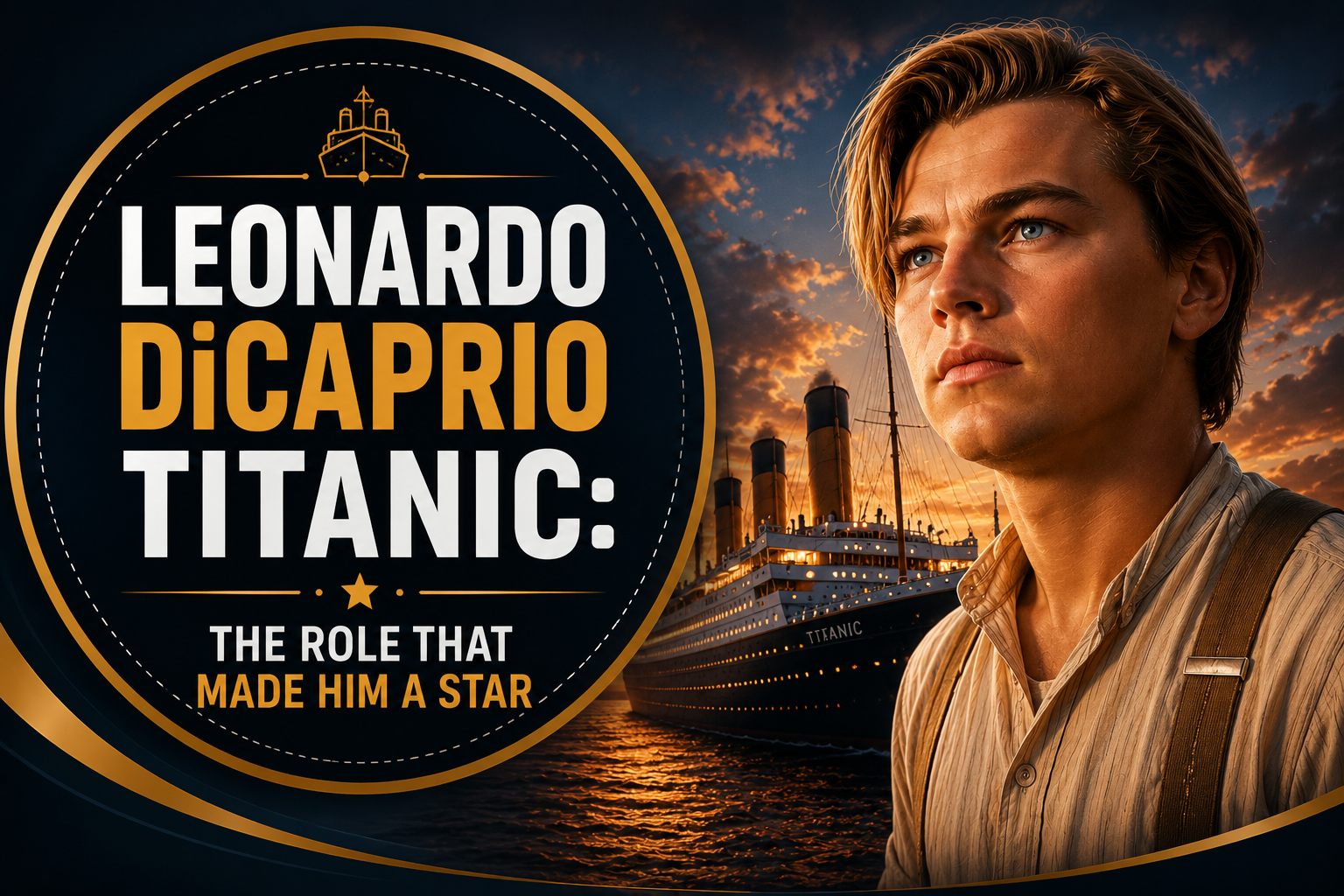
When people look back at the films that shaped Leonardo DiCaprio’s career, Titanic stands apart. Released in 1997, James Cameron’s epic romance became a worldwide phenomenon and transformed DiCaprio from a well-known young actor into an international star. His performance as Jack Dawson gave the film an emotional center while helping establish an image that would influence the next stage of his career.
DiCaprio was already building an impressive reputation before Titanic. He had appeared in films such as This Boy’s Life, What’s Eating Gilbert Grape, The Basketball Diaries, and Romeo + Juliet. However, Titanic reached an audience on a completely different scale. HISTORY describes the film as a production that catapulted its young stars, DiCaprio and Kate Winslet, to international fame.
The importance of the film was not simply its enormous popularity. Titanic brought together a historical disaster, a fictional love story, elaborate production design, ambitious visual effects, and strong performances. The Academy later recognized the film with 14 nominations and 11 wins, including Best Picture and Best Director.
Before Titanic
Leonardo DiCaprio did not enter Titanic as an unknown actor. He had spent years working in television and film and had already demonstrated that he could handle demanding dramatic roles.
One of the most important early performances came in What’s Eating Gilbert Grape, where DiCaprio played Arnie Grape. The role earned him an Academy Award nomination for Supporting Actor and helped critics take him seriously as a young performer.
His later work showed increasing range. The Basketball Diaries presented him in a difficult dramatic role, while Romeo + Juliet gave him the opportunity to play a famous literary character in a modern adaptation.
By the time Titanic was being developed, DiCaprio had already established himself as an actor with considerable potential. What he had not yet experienced was the extraordinary level of worldwide attention that would come with Jack Dawson.
Getting Jack Dawson
Jack Dawson is a fictional character created for Cameron’s story. He is not presented as a real historical passenger from the 1912 disaster. Instead, Jack allows the audience to experience the Titanic through the perspective of a young man who has little connection to the wealthy social world surrounding the voyage.
In the film, Jack is a working-class artist and adventurer who wins a third-class ticket aboard the Titanic. His chance meeting with Rose DeWitt Bukater, played by Kate Winslet, changes the direction of both their lives. HISTORY identifies Jack and Rose as the central romantic pair around which the film’s human story develops.
That fictional approach was important. Cameron could build Jack around the themes he wanted the story to explore: freedom, curiosity, social boundaries, courage, and the desire to live according to one’s own choices.
DiCaprio’s performance helped make those qualities feel natural rather than simply written into the character.
Jack Dawson
Jack’s appeal comes partly from his contrast with the environment around him. He does not belong to the wealthy world represented by Rose’s family and her fiancé, Cal Hockley. Instead, he approaches life with a sense of independence.
He sketches, travels, takes opportunities when they appear, and seems comfortable living without the material security expected by people in first class.
His personality also gives Rose something she desperately needs. She has been raised within a rigid social structure and is expected to marry according to her family’s wishes. Jack introduces another possibility: a life where she can make decisions for herself.
This is why Jack is more than simply the romantic lead. He represents freedom within the story.
DiCaprio understood that the character needed warmth and energy without becoming overly polished. Jack’s charm works because he feels spontaneous. He can joke, admire the world around him, and take risks, but he also treats Rose as a person rather than as a wealthy young woman whose family connections matter.
Working With Kate Winslet
The relationship between Jack and Rose is central to Titanic, which meant the chemistry between DiCaprio and Winslet was especially important.
Their characters come from very different social backgrounds, yet their relationship develops through conversations and shared experiences rather than simply through attraction. Rose begins to question the life planned for her, while Jack encourages her to look beyond the expectations surrounding her.
Winslet’s performance brings a strong emotional dimension to Rose, while DiCaprio gives Jack a youthful openness that balances her character.
The Academy recognized Winslet with a Best Actress nomination for Titanic, while the film itself received 14 nominations at the 70th Academy Awards.
Their performances became one of the defining elements of the film, and the pairing of Jack and Rose remains one of the most recognizable screen romances of the 1990s.
A Different Kind of Stardom
The impact of Titanic on DiCaprio’s career was enormous because the film reached audiences around the world.
Before its release, he was primarily known as a promising young actor. After its success, his face became internationally recognizable. The distinction matters because Titanic did not merely add another successful film to his résumé. It changed the scale of his public profile.
The film’s success also created a challenge. An actor can become strongly associated with a single character, especially when that character becomes part of popular culture. DiCaprio’s career after Titanic shows how deliberately he moved beyond that image.
Rather than repeatedly choosing roles similar to Jack Dawson, he pursued characters with very different personalities and dramatic demands.
Why Titanic Mattered
The scale of Titanic was unusual even by Hollywood standards.
The film combined a fictional romance with the historical story of the RMS Titanic, the passenger liner that sank in the North Atlantic in April 1912 after striking an iceberg. HISTORY records that more than 1,500 passengers and crew members died in the disaster.
Cameron’s film therefore had two different responsibilities. It needed to create a believable historical world while also telling an accessible emotional story.
The Academy’s recognition reflects how successfully the production handled those ambitions. Titanic won Oscars for cinematography, costume design, directing, film editing, original dramatic score, original song, sound, visual effects, and several other categories.
DiCaprio’s performance was not an Oscar-winning element of the film, but his contribution was crucial to the audience’s connection with the fictional story.
The Performance
One reason Jack Dawson remains memorable is that DiCaprio does not play him as a perfect hero.
Jack is young and sometimes impulsive. He is confident, but he is not presented as someone who has complete control over his circumstances. His charm comes from his ability to find excitement and meaning despite having very little.
That quality makes his relationship with Rose believable within the film’s world.
DiCaprio also gives Jack a sense of humor that keeps the character from becoming too serious. His lighter moments make the later emotional scenes more effective because audiences have had time to understand Jack as a person.
The result is a character who feels approachable rather than distant.
The Famous Drawing Scene
One of the most recognizable sequences involving Jack is the scene in which he sketches Rose.
The scene is important because it brings together several aspects of Jack’s character. He is an artist, Rose becomes the subject of his work, and the encounter gives Rose a temporary escape from the expectations surrounding her.
The moment also establishes trust between the characters.
Rather than relying entirely on dialogue, the scene uses Jack’s artistic ability to show how he sees Rose differently from the people around her. For Rose, that attention becomes part of her growing sense of independence.
It is one of the film’s clearest examples of how Jack’s identity as an artist supports the larger themes of the story.
A Historical Story With Fictional Characters
It is important to distinguish the historical Titanic from Cameron’s fictional romance.
The real Titanic disaster occurred in 1912 and involved thousands of passengers and crew. Jack Dawson and Rose DeWitt Bukater, however, were created for the film’s narrative.
This distinction allows Titanic to combine historical events with fictional storytelling. Real people appear alongside fictional characters, while the sinking of the ship provides the historical framework for the drama.
That combination helped the film reach audiences who might have been interested in either the historical disaster or the romance.
The Film’s Extraordinary Success
The scale of Titanic’s achievements is one reason DiCaprio’s role became such an important part of his career story.
At the 70th Academy Awards, Titanic won 11 Oscars from 14 nominations. Its wins included Best Picture and Best Director for James Cameron. It also won for cinematography, costume design, film editing, original dramatic score, original song, sound, sound effects editing, visual effects, and art direction.
The Academy notes that the 14 nominations tied Titanic with All About Eve for the most nominations received by a single film at that point, while its 11 wins tied the record previously set by Ben-Hur.
Those achievements demonstrate that the movie was not simply a commercial romance. It was also recognized as a major technical and artistic production.
The Effect on DiCaprio
The phrase “the role that made him a star” is useful, but it needs some context.
DiCaprio was already successful before Titanic. He had critical recognition, major film roles, and an Academy Award nomination. What Titanic did was take his existing career to an entirely different level.
The film gave him worldwide visibility.
That success could have easily defined his entire career. Instead, DiCaprio used the attention as a starting point for a much broader body of work.
In the years that followed, he worked with directors including Martin Scorsese, Steven Spielberg, Christopher Nolan, Quentin Tarantino, and Alejandro G. Iñárritu. His later performances demonstrated that he was interested in challenging roles rather than remaining tied to the image of Jack Dawson.
Life After Jack
After Titanic, DiCaprio continued to choose varied roles.
He returned to literary material with The Man in the Iron Mask and later worked with Martin Scorsese on Gangs of New York. Their collaboration became an important part of his mature career.
He also appeared in films such as Catch Me If You Can, The Aviator, The Departed, Revolutionary Road, Shutter Island, Inception, Django Unchained, The Great Gatsby, The Revenant, Once Upon a Time in Hollywood, and Killers of the Flower Moon.
This progression shows why Titanic should be viewed as a turning point rather than the complete definition of his career.
Jack Dawson introduced DiCaprio to a massive global audience. The roles that followed showed what he could do with that opportunity.
Jack’s Lasting Legacy
More than two decades after the film’s original release, Jack Dawson remains one of DiCaprio’s most recognizable characters.
Part of that longevity comes from the simplicity of the character’s central idea. Jack believes that life should be experienced rather than controlled entirely by social expectations. That idea connects directly with Rose’s struggle.
The historical setting also gives the character an unusual place in popular culture. Jack is fictional, but he exists inside one of the most famous real disasters in history.
That combination makes him easy to remember.
The Academy’s retrospective on Titanic describes the film as a worldwide phenomenon that propelled DiCaprio and Winslet to stardom. That assessment captures the broader importance of the movie: its success changed how audiences viewed both young actors.
Why the Role Still Matters
It would be easy to look at Jack Dawson simply as the romantic hero of a famous movie. His importance to DiCaprio’s career goes further.
The role arrived at exactly the point when DiCaprio was transitioning from promising young performer to major international actor. He had already shown his abilities, but Titanic gave him a platform on a scale few films could provide.
The character also showed that DiCaprio could carry a huge production while maintaining an intimate emotional connection with the audience.
That combination became valuable throughout his later career.
Final Thoughts
Leonardo DiCaprio’s role in Titanic was a defining moment, but it was not the beginning of his talent. He had already spent years developing as an actor and had earned serious critical attention before playing Jack Dawson.
What Titanic changed was the size of his audience.
Jack Dawson became a cultural landmark, and the film became one of the most celebrated productions of its era. With 14 Academy Award nominations and 11 wins, Titanic achieved a level of recognition that few films ever reach.
For DiCaprio, however, the greatest significance of Jack Dawson may be what came afterward. Instead of allowing one enormously popular role to define him permanently, he continued taking ambitious and dramatically different parts.
That is why Titanic remains such an important chapter in his story. Jack Dawson made Leonardo DiCaprio a global star, but the career that followed proved he was far more than one famous character.
Frequently Asked Questions
How old was Leonardo DiCaprio in Titanic?
Leonardo DiCaprio was 22 years old when Titanic was released in 1997. The film helped turn him from a respected young actor into an internationally recognized star.
What role did Leonardo DiCaprio play in Titanic?
DiCaprio played Jack Dawson, a fictional young artist and traveler who boards the Titanic in third class. His relationship with Rose becomes the emotional center of the movie.
Was Jack Dawson a real person?
No. Jack Dawson was a fictional character created for the film. The movie combines fictional characters such as Jack and Rose with the real historical events surrounding the Titanic disaster.
Did Titanic make Leonardo DiCaprio famous?
Yes. DiCaprio was already gaining recognition before Titanic, but the film brought him worldwide attention. The Academy describes the movie as a worldwide phenomenon that helped propel DiCaprio and Kate Winslet to stardom.
How successful was Titanic at the Oscars?
Titanic received 14 Academy Award nominations and won 11, including Best Picture and Best Director. Its achievements made it one of the most celebrated films of the 1990s.